It is a reflection of the reality that it is getting harder and harder to deny the responsibility of the Securitate for the post-22 December 1989 bloodshed and chaos–for evidence of this, see here for example: https://rolandothomassonphd.home.blog/2020/02/23/the-romanian-revolution-of-december-1989-declassified-cia-us-department-of-state-british-foreign-office-canadian-external-affairs-department/–that deniers increasingly appear willing to argue that the Romanian military and Securitate were in fact on the same side after 22 December. That this is what is happening is obvious whether or not its purveyors acknowledge or are able to acknowledge it. It can be categorized, to some extent, as the phenomenon of bargaining in order to save what is left of their erroneous arguments.
Part of this argument derives from an ideological desire to lump all the institutions of the Nicolae Ceausescu’s communist regime into one: a single, relatively undifferentiated elite made up of high level officials and officers from the party (PCR), the military (army), and the Interior Ministry/Securitate. (Never mind that Ceausescu’s personalist/sultanist dictatorship, eviscerated the corporate identity of the communist party (nothing more emblematic of that than the fact that whereas the parties in other communist states in the region could dump Honecker, Jakes, and Zhivkov in the fall of 1989, Nicolae Ceausescu was unanimously reelected in November 1989, converted the military into a conscript labor force that was so subordinated to the Securitate that by the fall of 1989 Romania had only four military attaches abroad (!, positions left vacant had not been refilled since 1979!), and ensured that the one institution upon which his power was based was the Securitate. For the residents of the cradle of the Revolution, Timisoara, this effort to tar the entire communist elite, across institutions, is based in the fact that all three of these institutions had a role in the bloody repression in Timisoara, and that several of their representatives show up in positions of power from 22 December. The focus is thus on the “interests” of those officials to cover up their role in the bloodshed or their tainted pasts during the communist/Ceausescu era. “Interests” is what you appeal to when the details don’t break your way. The problem with “interests” is that a list of suspects based on their “interests” in seeing a particular outcome is seemingly endless and gives many “false positives,” because it ignores a whole series of other equally relevant factors–most notably, capabilities and opportunity. When you are left appealing to “interests” above all else, it is a pretty good sign that your case is lost.
Indicative of how low those who argue the military-Securitate cabal have to sink to save this theory, is that they are left interpreting clips from two videos, one on 22 December in the CC and one from 1997 in which a TVR worker reminisces about a scene from 24 December at the M.Ap.N. military headquarters. It is telling that in both cases these are single source events, unsubstantiated elsewhere, and without the broader context to understand them.
Let us instead proceed to an event that comes from multiple different sources across different time periods with different interests and interpretations, who all nevertheless give a fairly similar description of the event at hand: Army General Victor Stanculescu’s decision on the night of 22/23 December (achieved partially, but not fully on 23 December) to order Stelian Pintelie (aka Pintilie) to interrupt or cut multiple phone lines used by the Securitate or being exploited/infiltrated by the Securitate especially after gunfire engulfed the country after 18:30/19:00 on 22 December 1989.
(In this first episode, we look at the following: claims in early 1990 about the decision to cut the phone lines.)
In the immediate weeks and months of 1990, when memories were still fresh, and significantly, before the Securitate had regrouped and began disseminating their revisionist narratives (in fact, disinformation) about December 1989, and thus before people started feeling the pressure to assimilate such claims into their own narratives, interlocutors were more willing to speak off the cuff about what they had witnessed and experienced.
Very different, of course, from his later claims–and he is just one of many such examples–are what Front member Mihai Montanu told Horia Alexandrescu in May (“Marturii din Linia-ntii (VII), Tineretul Liber, 13 mai 1990, p. 1; 2):
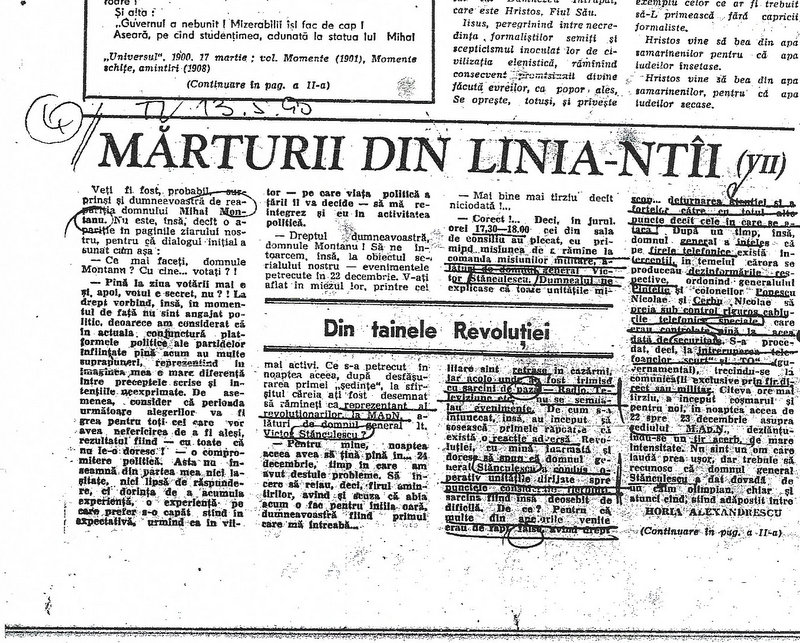
De cum s-a intunecat, insa, au inceput sa soseasca primele rapoarte ca exista o reactie adversa Revolutiei, cu mina inarmata si doresc sa spun ca domnul General Stanculescu a condus operativ unitatile dirijate spre punctele considerate fierbinte, sarcina fiind insa deosebit de dificila. De ce? Pentru ca multe din apelurile venite erau de fapt false, avind drept scop… deturnarea atentei si a fortelor catre cu totul alte puncte decit cele in care se ataca! Dupa un timp, insa, domnul general a inteles ca pe firele telefonice exista interceptii, in temeiul carora se producea dezinformarile respective, ordonind generalului Pintelie si coloneilor Popescu Nicolae si Cerbu Nicolae sa preia sub control riguros cablurile telefonice speciale care erau controlate pina la acea data de securitate. S-a procedat, deci, la intreruperea telefoanelor “scurt” si “TO” (guvernamental), trecindu-se la comunicatii exclusive prin fir direct sau militar….
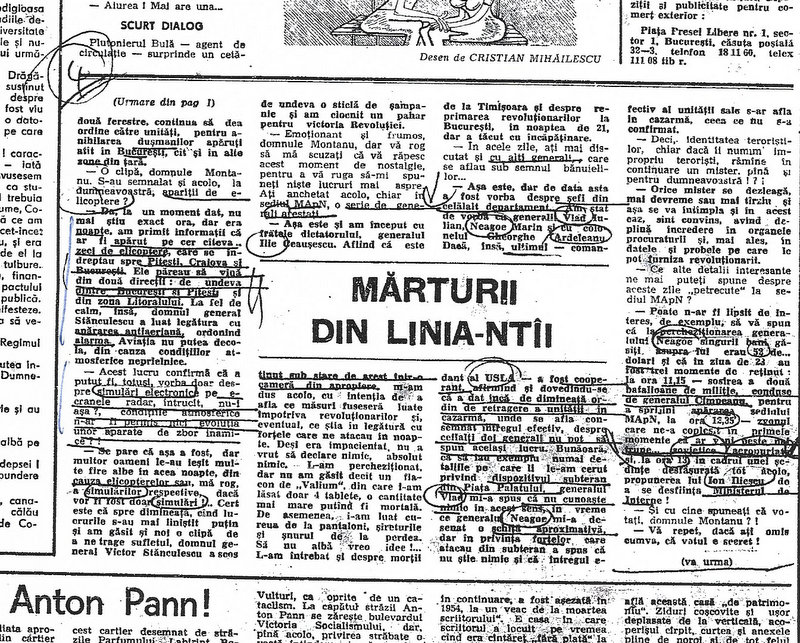
[Also, in reference to the credibility and loyalty of key Securitate officials, something which spurred the decision to interrupt their communications, Montanu added:…(In data de 22 decembrie, dupa amiaza) Asa este, dar de data asta a fost vorba despre sefi din celalalt departament. Am stat de vorba cu generalii Vlad Iulian, Neagoe Marin, si cu colonelul Gheorghe Ardeleanu. Daca, insa, ultimul–comandant al USLA–a fost cooperant, afirmind si dovedindu-se ca a dat inca de dimineata ordin de retragere a unitatii in cazarma, unde se afla consemnat intregul efectiv, despre celalti doi generali nu pot sa spun acelasi lucru. Bunoara, ca sa iau exemplu numai detaliile pe cae li le-am cerut privind dispozitivul subteran din Piata Palatului, generalul Vlad mi-a spus ca nu cunoaste nimic in acest sens, in vreme ce generalul Neagoe mi-a desenat o schita aproximativa, dar in privinta fortelor, care atacau din subteran a spus ca nu stie nimic si ca intregul efectiv al unitatii sale s-ar afla in cazarma, ceea ce nu s-a confirmat…]
Interestingly, the following from General Stefan Guse in late February/early March 1990 is something that would not show up again in his later much publicized interviews with former Securitate officer Pavel Corut (alias Paul Cernescu)…Like Montanu, he had not yet learned to forget, based on what others were increasingly arguing…
Colonel Cristian Leon, “Contributii la Elucidarea Adevarului (II). Interviu cu domnul general-locotonent STEFAN GUSA, Armata Poporului, nr. 10 (7 martie 1990), p. 3.
A fost o noapte foarte grea in care am simtit din plin precaritatea legaturilor, faptul ca de multe ori in retele noastre intrau prin diverse mijloace elemente ostile, teroriste, care transmiteau informatii false cautind sa ne dezorienteze, sa produca panica.

“Am continuat sa actionez in calitatea mea de sef al Marelui Stat Major, executind, fireste, dispozitiile domnului ministru. Am cooperat de pilda cu colonelul Stelian Pentelie (sic.) si cu colonelul Popescu Nicolae la elaborarea si punerea in practica a unui plan de blocare a legaturilor controlate de securitate chiar daca prin aceasta a trebuit sa renuntam pe anumite perioade la o parte din legaturile noastre cu garnizoanele din judete. Initiativa, venita de la colonelul Pentelie (azi general-maior si ministru ai Telecomunicatiilor) a dat roade, intrucit am observat ca actiunile teroristilor slabeau din intensitate, probabil nemaiavind posibilitatea de a fi coordonate.”
[Guse also commented on the “terrorists”, which at this point remained a reality for him…Era intuneric cind a inceput sa se trage de deasupra Palatului Republicii. Am fost surprins deoarece pina atunci fusese liniste. Ne-am dat relativ repede seama ca era vorba de elemente din garda dictatorului [deci Directia a V-a a Securitatii], insa nu puteam sti care este numarul si forta lor….Sigur, ne masuram cu un inamic viclean, foarte bine inarmat si instruit, practic invizibil, pe de alta parte militarii nostri aveau doar trei luni de instructie, nu erau pregatiti pentru o asemenea lupta de gherila urbana.

 Roland O. Thomasson, PHD
3 thoughts on “23 December 1989: When General Stanculescu ordered Pintelie “to cut the Securitate’s phone lines” (I)”