(My thanks to my co-author, Andrei Ursu, for reigniting interest on this question in recent discussions)
To believe the revisionist narratives so popular and influential inside and outside Romania about the Revolution of December 1989, everything worked like clockwork for those who came to power on the afternoon of 22 December 1989 when the Ceausescus were evacuated from the PCR CC building shortly after noon. Everything was prepared for Ion Iliescu and Ion Iliescu (alone) and the National Salvation Front (which “had been in existence for six months already”) to take power.
In Rechizitoriul Dosarului Revolutiei of 9 April 2019–a 501 page document–Corneliu Manescu, one of the signatories of the famous anti-Ceausescu “Letter of the Six” made public in March 1989, is mentioned only twice–once as a member of the CFSN (p. 140) and once in passing without first name by General Stefan Kostyal (p. 25)–and the Manescu who is mentioned far more is Manea Manescu, former PM and Ceausescu loyalist to the end. No mention is made of “Frontul Renasterii Nationale” and certainly not in discussing the first media after the Ceausescus left the CC. (https://www.b1.ro/stiri/eveniment/exclusiv-b1-ro-prezinta-integral-rechizitoriul-revolutiei-romane-episodul-1-dovada-implicarii-rusiei-in-evenimentele-din-decembrie-1989-filosovietismul-lui-iliescu-si-acolitilor-sai-286156.html)
It thus cannot explain, and clearly does not want to refer to the following, the banner on the first post-Ceausescu flight newspaper on the 22nd:
Libertatea: Ziar al Frontului Renasterii Nationale
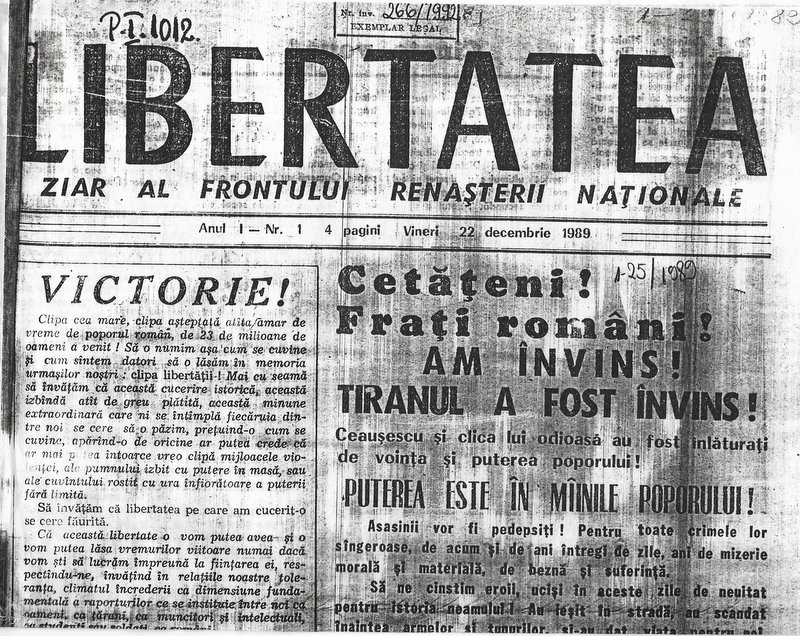
If all the central organs of the communist party-state were in lockstep, and the arrival of Ion Iliescu and the prior existence of the National Salvation Front were known and expected, then how does one explain this rather glaring mistake? The answer: because the miserable manipulations of things such as the Rechizitoriu or the televised series of Mihalache and Butaru “Decembrie Rosu” want a tight, damning narrative. They aim to hang Iliescu and co., and as a nice collateral (?) benefit, they absolve the Securitate of responsibility for the massive bloodshed that they created.
“Frontul Renasterii Nationale” was also not the only alternative grouping by those alleged to be plants for Iliescu from the start. Mircea Dinescu in one of his early interventions on TV, referred to “Adepti ai Frontului unit muncitoresc din Romania” (Revolutia Romana in direct, p. 27). (Both FRN and FUM had precursors in Romanian history that ultimately made them inappropriate.) And we also know that in these early hours of the afternoon of 22 December, that chants emanated from the crowd: “Manescu, Manescu!” (see online videos, also Flacara, “Guverne, Guverne,” nr. 20, 16 mai 1990, p. 13).
In fact, Corneliu Manescu was assumed to be the new leader (although under a different group name “Frontul Salvarii Patriei”) in Radio Free Europe’s Romanian Service’s live coverage of events on 22 December 1989:
Radio Belgrad relatează că Ceauşescu a fugit după ce la Bucureşti armata s-a solidarizat cu demonstranţii. Potrivit diplomaţilor occidentali miniştrii au părăsit clădirea Comitetului Central, retrăgându-se la locuinţele lor din cartierul în care se află şi casa lui Ceauşescu, spre care se îndreaptă acum mii de manifestanţi. Potrivit relatărilor care sosesc la redacţie, fostul ministru de externe, Corneliu Mănescu face parte, într-adevăr, dintre cei care au preluat puterea în urma prăbuşirii dictatorului Ceauşescu. Cosemnatar al scrisorii deschise din luna martie în care se critica vehement politica şi modul dictatorial de conducere al lui Ceauşescu, Corneliu Mănescu s-a aflat la aceea dată sub arest la domiciliu. Ţara întreagă era sub arest, spunem noi. El a fost deasemeni exclus din Partidul Comunist….
22.12.89 – Actualitatea românească: Căderea lui Ceaușescu comentată de redactorii Europei Libere
The reference to Radio Belgrade (Yugoslavia) is quite intriguing, because the compendium of chronological foreign press dispatches that was published in Revista 22 a year later (nr. 49, 21 decembrie 1990, pp. 8-9) shows that a little over a half hour after the Ceausescus were evacuated from the CC (1141 Belgrade time; 1241 Bucharest), shows Radio Belgrade announcing that “Un comitet de Corneliu Manescu, fost ministru de externe, a preluat puterea in Romania, informeaza agentia Tanjug.”
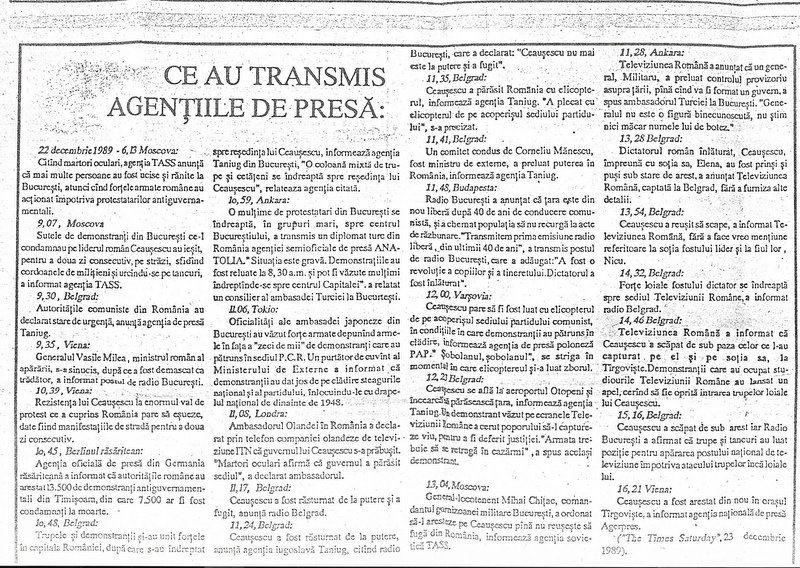
Peter Siani-Davies writes on p. 183 of The Romanian Revolution of December 1989 (Cornell, 2005): “Moreover, some tantalizing evidence exists to suggest that it was not Iliescu but Corneliu Manescu, a former Romanian foreign minister and one of the signatories of the ‘Letter of the Six,’ that the USSR expected to head the NSF.” Siani-Davies points to Valentin Falin’s (Head of International Department of the Communist Party of the Soviet Union) 1990 New Perspectives Quarterly article to this effect: Falin says Manescu declined the offer because of his “ill health” (elsewhere from Siani-Davies’ book, military prosecutor Dan Voinea has claimed that Manescu was found drunk at his residence and in no state to assume power). Siani-Davies notes how Manescu’s name appeared on a number of lists of new leaders read out from the balcony of the CC on 22 December and notes “how quickly news that Manescu had taken power was broadcast by foreign news agencies, with Agence France Press and Tanjug carrying the story little more than an hour after the flight of the Ceausescus.” (His speculation about the British diplomat Jonathan Lamb in fn. 173, doesn’t pan out when one reads the Times article he refers to; Lamb was clearly speaking later in the day. for accessible text without paywall, see, https://www.latimes.com/archives/la-xpm-1989-12-23-mn-517-story.html)
It remains unclear if the sources for the claim that Corneliu Manescu had taken power were from within Romania and transmitted to the outside world (e.g. by Tanjug), from plugged in Western diplomats inside or oustide Romania, or perhaps even, as Siani-Davies suggests, by the Soviets (which even if it is true, does not mean he was the only horse they were backing or were willing to back.)
What does seem unambiguous about Corneliu Manescu, Frontul Renasterii Nationale, etc. on 22 December 1989, is that the retrospectively airbrushed version of the 22nd of December is tied to tendentious, revisionist narratives to suggest everything was stage-managed (regizat), from Mircea Dinescu on TV, the central organs of the communist press, foreign radio (including Radio Free Europe in some accounts), etc. to ensure the seizure of power by Ion Iliescu and the National Salvation Front. The research above should demonstrate that those narratives cannot stand up to the light of day.

 Roland O. Thomasson, PHD