It bears repeating until it starts to sink in. Confirmation that evidence that the Securitate were the core of the counter-revolutionary resistance in December 1989 is sufficiently hard to completely deny or ignore can be found in the evolving rebuttals/adaptations of arguments/theories which attempt to suggest that sure, the Securitate were involved, but senior military officers were also involved in the “terrorism.” There is a clear ideological/mental prism that frames such a view. It is the idea that the whole communist party-state system was involved in the repression prior to 22 December 1989 and therefore, “logically” also in the “terrorism” after 22 December 1989 when Nicolae and Elena Ceausescu and several other members of the CPEx (Ceausescu’s cronies in the leadership) fled Bucharest by helicopter midday on that day. The problem is the facts simply do not show a level of corporate or even leadership involvement of the military in the post-22 December counter-revolutionary violence. The single notable exception is General Stefan Gusa, who unlike other senior military officials, did not decamp to Defense Ministry Headquarters (in itself, a sort of recognition of corporate allegiance), but remained with Securitate General Iulian Vlad, in the Central Committee building of the Romanian Communist Party, i.e. seat of Nicolae Ceausescu’s personal dictatorship).
Those who seek to argue that senior Army officials were also “in on it”, involved with the counter-revolutionary resistance, perhaps realize they cannot just point to Gusa…so they inevitably turn to General Victor Stanculescu, also guilty for his role in directing the repression of anti-regime demonstrators in Timisoara in mid-December. It simply does not stand and instead shows that they have an agenda with trying to inculpate Stanculescu for his actions on 22 December 1989 and in the immediate days thereafter. There aren’t just the statements by Hungarian military officials with whom Stanculescu, unlike Gusa, were willing to cooperate during these days to take out Securitate transmitters (see for example, https://rolandothomassonphd.home.blog/2020/03/07/borsits-revealed-that-hungary-helped-with-what-he-calls-technical-means-presumably-meaning-intercepts-the-hungarian-army-was-able-to-pin-down-the-location-of-securitate-troops-and-pa/ ; https://rolandothomassonphd.home.blog/2020/04/11/general-stefan-gusa-unintentionally-confirms-hungarian-claims-of-communicating-locational-data-on-securitate-transmitters-to-the-romanian-army-in-december-1989/ )–those who maintain Stanculescu was working with the Securitate in the counter-revolutionary campaign cannot explain why he would cooperate with the Hungarians to neutralize Securitate transmitters involved in the counter-revolutionary campaign–there are the complaints of former Securitate officials, bitter complaints, that they believe they were “betrayed” by Stanculescu in December 1989.
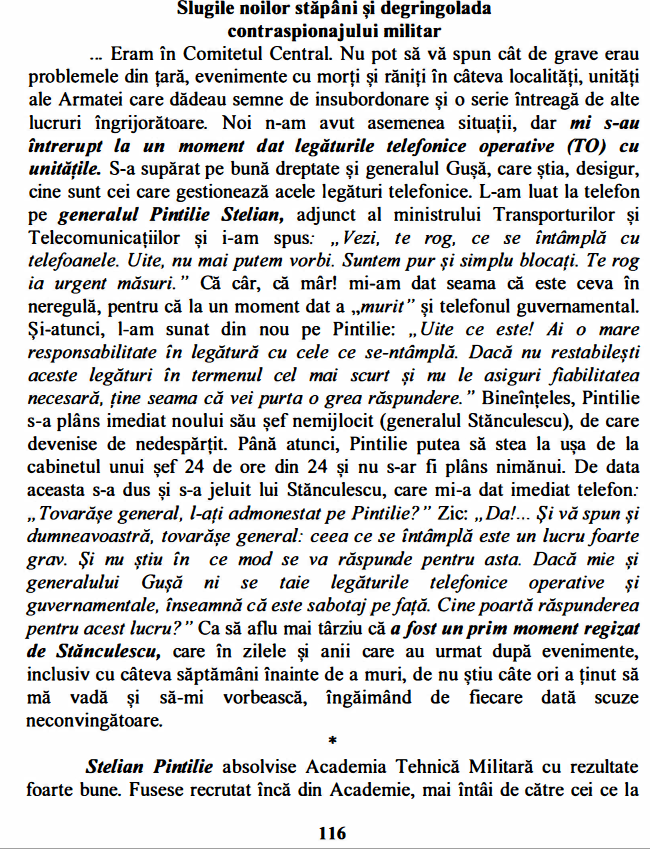
One of the most bitter complaints of the Securitate is that Stanculescu ordered the senior communications’ official Stelian Pintilie on 22/23 December to cut the lines of secret Securitate phone lines (hence, probably why the Securitate transmitters took on a new importance after this). (Once again, for the deniers, if Stanculescu was with the Securitate in supporting the counter-revolution, why would he order Pintilie to cut the Securitate’s secret communications?) We know from no less that Securitate Director Vlad that they were furious with Pintilie and Stanculescu for this and attempted to get the order countermanded. Clearly, Stanculescu and the Securitate were not on the same side, and those with their sui generis, insufficiently researched and blatantly internally contradictory, narratives about December 1989 need to start taking this into account.
Periscop nr. 37 (ianuarie – martie 1990)
Not surprisingly, Dan Andronic and the pro-Securitate narrative Evenimentul Zilei republished this at https://evz.ro/ideologul-revolutiei-din-1989-silviu-burcan-a-fost-agentul-rusi.html
Slugile noilor stăpâni și degringolada contraspionajului militar … Eram în Comitetul Central. Nu pot să vă spun cât de grave erau problemele din țară, evenimente cu morți și răniți în câteva localități, unități ale Armatei care dădeau semne de insubordonare și o serie întreagă de alte lucruri îngrijorătoare. Noi n-am avut asemenea situații, dar mi s-au întrerupt la un moment dat legăturile telefonice operative (TO) cu unitățile. S-a supărat pe bună dreptate și generalul Gușă, care știa, desigur, cine sunt cei care gestionează acele legături telefonice. L-am luat la telefon pe generalul Pintilie Stelian, adjunct al ministrului Transporturilor și Telecomunicațiilor și i-am spus: „Vezi, te rog, ce se întâmplă cu telefoanele. Uite, nu mai putem vorbi. Suntem pur și simplu blocați. Te rog ia urgent măsuri.” Că câr, că mâr! mi-am dat seama că este ceva în neregulă, pentru că la un moment dat a „murit” și telefonul guvernamental. Și atunci, l-am sunat din nou pe Pintilie: „Uite ce este! Ai o mare responsabilitate în legătură cu cele ce se-ntâmplă. Dacă nu restabilești aceste legături în termenul cel mai scurt și nu le asiguri fiabilitatea necesară, ține seama că vei purta o grea răspundere.” Bineînțeles, Pintilie s-a plâns imediat noului său șef nemijlocit (generalul Stănculescu), de care devenise de nedespărțit. Până atunci, Pintilie putea să stea la ușa de la cabinetul unui șef 24 de ore din 24 și nu s-ar fi plâns nimănui. De data aceasta s-a dus și s-a jeluit lui Stănculescu, care mi-a dat imediat telefon: „Tovarășe general, l-ați admonestat pe Pintilie?” Zic: „Da!… Și vă spun și dumneavoastră, tovarășe general: ceea ce se întâmplă este un lucru foarte grav. Și nu știu în ce mod se va răspunde pentru asta. Dacă mie și generalului Gușă ni se taie legăturile telefonice operative și guvernamentale, înseamnă că este sabotaj pe față. Cine poartă răspunderea pentru acest lucru?”. Foto: Ion Iliescu Ca să aflu mai târziu că a fost un prim moment regizat de Stănculescu, care în zilele și anii care au urmat după evenimente, inclusiv cu câteva săptămâni înainte de a muri, de nu știu câte ori a ținut să mă vadă și să-mi vorbească, îngăimând de fiecare dată scuze neconvingătoare.

 Roland O. Thomasson, PHD