Younger scholars are always looking for their own, new, intriguing angle. I get it; who hasn’t been there before? The problem is: you have to back up your contentions with evidence. One of the latest, although it is not really that new, is to create a strawman that the Romanian military from December 1989 on claimed/claims that it “had nothing to do with the Securitate” during the communist regime, and especially the “Golden Era” of Nicolae Ceausescu. Instead, we are told, in this supposedly daring “new” argument that the Securitate and the Army worked hand-in-glove together, in tandem, sure there was a rivalry and mutual hostility, but in the end they were part of the communist regime repression, Party, Military, Securitate all together. To argue otherwise we are told is a “post 1990 construct”! Oddly, we are told that one of the pieces of evidence for this…is that senior military officials in December 1989 (Milea, Stanculescu) turn out to have been Securitate informers. (Of course, it isn’t enough to throw out the collaboration status, which is true, one has to link it directly to behavior in December 1989…and that is where such a theory fails.) But, note here, there is no discussion here of a reciprocal recruitment of Securitate officials by the military? Why is that? It is does appear to have happened, via DIA, the Army’s intelligence unit, but it was exceedingly rare. And why was it rare? Because the Securitate controlled an entire directorate, the Fourth Directorate (IV), that was charged with Military Counter-intelligence, the dreaded CI-stii who gave the Securitate substantial informational and operational control over the military. There was no counterpart, this was not a “reciprocal” relationship, and to do so is indeed the real post-1990 revisionist construct here.
There are many examples to disprove the contention of Dinamo-Steaua being little more than football match tensions! These pages here, and others on the internet, are full with examples of the woeful difference in the budget, training, equipment, munitions, conspiratorial capacity, civilian networks responsible to the institutions (informers, collaborators), and societal and political influence and capability for influence of the Securitate versus the Romanian military. Much of this was borne out in December 1989 and explains much of the mayhem and bloodshed of December 1989. Here, I will avoid those examples, however, to things which happened before 16 December 1989 and the outbreak of the revolution in Timisoara.
I will begin here with two examples: 1) the precipitous fall-off in defense attaches posted abroad as the Ceausescu era deepened and the Securitate became more institutionally powerful; and 2) the decision prior to the outbreak of demonstrations to transfer the border guards from the Ministry of Defense to the Ministry of the Interior…
1) https://rolandothomassonphd.home.blog/2020/08/05/dia-chief-stefan-dinu-1-1994-din-martie-1979-nu-s-a-mai-numit-nici-un-atasat-militar-in-exterior-pe-stat-erau-31-de-atasati-militari-pentru-acoperirea-a-50-de-tari-dar-de-fapt-aveam-patru/
In his testimony before the so-called Gabrielescu Senatorial Commission investigating December 1989, the head of DIA in December 1989, Rear Admiral Stefan Dinu stated in January 1994 that on paper the Romanian military had 31 military attaches abroad to cover 50 countries; in reality, by December 1989, it had only four, in Budapesta, Belgrada, Paris, si Roma![1] According to Dinu,
Deci, aveam o sectie a atasatilor militari romani in strainatate. Pe stat erau 31 de atasati militari pentru acoperirea a 50 de tari, dar de fapt aveam patru in decembrie. Pentru ca, treptat-treptat, datorita poate adversitatii serviciilor de informatii DSS, nu avea interes sa mai existe alaturi de ei, undeva, independent, vreun serviciu de informatii. Aveau intotdeauna obsesia ca nu se lucra corect in aceste servicii—vorbesc de cele externe, ca in tara noi nu aveam nimic—, ofiterilor sub acoperire li se gaseau tot felul de sicane ca sa fie retrasi. Ii retragem si altii nu s-a mai numit. Deci eu va declar aici cu toata raspunderea ca din martie 1979 nu s-a mai numit nici un atasat militar in exterior.
Cu exceptia astora patru care erau foarte in varsta si bolnavi. Veneau si stateau in tara cate 3-4 luni la refacere si nu puteam sa numim altii.
Acestia erau la Budapesta, Belgrad, Paris, Roma.[2]
[1] Serban Sandulescu, Lovitura de Stat a Confiscat Revolutia Romana (Bucharest: Omega, 1996), pp. 211-212
[2] Serban Sandulescu, Lovitura de Stat a Confiscat Revolutia Romana (Bucharest: Omega, 1996), pp. 211-212
It is noteworthy that the total breakdown in relations and trust and mutual collaboration between the military and the Securitate has been confirmed through the years by BOTH military and Securitate sources, because it was such a blatant fact of life. Were this some kind of equal relationship, do we really think that the Romanian military would have been denied its own means for collecting information abroad to communicate back home? Moreover, the Securitate’s efforts to reduce alternative sources of information to Nicolae Ceausescu was mirrored by the Securitate’s gradual elimination of the Communist Party itself as an avenue for information (Cornel Burtica and none other than Nicu Ceausescu spoke about this). The Securitate wanted to be and emerged as the single gatekeeper for information flowing to Nicolae and Elena Ceausescu by the end of their reign.
2) https://rolandothomassonphd.home.blog/2020/12/12/in-decembrie-1989-nicolae-ceausescu-avea-incredere-numai-in-partidul-si-armata-hohote-de-ris-sau-ce-s-a-intimplat-pe-11-13-decembrie-1989/
When push came to shove, when things got hot, and the regime was under pressure, the Ceausescus did not ultimately trust the military–which they feared might overthrow them under the right circumstances–and did trust the Interior Ministry (the nice, formal name for the Securitate…). So, as the regime hunkered down following the fall of likeminded fellow “rejectionist” regimes in East Germany, Czechoslovakia, and Bulgaria in October and November 1989, and possibly in response to/hastened by the flight across the border of regime sports icon Nadia Comaneci in late November 1989, the Ceausescus transferred control of the border guards (graniceri) from the Ministry of National Defense to the Interior Ministry.
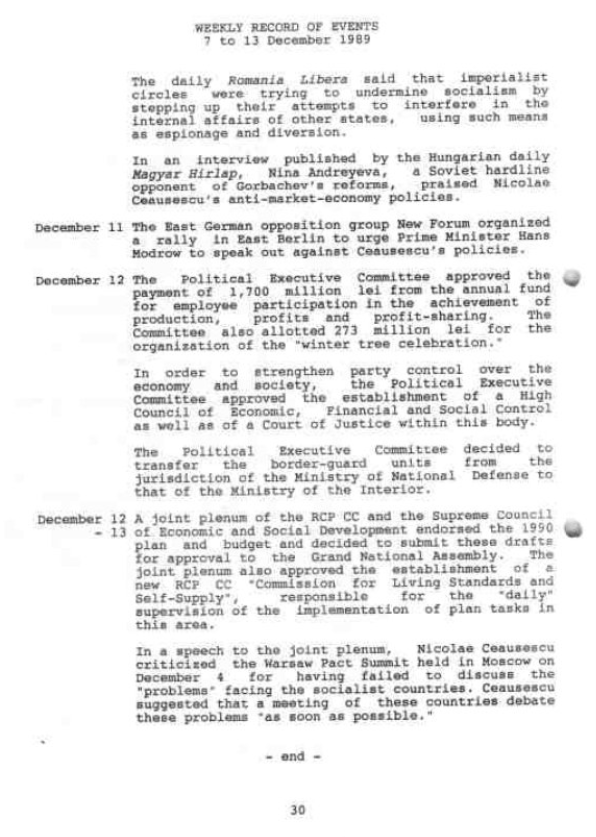
Below from Radio Free Europe’s Weekly Record of Events, 7 to 13 December 1989 (http://storage.osaarchivum.org/low/0e/b2/0eb2876f-9699-445d-9b0a-6f81e2604383_l.pdf). Of note, the entry on page 30 for December 12:
The Political Executive Committee [of the Romanian Communist Party] decided to transfer the border-guard units from the jurisdiction of the Ministry of National Defense to that of the Ministry of the Interior.
DECRET nr. 313 din 11 decembrie 1989privind trecerea trupelor de graniceri de la Ministerul Apărării Naţionale la Ministerul de Interne
| EMITENT | CONSILIUL DE STAT |
Publicat în BULETINUL OFICIAL nr. 41 din 13 decembrie 1989
Consiliul de Stat al Republicii Socialiste România decretează:Articolul 1Pe data prezentului decret trupele de graniceri trec de la Ministerul Apărării Naţionale la Ministerul de Interne.Articolul 2Orice dispoziţii contrare prevederilor prezentului decret se abroga.NICOLAE CEAUŞESCUPreşedintele Republicii Socialiste RomâniaBucureşti, 11 decembrie 1989.Nr. 313.
http://legislatie.just.ro/Public/DetaliiDocument/46897

 Roland O. Thomasson, PHD