I inevitably await the SPM and the know it alls in the media and among Romania’s intellectuals to reaffirm the work of the SPM, to tell us we don’t understand their profession, that sure, sure they know all of these documents, but they concluded they have no relevance, etc. etc.
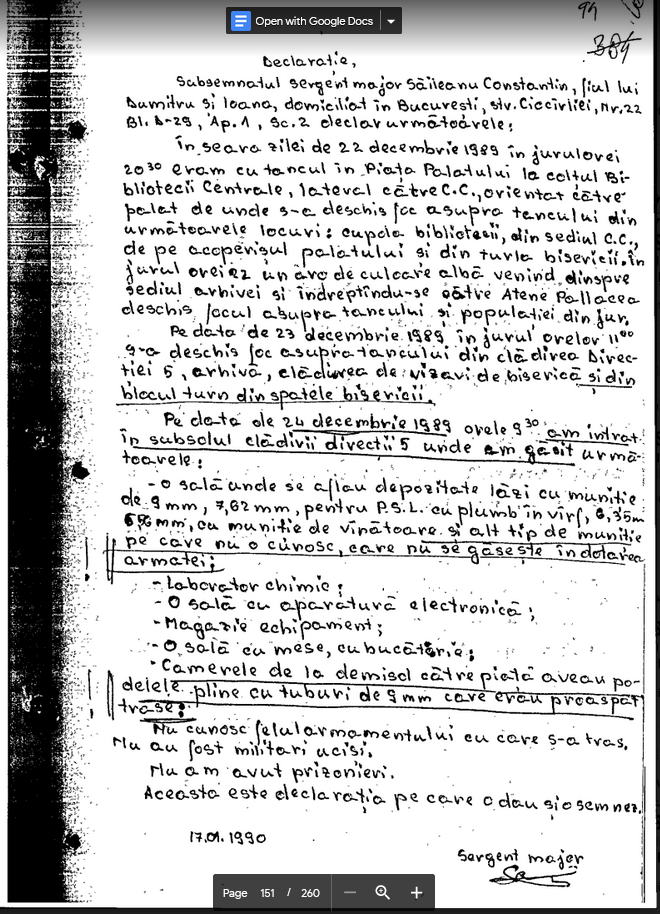
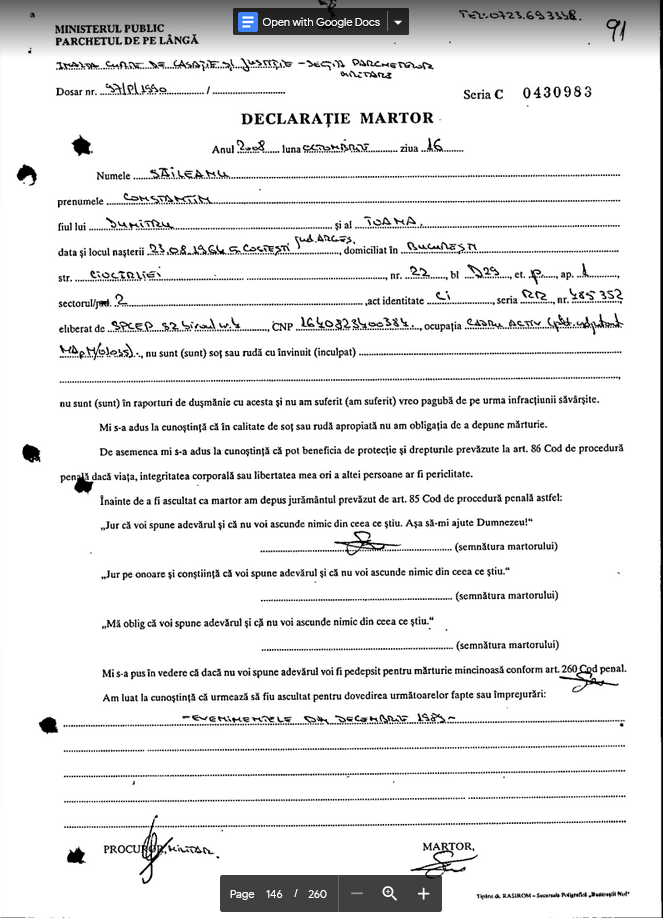
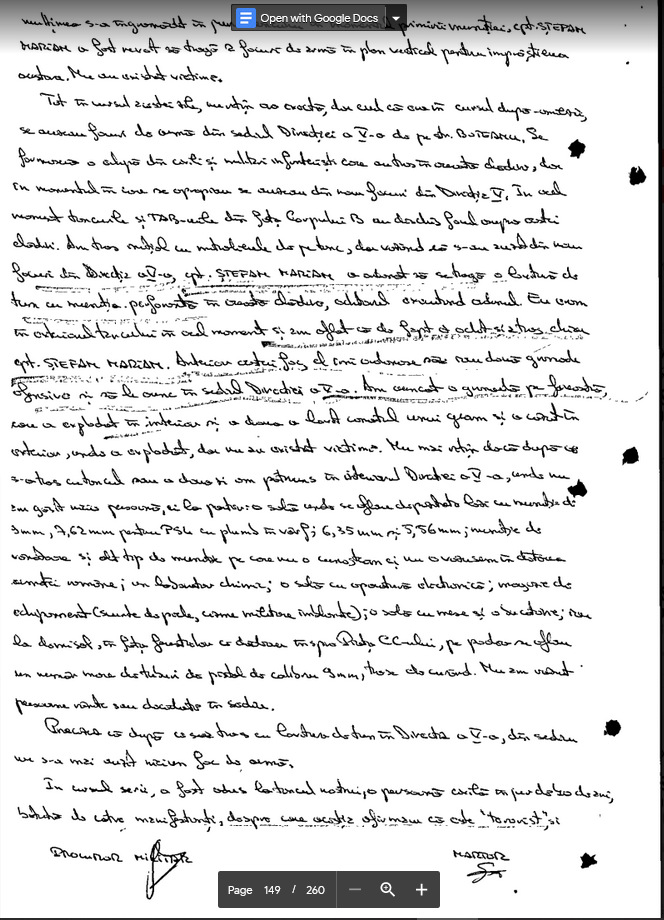
This is a good example, however, of what you see in the Files of the Revolution. Copies of the same declaration–damning declaration showing up multiple times in different volumes. Even better in this case is the consistency of Constantin Saileanu, he essentially says the same things in 2008 he said back in 1990. He hasn’t changed his story, even though the military prosecutors have. Below, Saileanu’s original handwritten declaration/witness statement from 17 January 1990. This appears in the following volumes: CC vol 24 Victime prin impuscare Sala Palatului, p. 71, CC Declaratii Militari UM 0160 Bucuresti p. 151, and CC vol 101 p. 589. Saileanu’s witness statement from 16 October 2008 appears in CC Declaratii Militari UM 0160 Bucuresti vol. 99 (starting p. 146) and CC vol 24(starting p. 66). I will just pull a few excerpts for now from the 17 January 1990 statement and publish a few pages from the longer 2008 statement that show the consistency of Saileanu’s story.
Pe data de 23 decembrie 1989 in jurul orelor 1100 s-a deschis foc asupra tancului [sau] din cladirea Directiei 5, arhiva, cladirea de vizavi de biserica si din blocul turn din spatele bisericii.
Pe data de 24 decembrie 1989 orele 930 am intrat in subsolul cladirii directii 5 unde am gasit urmaoarele: o sala unde se aflau depozitate lazi cu munitie de 9 mm, 7,62 mm, pentru P.S.L. cu plumb in virg, 6,35 mm, 5,56 mm, cu munitie de vinatoare si alt tip de munitie pe care nu o cunosc, care nu se gaseste in dotarea armatei…Camerele de la demisol catre piata aveau podele pline cu tuburi de 9 mm care erau proaspate trase.
“The Army shot into the Army…it was all “friendly fire”…who shot after 22 December? whoever had a gun…Iliescu and the Front and the Army they distributed arms to anyone who wanted them…they all shot into one another like a bunch of frightened idiots…the Army would take over a building and then the Army would be sent to that building and they would shoot each other…it was all a misunderstanding…it was a diversion from television…the Army needed to wipe the blood off its hands because of Timisoara and its bloodshed before the 22nd…they invented the terrorists…no, no, Iliescu, Brucan, Militaru, Brates, samd, they invented the terrorists…the terrorists were Soviet special forces sent in as “tourists”…the “terrorists” were a metaphor, a means of coping with the collapse of the regime and all their worst associations and fears of the Ceausescu regime” BLAH BLAH BLAH…ALL BULLSHIT…ALL OF IT ABOVE! FROM THE MILITARY PROSECUTORS IN THE RECHIZITORIU OF APRIL 2019 TO THE MEDIA WHETHER NATIONALIST OR LIBERAL, RIGHT OR LEFT, TO THE INTELLECTUALS AT 22 AND GDS TO THE ROMANIAN EMIGRE SCHOLARS AND PROFESSORS ABROAD TO WESTERN SCHOLARS WHO REPLACE HISTORIOGRAPHY WITH POSTMODERNIST DECONSTRUCTIONISM
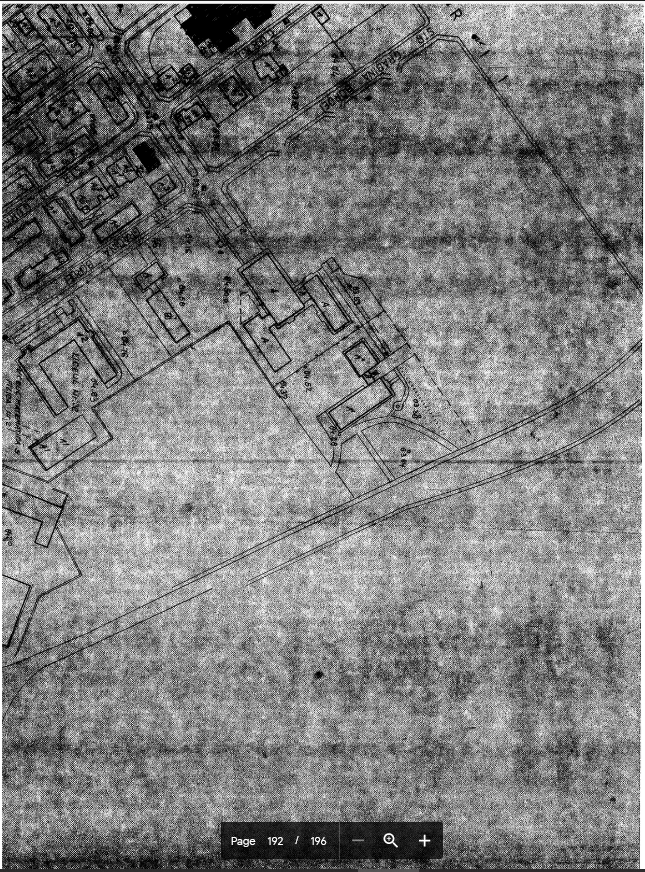
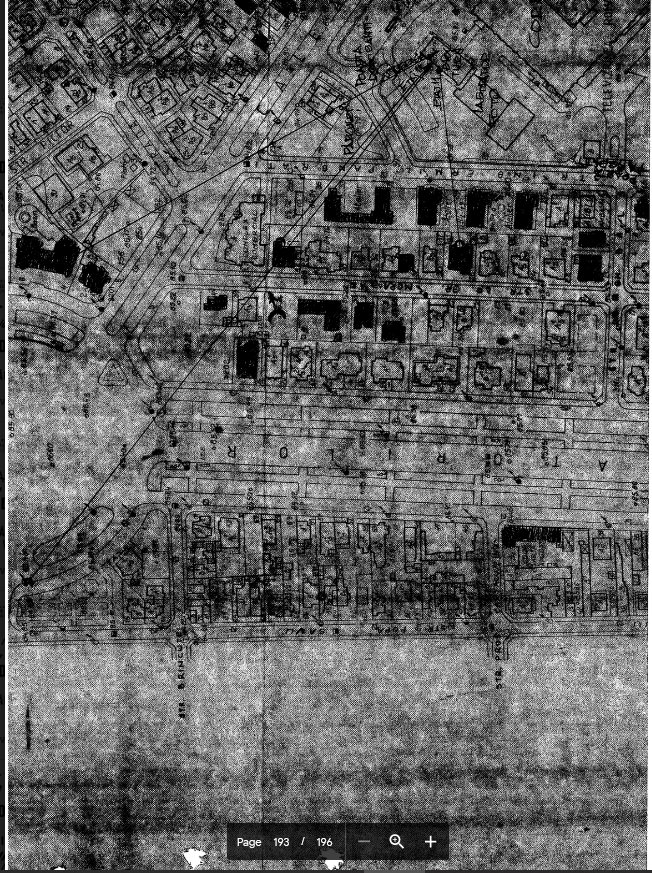
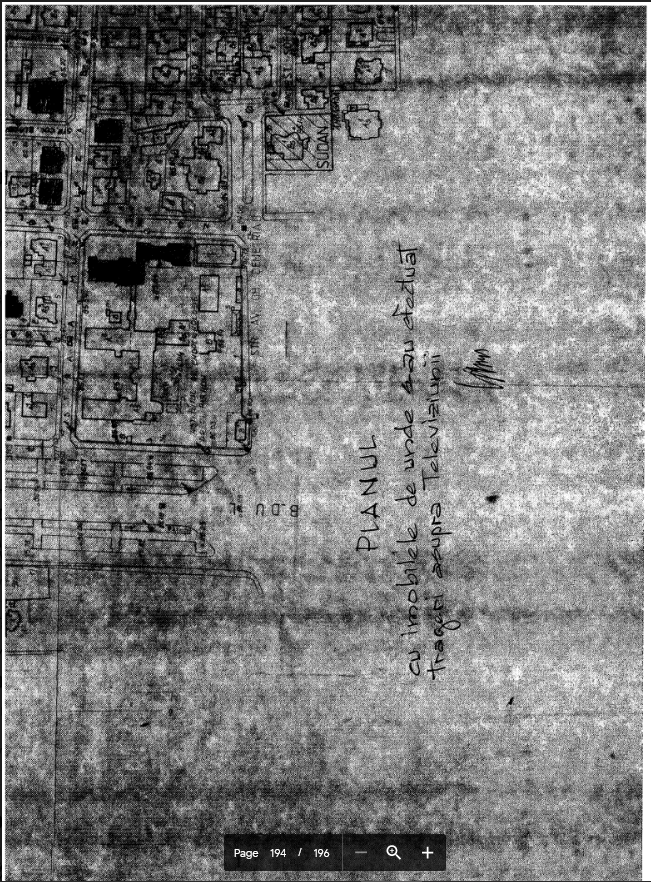
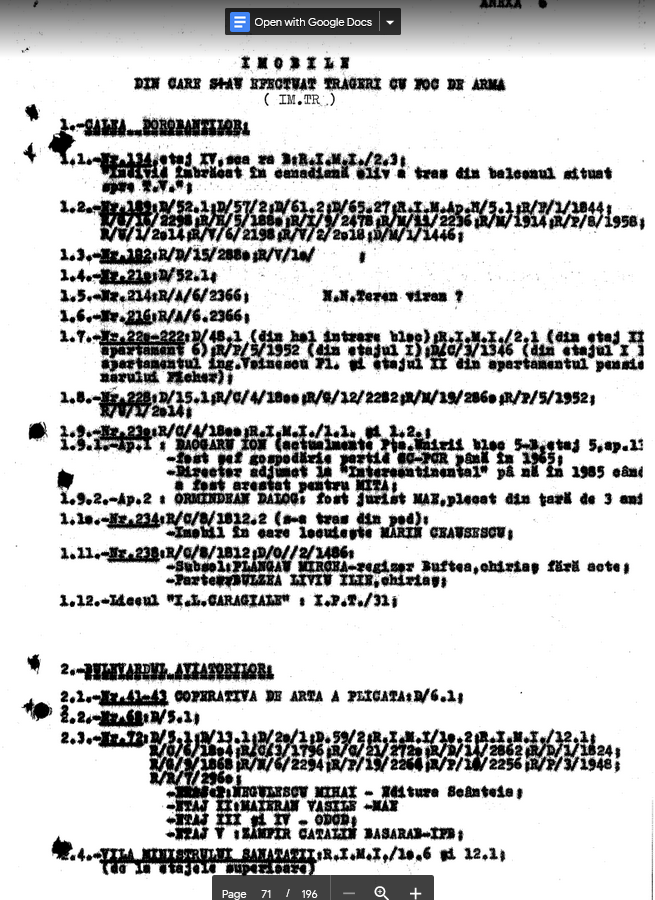
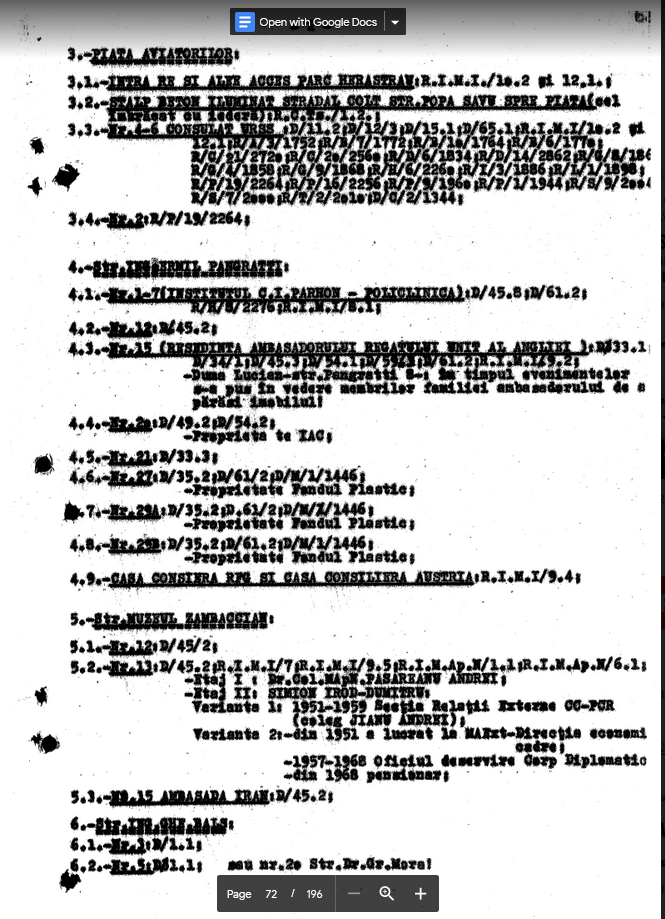
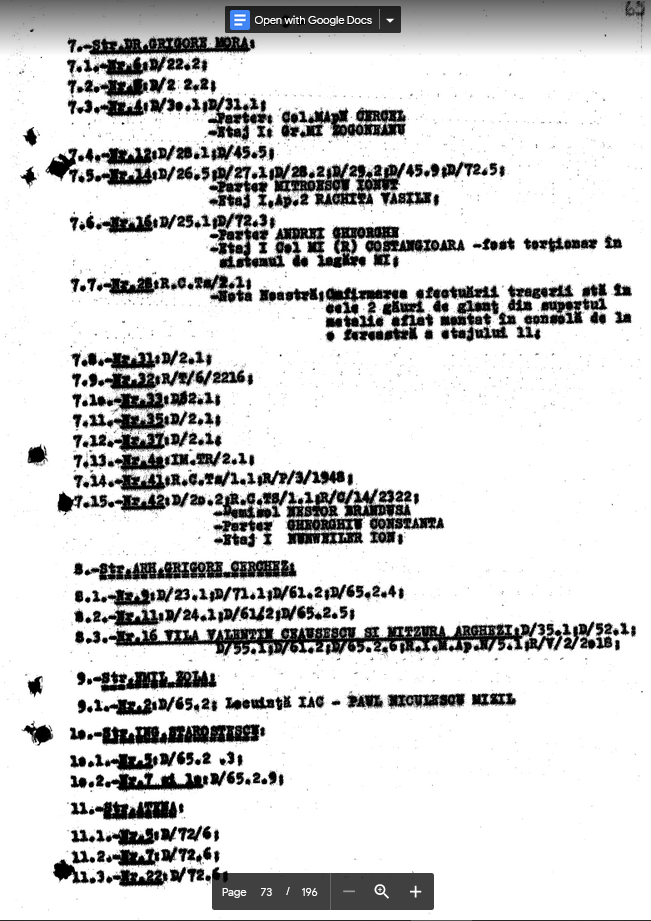
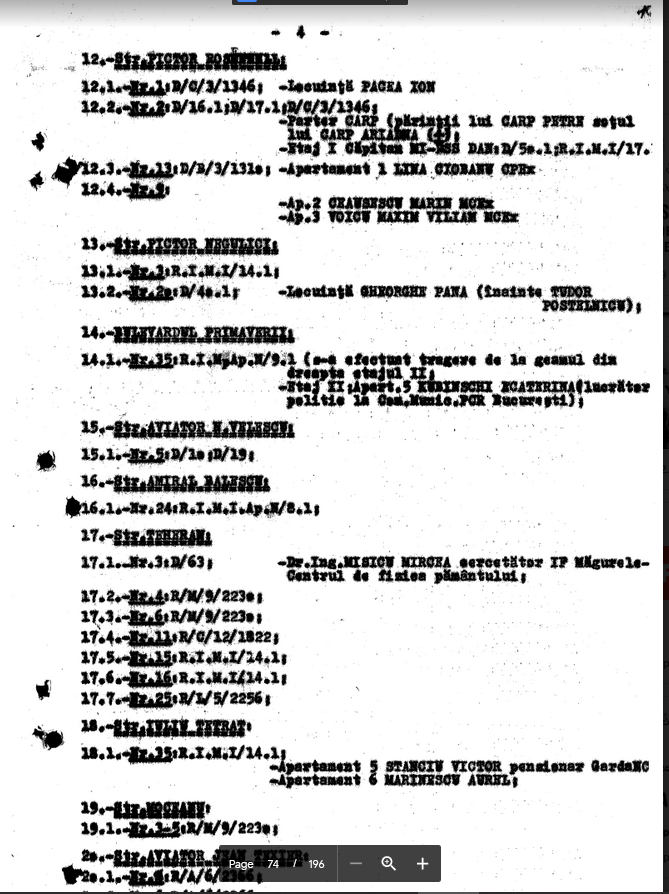
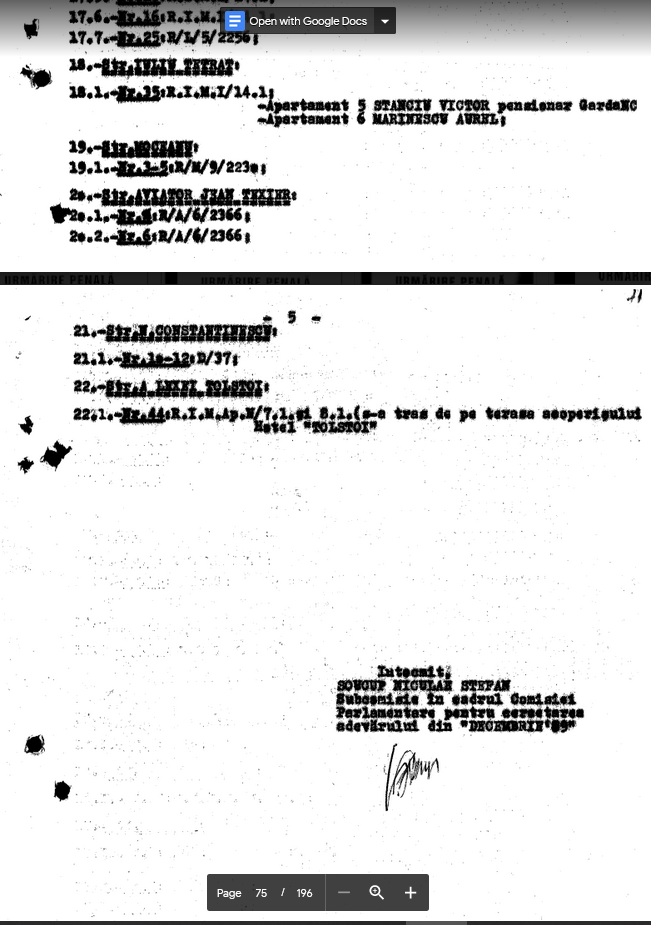
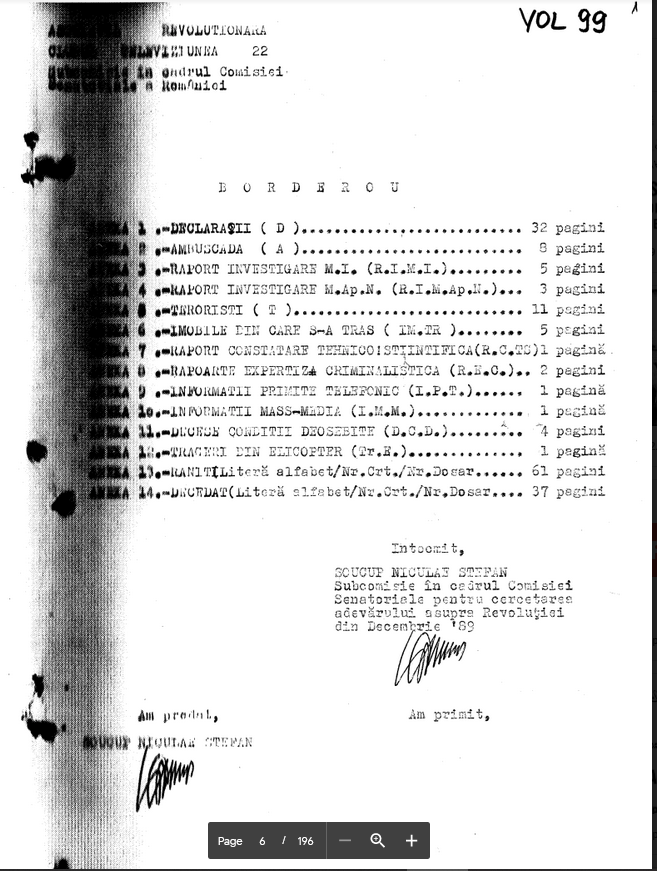
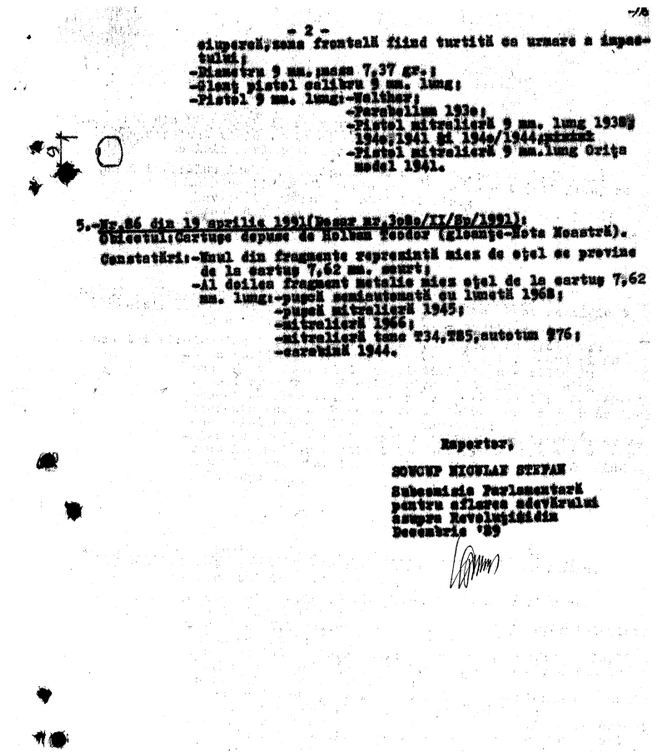
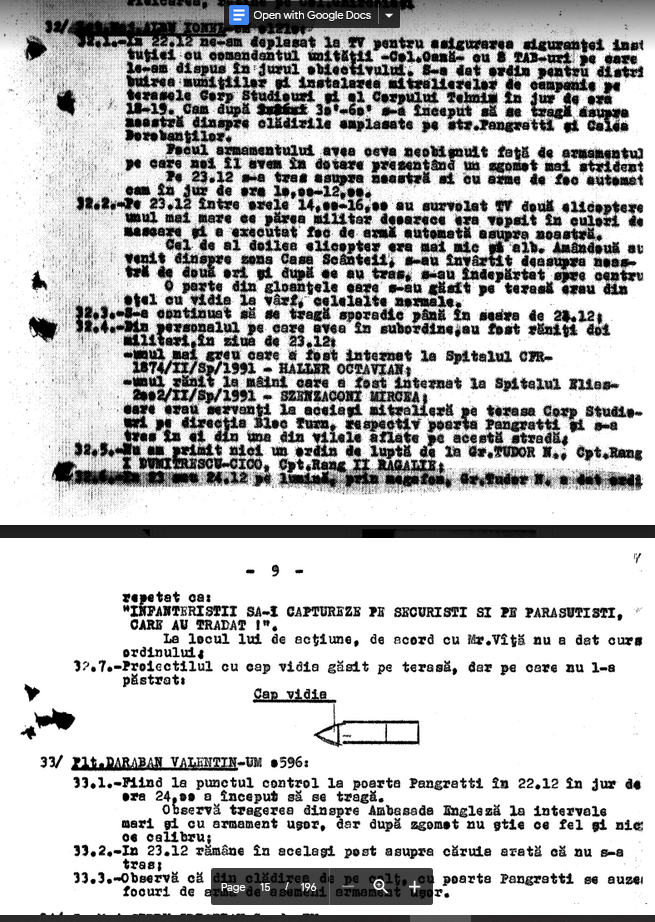
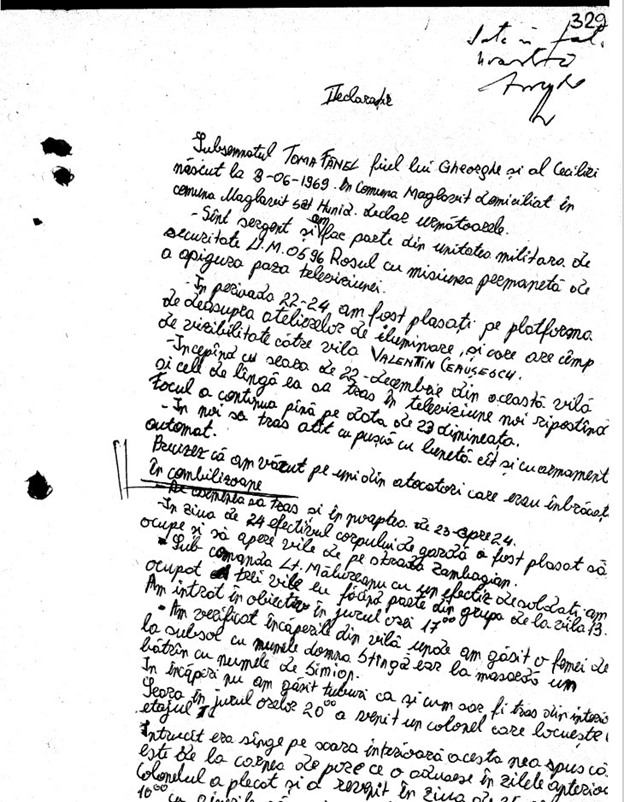
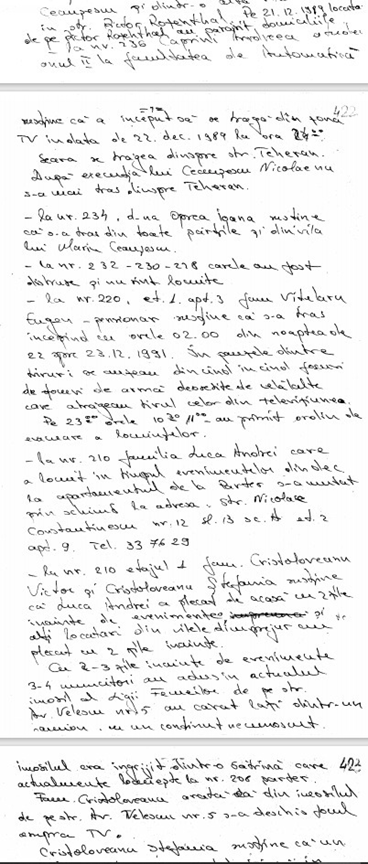
The following put together by one of the revolutionaries who fought at the Television Station
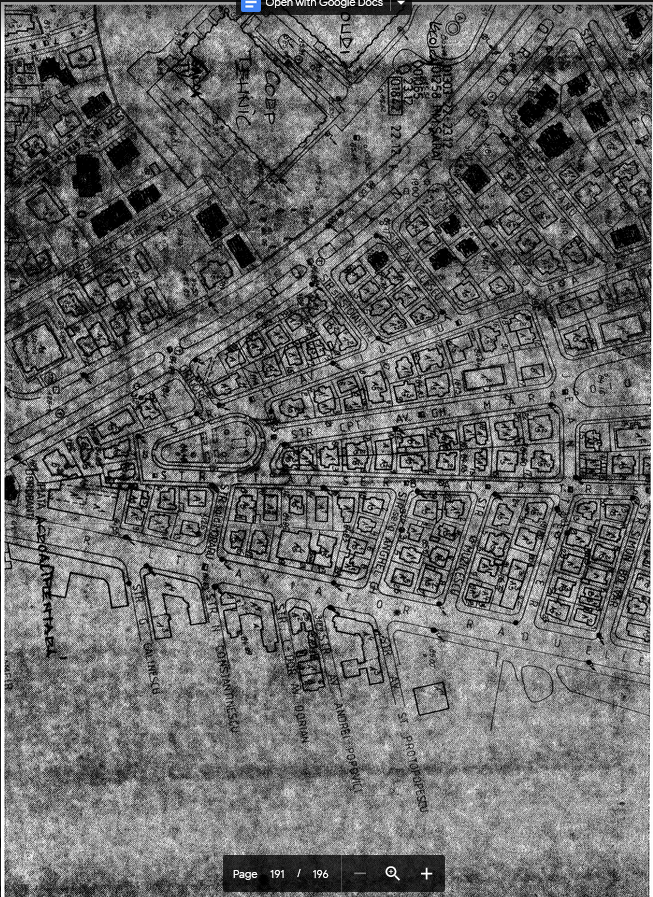
(TVR vol. 99 (SPM)–Raportul pentru subcomisie parlamentara despre decembrie 1989, Niculae Stefan Soucoup) was and is a roadmap, literally, for running to ground from where there was shooting toward the Television Station, who lived there, and in some cases who fired from there, who was captured there. In other words, Soucoup did the work of the military prosecutors, the work they failed to do. (It is hard to read, but it could still be useful.) Oh, yeah, sure, who lived in these houses and buildings, in the neighborhood dominated by the Ceausescus, important communist party members and nomenklaturists, higher ups of the Interior Ministry and Securitate? It is only the Securitate’s 32 years of disinformation and revisionism that makes it hard for Romanians, and sadly many Romanianists abroad, to answer that question.
Dan Voinea: “Pe durata evenimentelor s-a folosit munitie de razboi, munitie normala care se gasea la vremea respectiva in dotarea Ministerului de Interne si a Ministerului Apararii Nationale.“
TVR vol. 99 (SPM) Raportul pentru subcomisie parlamentara despre decembrie 1989, Niculae Stefan Soucoup
4.4 In decurusl zilei de 23.12 in vilele de unde se tragea au fost prinsi mai multi suspecti, unii raniti, aveau arme asupra lor (pistoale mici) si o imbracaminte de culoare inchisa (neagra), aproape toti fiind imbracati la fel
There were no terrorists in December 1989? Nobody fought for Nicolae Ceausescu? Then why were there so many detailed depositions and reports of gunfire from the villas of the Ceausescu family, senior regime officials, members of the nomenklatura, and of important figures whose careers had been tied to the Ceausescu regime?
Many intellectuals, academics, journalists, politicians, and everyday people lament the nostalgia shown by parts of Romanian society for Nicolae Ceausescu and the Golden Era. There are many factors that contribute to such nostalgia. But is it not worth asking whether some of this nostalgia is the product of decades of revisionism, disinformation, and lies about the fall of the Ceausescu regime in December 1989?
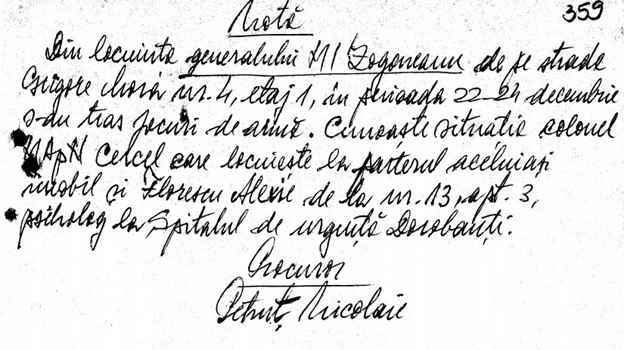
“Din locuinta generalului MI Zagoneanu de pe strada Grigore Mora nr. 4, etaj 1, in perioada 22-24 decembrie s-au tras focuri de arma.”
mai mult despre Generalul Zagoneanu: “Brasovul era pregatit pentru ceva asemanator. Doua personaje cheie se ocupau de aceste planuri. Primul, generalul Zagoneanu, sef al Inspectoratului judetean al M.I., venit pe 19 noiembrie 1987 la Brasov…Pe 19 si 20 decembrie 1989 acest plan a fost pus pe curat in cinci exemplare pe harta orasului Brasov. Pe 7 februarie 1990 aceste planuri i-au parvenit generalului Florea din partea lui Zagoneanu. Urmau sa fie distruse. Pe 18 decembrie avea loc o intilnire intre Gheorghe Pana, delegat al CC al PCR Petre Preoteasa, prim-secretar, si Zagoneanu, in care se discuta planul de interventie. In cladirea “Modaromului” s-au dispus tragatori de elita la mai multe niveluri. …“
“Semnalele luminoase pe care la-am sesizat personal in noaptea de 23/24 decembrie erau date de la ? din mansarada vilei a 2-a de pe strada Zambaccian...vila G(h)izelei Vass…” [the rest of the details from this document suggest there was also gunfire from the location]
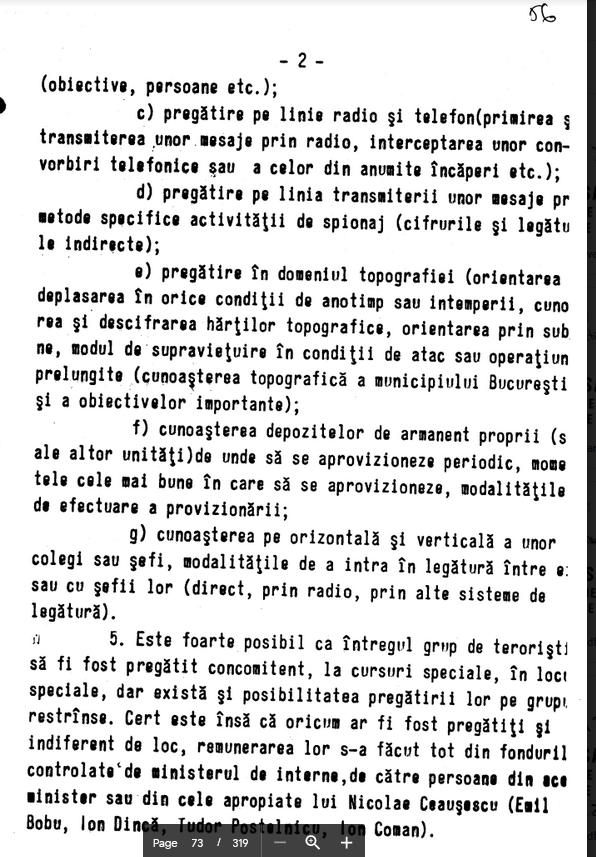
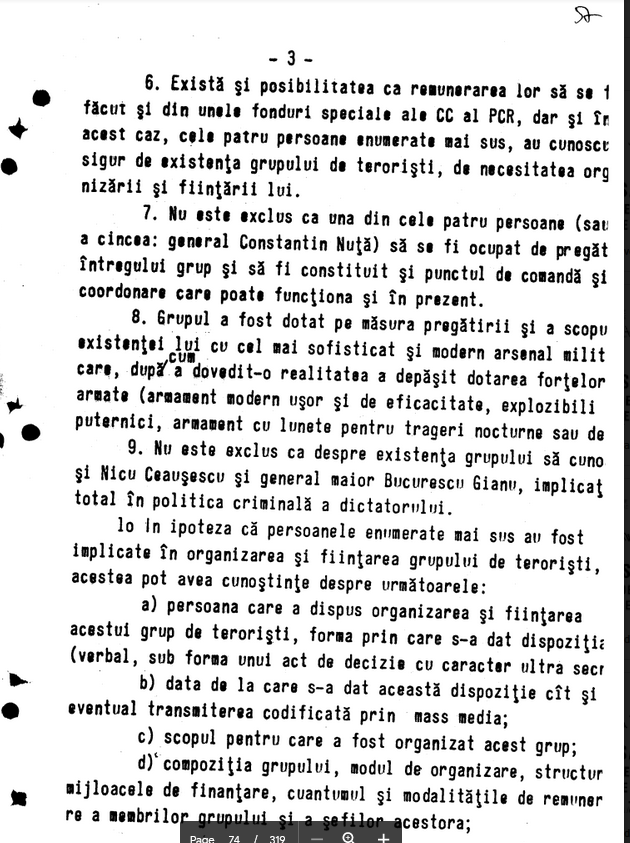
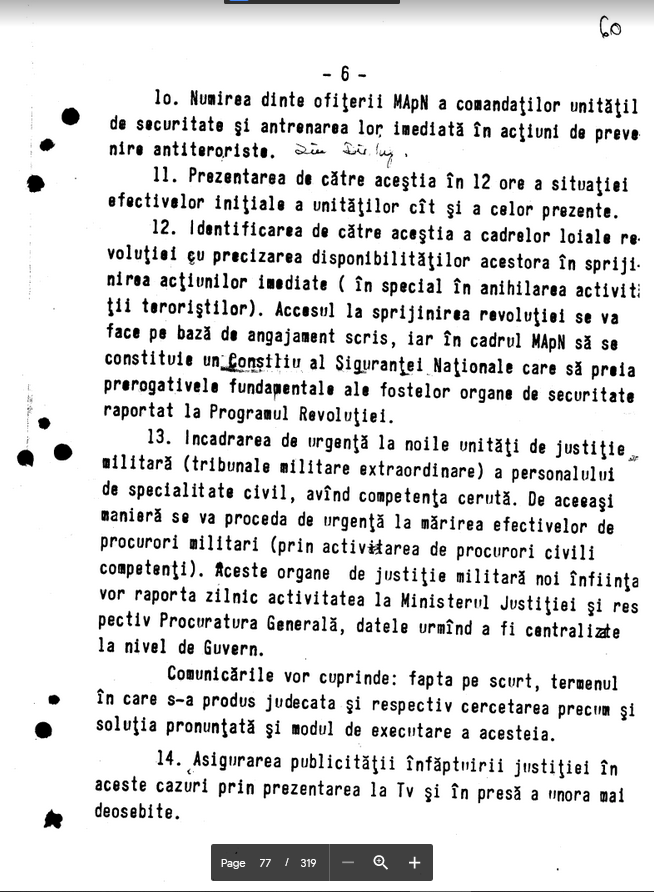
For now I will merely post this. My colleague and co-author Andrei Ursu included a link and excerpts from this previously unpublished original document in the following: http://gh-ursu.ong.ro/ApelCreareServiciuParchet.pdf . What this Strict Secret – marked “Synopsis of problems regarding the means of discovering and capturing the terrorists who remain at large” tells us is in keeping with the details of previously unpublished original documents posted on this site: 1) https://rolandothomassonphd.home.blog/2021/12/01/dosarul-revolutiei-the-past-is-coming-1-proces-verbal-30-ianuarie-1990-constantin-oancea-adjunct-m-a-e/ and 2) https://rolandothomassonphd.home.blog/2021/07/05/dosarul-revolutiei-the-25-december-1989-message-of-securitate-die-col-baltei-domitian-that-military-prosecutors-possess-but-have-ignored/ . Significantly, this document shows that what leaders of the National Salvation Front were saying publicly about the existence and institutional affiliation of the terrorists at the time, is matched by what they were writing privately. This 7 page typed document was signed by Deputy Prime Minister Gelu Voican Voiculescu on 29 December 1989 (page seven) and Prime Minister Petre Roman on 30 December 1989 (page one, top right). In recent years in particular, but for a long time overall, Voican and Roman have publicly denied exactly what is detailed in this document. In fact, both have gone so far as to allege that the Romanian Army invented the myth of counterrevolutionary Securitate terrorists fighting to save Nicolae Ceausescu in order to cover up their own responsibility for bloodily repressing demonstrators before 22 December 1989. This document shows that both Voican and Roman knew better back then, and that they have suffered remarkable opportunistic amnesia as time has gone by. Nor should it be a surprise, especially when one considers that Voican set up the first post-Ceausescu security arm, so called “doi si un sfert” MI unit 0215, by enlisting large numbers of former Securitate officers from the Fourth Directorate, the so-called CI-stii or military counter-intelligence officers. And not surprisingly, CI officers were involved in the Securitate’s failed counterrevolution after 22 December. In saving those officers and legitimizing them, so too he succeeded in assimilating and enabling their disinformation and revisionism on December 1989. Hence, his “amnesia” was situational and dictated by the politics of political competition and the fight for power in 1990. The same likely applies to the behavior of his boss, Petre Roman. This original document is a powerful corrective to their amnesia and in fact to the amnesia of the broader Romanian media, intelligentsia, and society about what really happened in December 1989.
My colleague and co-author Andrei Ursu has posted the following Appeal and Communique with links and pdfs: Please read! My thanks to Andrei for his amazing commitment to and work for this cause! http://gh-ursu.ong.ro/ApelCreareServiciuParchet.pdf
This post will hopefully begin a series of posts over the next month, marking the 32nd anniversary of the Romanian Revolution of December 1989, that will publish original documents from the so-called Revolution File. These are documents which the military prosecutors of the SPM, past and present, have clearly either overlooked, forgotten, avoided, or studiously ignored. They tell a very different, in fact a completely different story, than the one the military prosecutors have claimed publicly. I plan to synthesize and analyze these documents, time permitting (I may return to update/clarify insights on certain documents).
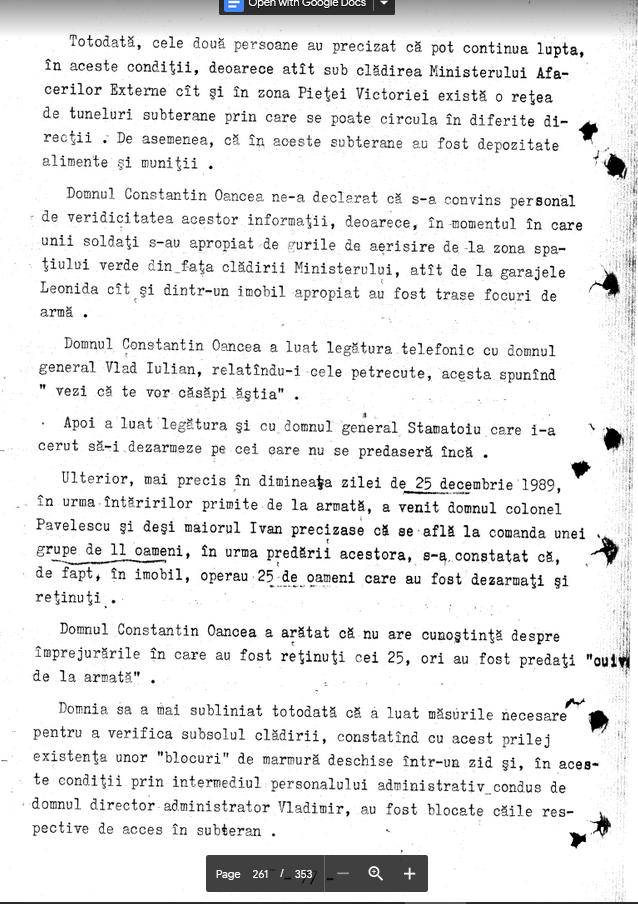
Today, the Proces Verbal of Constantin Oancea from the Foreign Affairs Ministry recorded in typed format on 30 January 1990.
CC vol. 70 pp. 260-262
Why is it important? What do we learn?
1) Oancea notes that from the 22 December, on the roof of the Foreign Ministry building, Securitate officers were stationed.
2) At a certain point, there was gunfire against Army soldiers stationed outside in front of the building. The Army wanted to respond, but Oancea, instead said he would go make contact with those who were shooting.
3) He found two people in the center of the building who presented themselves as Majors Ivan and Oprita, from the Interior Ministry (M.I.)
4) Here is what Oancea recounts they told him: Majors Ivan and Oprita…”said they would not put down their arms until they were convinced that Nicolae Ceausescu had abdicated, defending their position by saying they were well-compensated and that, besides, they had sworn an oath of loyalty to Nicolae Ceausescu.”
5) “Moreover, the two [Ivan and Oprita, M.I.] specified that they could continue fighting, under these conditions, because both under the building of the Foreign Affairs Ministry and in the area of Victory Square there existed a network of underground tunnels through which they could gain access from different directions. In addition, in these bunkers there were deposits of food and ammunition.”
6) Oancea said that he believed what they told him was true because he saw how when soldiers attempted to approach an air vent on the lawn in front of the Foreign Affairs Ministry building, both from a nearby garage and building, gunfire was opened on them.
7) Then critically, Oancea recounts that he got in contact with the head of D.S.S., the Securitate, General Iulian Vlad, and upon telling him what was going on, Vlad replied “see here, these guys will slaughter you,” in a rather clear reference to the MI people (i.e. Securitate) who were resisting the Revolution. Oancea then gets in touch with the head of Foreign Intelligence, Stamatoiu, who by contrast it appears, tells him to disarm those who have not surrendered yet.
8) “Later, on the morning of 25 December 1989 [i.e. the day Nicolae and Elena Ceausescu were summarily tried and executed], after being reinforced by Army forces, Pavelescu [presumably Dumitru Pavelescu, head of the Securitate’s uniformed troops] arrived and although Major Ivan had said that he had only 11 people under his command, after they surrendered, it was discovered that in the building there were in fact 25, who were then disarmed and detained.”
9) Oancea then says he ordered an official to move marble blocks to block any further access from the underground tunnels.
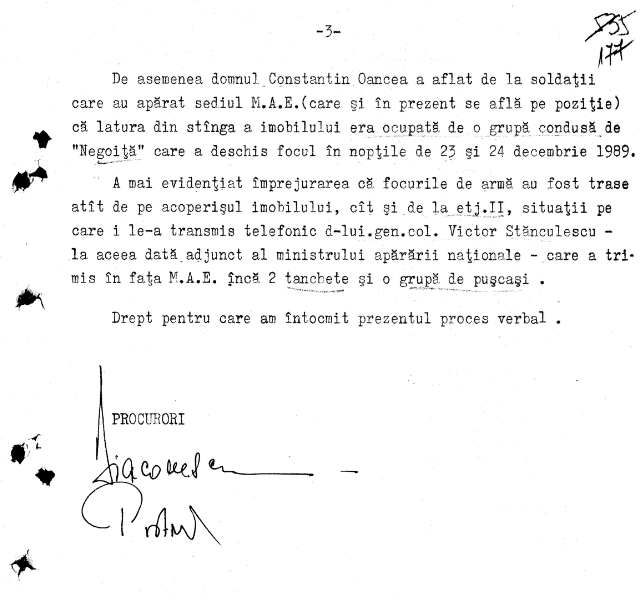
10) Oancea says he then found out from soliders defending the Foreign Ministry building (and who as of the date of this declaration were still there) that those from the left side of building who opened fire on the nights of 23 and 24 December 1989 were commanded by a certain “Negoita.” The circumstances of the gunfire from the rooftop of the building as well as from the second floor (European) were transmitted to Gen. Col. Victor Stanculescu who at that time was Deputy Defense Minister and who as a result sent an additional two tanks and a team of riflemen to the Foreign Ministry.
Sadly, but predictably, it has been all but ignored by the Romanian media and intellectuals. Is that because it is unworthy of attention? Of course not. It is because it does not fit with the prevailing, but false narrative that has been favored for so long, particularly by those intellectuals.
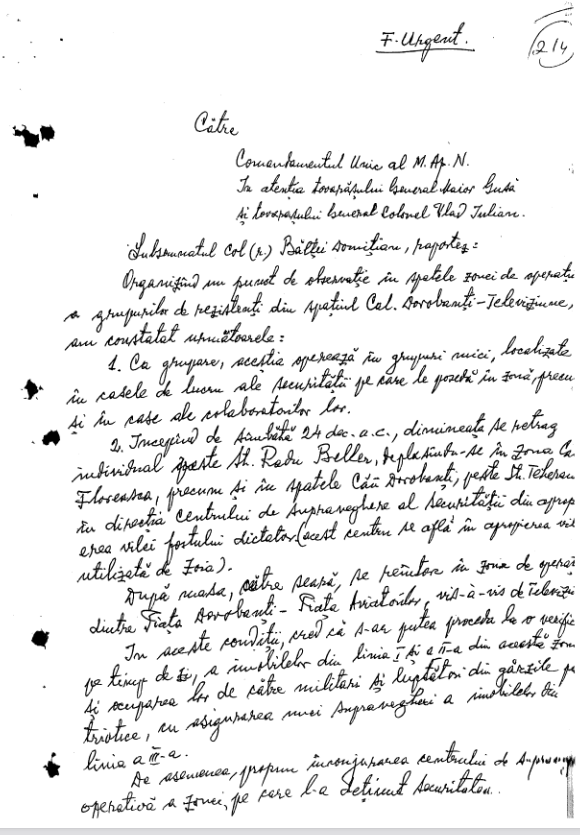
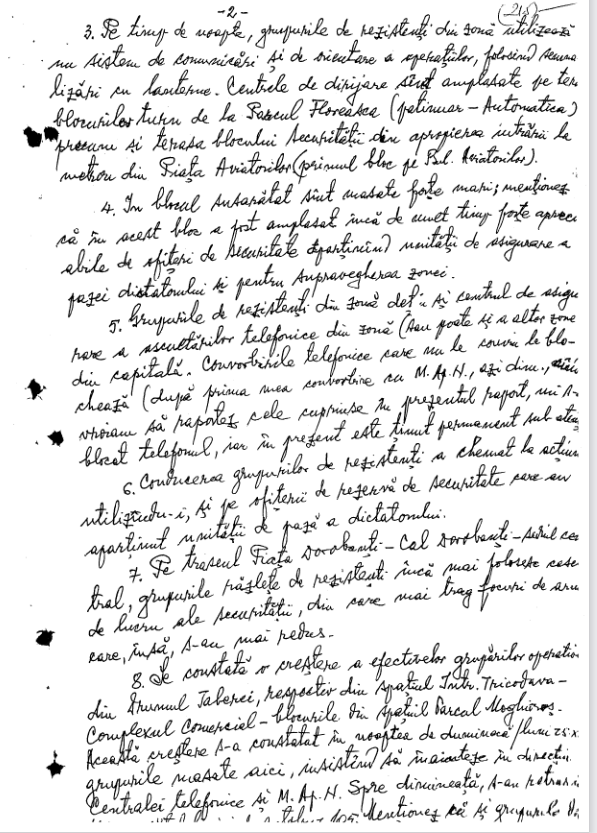
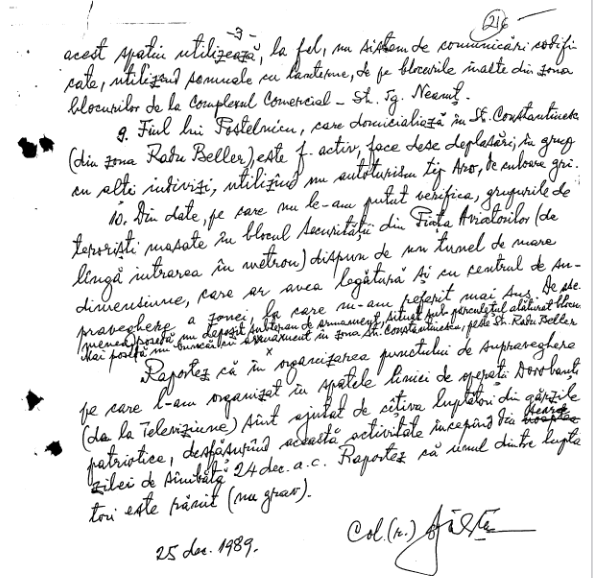
Andrei also attached a handwritten message of retired Securitate (DIE, foreign intelligence directorate) Colonel Domitian Baltei dated 25 December 1989 and directed to Securitate General Iulian Vlad and Army General Stefan Guse, with the heading “F(oarte) Urgent,” or in other words Very Urgent. Here I will unpack the significance of this letter. Keep in mind here, this yet again is another devastating blow to the military prosecutors involved in the Revolution File, because this document comes directly from the Revolution File. They included it in there, although one wonders if they ever read it or how well they read it, or if they did anything to follow up on the details given by Baltei. (Below a rough first cut at translating the content.)
TVR vol. 95 pp. 310-312
Page 1 (of 3)
Here, on page 1, Baltei talks about the “grupuri de rezistenti” in the area around the TVR television station (Calea Dorobanti-Televiziune). To begin with, his use of the term “rezistenti” from “rezistenta” is critical. While others were referring to those who were firing on those supporting the overthrow of Nicolae Ceausescu as “loyalists,” “counterrevolutionaries,” “Securitate loyal to Ceausescu,” or “(Securitate) terrorists,” Baltei calls them resisters. That is critical because as we have discussed in our book–Trăgători și mistificatori. Contrarevoluția Securității în decembrie 1989 (Polirom, 2019)–those firing were not doing something ad hoc and unplanned, but were following a plan, specifically the long planned “lupta de rezistenta” of “resistance war.” As a retired Securitate officer, Baltei was signalling already his background knowledge and prior/current access to classified information.
In pt. 1, Baltei, says that as a group they operate in “small numbers” from the Securitate safehouses and the houses of Securitate collaborators (so much for those, see previous posts for example, on Braila, who sought to suggest to us otherwise…)
In pt. 2, Baltei says that beginning on Sunday morning the 24th, individuals of this group were one by one withdrawing to a different zone, towards the Securitate’s surveillance center near to the vila of the “former dictator” (i.e. Nicolae Ceausescu) and to a vila used by his daughter Zoia. (so as one can see everything here is linked to the Securitate and to the Ceausescus). Later, when it is turning dark, the resisters return to the area around the Television Station (Piata Dorobantilor-Piata Aviatorilor).
Baltei advises that therefore, during the day, it would be possible to verify/inspect the first and second line dwellings in this area, and to send soldiers and members of the Patriotic Guards to occupy these places, while securing the third line of dwellings. He then goes on to suggest the need to surround the surveillance center of the Securitate in the area.
On page 2 (of 3)
In pt. 3, Baltei talks about what the “grupurile de rezistenti” do at nighttime, saying they use a system of communication and direction of their operations, involving signal lanterns. The command centers of the operations in the area are then detailed including a Securitate bloc.
In pt. 4, Baltei talks about a bloc in which there are amassed a large force, who had been placed there for a long time and belonging to the Securitate units responsible for the security and guarding of the dictator (i.e. Directia a V-a) and the surveillance of the area.
In pt. 5, Baltei says the “grupuri de rezistenti” also have at their disposal a center for surveilling telephone calls in the area (and possibly in the rest of the capital he surmises). He then says that phone calls the resistance groups don’t like are blocked, and recounts how earlier he tried to call the Defense Ministry to give the details outlined in this letter, but his phone was blocked and was permanently out of service thereafter.
In pt. 6, Baltei notes that the leadership of the resistance groups have also called into action reserve officers of the Fifth Directorate.
In pt. 7, Baltei notes that presumably, at the moment he was writing, that there were still scattered resistance fighters firing from Securitate safehouses, although the gunfire was reduced from earlier (note–it is unclear if this was after the announcement and broadcast of the video showing the execution of the Ceausescus or just the usual fall off at certain times of day).
In pt. 8, Baltei talks about the intensification of resistance activities in the Drumul Taberei region and elsewhere on the night of Sunday into Monday (24th/25th), with these groups attempting to reach the Telephone Center and the Defense Ministry, before withdrawing in the morning. He then talks about how this group is also using “semnale luminoase” to communicate with one another and specifies the tall blocs from the Complexul Comercial – Str. Tirgu Neamt zone from which they are operating (note–once again, throughout, Baltei makes very specific claims).
On page 3 (of 3)
In pt. 9, Baltei talks about the son of Interior Minister and former head of the Securitate Tudor Postelnicu as being very active from his place of residence, making lots of trips with different individuals.
In pt. 10, Baltei specifies that “from information, that I have been unable to verify” (note therefore contrasting it to the other information) the groups of terrorists (for the first time he uses, interchangeable with the resistance fighters, the term terrorists) have at their disposal in a Securitate bloc on Piata Aviatorilor (near the metro entrance), a large tunnel, that links up with the surveillance center in the area to which he previously referred. There they have an underground deposit of weapons, situated across from the little park next to the bloc. They also have bunkers with arms in the Str. Constantinescu, Str. Radu Beller area.
Baltei closes by saying that he has gathered this information as a result of an observation post he set up with the help of several members of the Patriotic Guards, beginning on the evening of Saturday 24 December (note–assume he means night of 23/24 December). He reports that one of the Patriotic Guards was wounded but not seriously.
Dated and Signed 25 December 1989
Why the Baltei message is important?
Baltei wasn’t just anyone. He was a retired Securitate officer, albeit in the foreign intelligence directorate. He had at least indirect access to plans associated with the “lupta de rezistenta” or to those who had access to them or were even involved in it. What he didn’t know he could surmise in part as having been a member of the organization and likely continuing to keep friends and acquaintances in it. What isn’t clear here is Baltei’s motivation. Was he attempting to save his own skin by providing information on his former colleagues, to use this as a bargaining chip in the new world of a new post-Ceausescu regime? Was he giving General Vlad a potential “out” or acknowledging an emerging potential “out” by seeking to pin things on Tudor Postelnicu via Postelnicu’s son? No doubt there are those who will read this, and in their seemingly bottomless denial, suggest that because the previous two suppositions were true, or because he was a former Securitate officer, Baltei was just inventing things and lying. No, he may or may not have been leaking about his former colleagues, but it is abundantly clear from the detail above (how it matches the details given by others involved in the fighting in that area), from the differentiation between what he claimed to observe and what he could not verify personally, from its almost matter of fact rather than hyperbolic tone, that Baltei knew more and could see and observe more than the average citizen, precisely because he worked for the organization responsible for the pro-Ceausescu Securitate terrorism carried out by these “grupuri de rezistenti.”
One must ask then? If this exists in the files of the Revolution, how many other things, notes, depositions, etc. must exist that discredit the ridiculous Rechizitoriu of April 2019 and that actually reveal the Securitate’s responsibility for the bulk of the post-22 December mayhem and bloodshed? Could there be more to come?
Perhaps, indeed, finally, however incrementally…the PAST IS COMING!
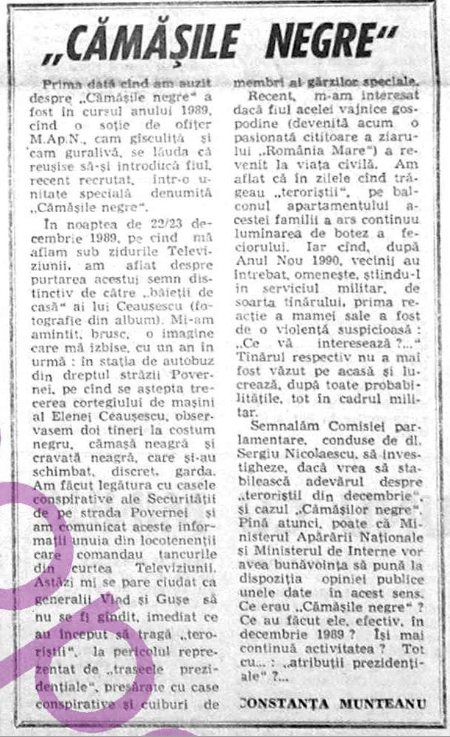
Once upon a time, in the initial post-1989 years (1990-1991 especially), even those opposed to Ion Iliescu and the National Salvation Front, still remembered from personal experience what had happened in December 1989, and could not easily forget what they had seen and heard in order to have it “fit” with the emerging partisan narratives of the Revolution….
Constanta Munteanu, “Camasile Negre,” Dreptatea , 16 iulie 1991, p. 1
“Prima data cina am auzit despre ,Camasile negre’ a fost in cursul anului 1989, cind o sotie de ofiter M.Ap.N., cam gisculita si cam guraliva, se lauda ca reusise sa-si introduca fiul recent recrutat, intr-o unitate speciala denumita ,Camasile negre.’ In noaptea de 22/23 decembrie pe cind ma aflam sub zidurile Televiziunii, am aflat despre purtarea acestui semn distinctiv de catre ,baietii de casa’ ai lui Ceausescu (fotografie din album).
Mi-am amintit, brusc, o imagine care ma izbise, cu un an in urma: in statia de autobuz din dreptul strazii Povernei, pe cind se asteapta trecerea cortegului de masini al Elenei Ceausescu, observasem doi tineri la costum negru, camasa neagra si cravata neagra care si-au schimbat, discret, garda. Am facut legatura cu casele conspirative ale Securitatii de pe strada Povernei si am comunicat aceste informatii unuia din locotenentii care comandau tancurile din curtea Televiziunii. Astazi mi se pare ciudat ca generalii Vlad si Guse sa nu se fi gindit, imediat ce au inceput sa traga ,teroristii’, la pericolul reprezentat de ,traseele prezidentiale’, presarate cu case conspirative si cuiburi de membri al garzilor speciale.“
for previous discussions of “camasile negre” (“the black shirts”) see, for example, here:
Younger scholars are always looking for their own, new, intriguing angle. I get it; who hasn’t been there before? The problem is: you have to back up your contentions with evidence. One of the latest, although it is not really that new, is to create a strawman that the Romanian military from December 1989 on claimed/claims that it “had nothing to do with the Securitate” during the communist regime, and especially the “Golden Era” of Nicolae Ceausescu. Instead, we are told, in this supposedly daring “new” argument that the Securitate and the Army worked hand-in-glove together, in tandem, sure there was a rivalry and mutual hostility, but in the end they were part of the communist regime repression, Party, Military, Securitate all together. To argue otherwise we are told is a “post 1990 construct”! Oddly, we are told that one of the pieces of evidence for this…is that senior military officials in December 1989 (Milea, Stanculescu) turn out to have been Securitate informers. (Of course, it isn’t enough to throw out the collaboration status, which is true, one has to link it directly to behavior in December 1989…and that is where such a theory fails.) But, note here, there is no discussion here of a reciprocal recruitment of Securitate officials by the military? Why is that? It is does appear to have happened, via DIA, the Army’s intelligence unit, but it was exceedingly rare. And why was it rare? Because the Securitate controlled an entire directorate, the Fourth Directorate (IV), that was charged with Military Counter-intelligence, the dreaded CI-stii who gave the Securitate substantial informational and operational control over the military. There was no counterpart, this was not a “reciprocal” relationship, and to do so is indeed the real post-1990 revisionist construct here.
There are many examples to disprove the contention of Dinamo-Steaua being little more than football match tensions! These pages here, and others on the internet, are full with examples of the woeful difference in the budget, training, equipment, munitions, conspiratorial capacity, civilian networks responsible to the institutions (informers, collaborators), and societal and political influence and capability for influence of the Securitate versus the Romanian military. Much of this was borne out in December 1989 and explains much of the mayhem and bloodshed of December 1989. Here, I will avoid those examples, however, to things which happened before 16 December 1989 and the outbreak of the revolution in Timisoara.
I will begin here with two examples: 1) the precipitous fall-off in defense attaches posted abroad as the Ceausescu era deepened and the Securitate became more institutionally powerful; and 2) the decision prior to the outbreak of demonstrations to transfer the border guards from the Ministry of Defense to the Ministry of the Interior…
In his testimony before the so-called Gabrielescu Senatorial Commission investigating December 1989, the head of DIA in December 1989, Rear Admiral Stefan Dinu stated in January 1994 that on paper the Romanian military had 31 military attaches abroad to cover 50 countries; in reality, by December 1989, it had only four, in Budapesta, Belgrada, Paris, si Roma![1] According to Dinu,
Deci, aveam o sectie a atasatilor militari romani in strainatate. Pe stat erau 31 de atasati militari pentru acoperirea a 50 de tari, dar de fapt aveam patru in decembrie. Pentru ca, treptat-treptat, datorita poate adversitatii serviciilor de informatii DSS, nu avea interes sa mai existe alaturi de ei, undeva, independent, vreun serviciu de informatii. Aveau intotdeauna obsesia ca nu se lucra corect in aceste servicii—vorbesc de cele externe, ca in tara noi nu aveam nimic—, ofiterilor sub acoperire li se gaseau tot felul de sicane ca sa fie retrasi. Ii retragem si altii nu s-a mai numit. Deci eu va declar aici cu toata raspunderea ca din martie 1979 nu s-a mai numit nici un atasat militar in exterior.
Cu exceptia astora patru care erau foarte in varsta si bolnavi. Veneau si stateau in tara cate 3-4 luni la refacere si nu puteam sa numim altii.
Acestia erau la Budapesta, Belgrad, Paris, Roma.[2]
[1] Serban Sandulescu, Lovitura de Stat a Confiscat Revolutia Romana (Bucharest: Omega, 1996), pp. 211-212
[2] Serban Sandulescu, Lovitura de Stat a Confiscat Revolutia Romana (Bucharest: Omega, 1996), pp. 211-212
It is noteworthy that the total breakdown in relations and trust and mutual collaboration between the military and the Securitate has been confirmed through the years by BOTH military and Securitate sources, because it was such a blatant fact of life. Were this some kind of equal relationship, do we really think that the Romanian military would have been denied its own means for collecting information abroad to communicate back home? Moreover, the Securitate’s efforts to reduce alternative sources of information to Nicolae Ceausescu was mirrored by the Securitate’s gradual elimination of the Communist Party itself as an avenue for information (Cornel Burtica and none other than Nicu Ceausescu spoke about this). The Securitate wanted to be and emerged as the single gatekeeper for information flowing to Nicolae and Elena Ceausescu by the end of their reign.
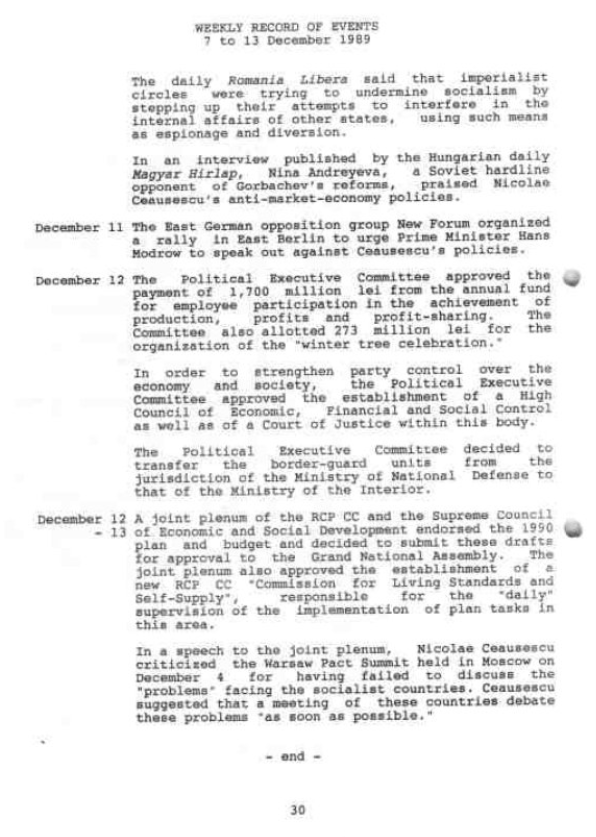
When push came to shove, when things got hot, and the regime was under pressure, the Ceausescus did not ultimately trust the military–which they feared might overthrow them under the right circumstances–and did trust the Interior Ministry (the nice, formal name for the Securitate…). So, as the regime hunkered down following the fall of likeminded fellow “rejectionist” regimes in East Germany, Czechoslovakia, and Bulgaria in October and November 1989, and possibly in response to/hastened by the flight across the border of regime sports icon Nadia Comaneci in late November 1989, the Ceausescus transferred control of the border guards (graniceri) from the Ministry of National Defense to the Interior Ministry.
The Political Executive Committee [of the Romanian Communist Party] decided to transfer the border-guard units from the jurisdiction of the Ministry of National Defense to that of the Ministry of the Interior.
DECRET nr. 313 din 11 decembrie 1989privind trecerea trupelor de graniceri de la Ministerul Apărării Naţionale la Ministerul de Interne
EMITENT
CONSILIUL DE STAT
Publicat în BULETINUL OFICIAL nr. 41 din 13 decembrie 1989
Consiliul de Stat al Republicii Socialiste România decretează:Articolul 1Pe data prezentului decret trupele de graniceri trec de la Ministerul Apărării Naţionale la Ministerul de Interne.Articolul 2Orice dispoziţii contrare prevederilor prezentului decret se abroga.NICOLAE CEAUŞESCUPreşedintele Republicii Socialiste RomâniaBucureşti, 11 decembrie 1989.Nr. 313.
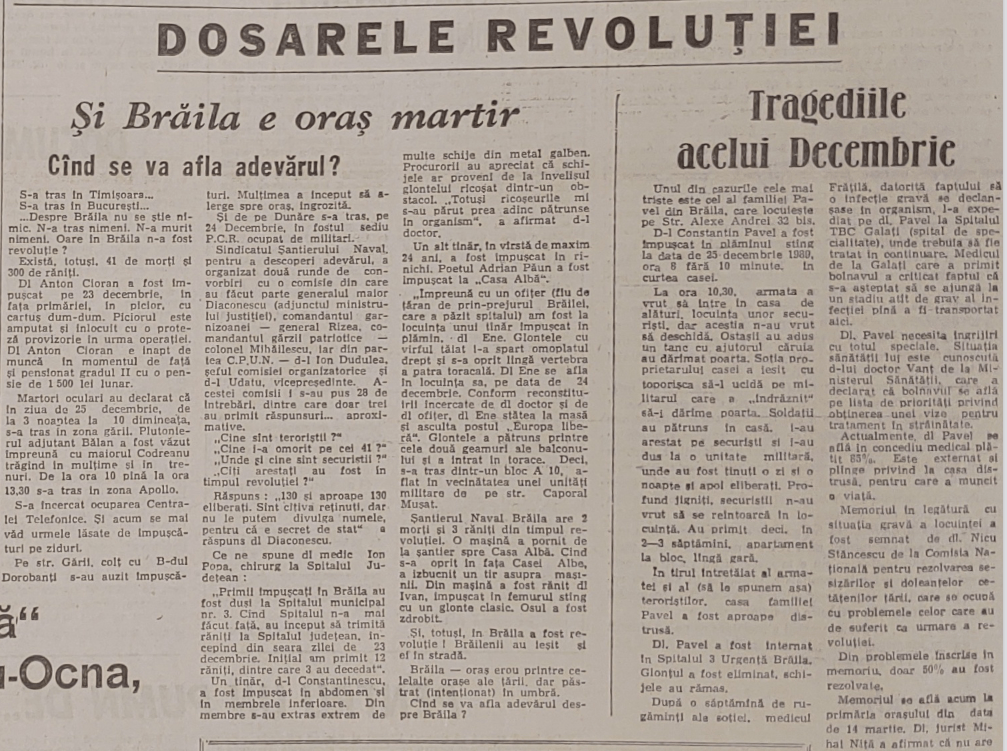
The following article from the opposition daily Dreptatea discussed two examples of people wounded by atypical munitions in Braila in the days after 22 December 1989: 1) the first (column 1) is Anton Cioran, “a fost impuscat pe 23 decembrie, in fata primariei, in picior, cu cartus dum-dum; 2) the second (column 3) dl. Ene, who was shot on 24 December 1989 in his apartment with “glontele cu virful taiat”…by someone shooting from a building in the vicinity of a military unit, “Deci, s-a tras dintr-un bloc A 10, aflat in vecinatatea unei unitatii militare de pe str. Caporal Musat.”
Certainly, we know of other cases in Braila where people were shot with dum-dum bullets or cut/notched/sharpened/pointed bullets (taiat, ascutit, crestat, vidia) of smaller/reduced caliber. For example:
Decembrie însângerat ‘89 la Brăila: Colegul lui Patzaichin a fost ucis cu gloanţe dum-dum
Costel Sărnache, de 33 de ani, sportiv de performanţă, a fost împuşcat vizavi de blocul în care locuia, în zona Palatului Administrativ.
Ucis prea devreme
“Fiul meu a fost lovit în piept de un glonte dum-dum. Mi-au confirmat medicii. Locuia împreună cu soţia şi fiica de trei ani vizavi de Romarta, deasupra Farmaciei «Iris». Sâmbătă, când a început să se tragă, a pus mâna pe un băţ şi a ieşit şi el, să vadă ce se întâmplă. Nu putea să stea, când oraşul era în clocot. A fost împuşcat la ora 21.00 şi a murit pe loc. Era un bărbat puternic, făcea sport de la vârsta de 13 ani”, povesteşte mama eroului ucis în acel decembrie însângerat, Vasilica Sărnache.
Locotenent colonel Viorel Lazar: Tot in noaptea de 23/24 decembrie a fost ucis si maiorul Milea Dumitru. Se spune ca nu s-a supus soamtiei de a cobori din autoturismul cu care venise la Consiliu fara arma. E adevarat, dar glontele n-a pornit din Consiliu, ci din directia Casei Tineretului sau de undeva de pe strada care separa Casa Tineretului de Consiliu. Am facut a doua zi, pe lumina, reconstituirea. Glontul, unul singur, a pornit dintr-o arma de profesionist, dotata probabil cu dispozitiv de ochire pe timp de noapte. A lovit drept in inima. A fost o arma de calibru mic, pentru ca orificile de intrare si iesire erau mia mici decit cele produse de armamentul obisnuit, calibrul 7,62 mm, aflat in dotarea noastra.
Marcela Pirlog: “In perioada evenimentelor din decembrie ’89 am fost asistenta instrumentist la sectia chirurgie a Spitalului de urgenta Braila. Noptile de 23/24 si 24/25 au fost de groaza. Chirugrii au lucrat aproape 24 de ore din 24, pentru salvarea ranitilor. Ceea ce m-a frapat este ca plagile aveau un aspect infiorator. Aproape de la nici un pacient n-am scos gloante intregi, ci gloante inflorite la partea de virf. La 10-15 cm de acestea, se gaseau schije din acelasi metal, care se vedeau pe ecran ca niste punctisoare cit babul de griu. Mare parte din ? proiectile ciudate le-am spalat de singe si am ? in plicuri in dulapurile noastre. Pe 27 sau 28 decembrie s-au prezentat trei persoane la spital, care le-au luat pentru cercetari.
(N.A. Dupa aprecierile specialistilor au fost gloante dum-dum folosite si in Bucuresti si in alte orase. Unele persoane ale caror nume nu le pot dezvalui deocamdata, sustin ca asemenea gen de munitii se afla in dotarea unor agenti straini. Ce ne pot spune fostele organe de contrainformatii in acest sens?)
Lt. Col. Fanica VOINEA ENE, “Braila in zilele revolutiei (6),” Libertatea (Braila), 7 noiembrie 1991, p. 1; p. 4.
Attention: at min. 3:44, article by Virgil Matei, “Sub tirul terorist”…discusses the case of Veronica Moise, who was brought to Emergency Hospital in Braila Din umar i-au scos un glonte ,dum-dum’: “Semana cu o floare, cea mai oribila floare ce am “primit-o” cadou. De aceea nici nu l-am pastrat.”
“Iata ce spune lt. maj. Ionut Voicu aflat in noaptea de 23/24 decembrie in padurea Stejaru: ‘Din nou se aud zgomotele gloantelor. Au un suierat specific, banuim ca sint de calibru redus (dimineata presupunerea s-a adeverit, am gasit gloante de calibru 5,6 mm). Nu sint flacari la gura tevii. Dei au ascunzator la gura tevii.”
Subinginer Nicu Preda: Ciudat e ca n-am gasit tuburi la fata locului, dar de pe jos, unde ricosasera gloantele, am putut aduna proiectile de o factura deosebita, calibru mic, ascutite la virf. Le-am predat procurorului militar. Lt. Col. Fanica VOINEA ENE, “Braila in zilele revolutiei (5),” Libertatea (Braila), 5 noiembrie 1991, p. 1; p. 3.
Dr. Petru Cotoiu, Spitalul de Urgenta: Am operat in noptile de 23/24 si 24/25 dec. 1989 14 raniti prin impuscare. A fost o munca epuizanta. Asistentul meu a cazut din picioare de oboseala, pe timpul unei operatii. Dar astea au mai putina importanta. Trebuia sa ne facem datoria. Ceea ce mi s-a parut bizar este faptul ca la unii pacienti, tesuturile erau distruse pe spatii mari. In interiorul nu gaseam gloantele intrege ci… dezbracate la cap de folia exterioara. In jurul lor, la oarecare distanta, se aflau schije din acelasi invelis. Nu cred sa fi fost vorba de o farimitare mecanica la impactul glontului cu oasele sau tesuturile tare ale pacientului.
Si a a mai fost ceva, care m-a revoltat. Fostul director adjunct al Directiei Sanitare Judetene Braila, doctorul Tudorache ne-a cerut atunci sa nu consemnam in fise ca au fost plagi prin impuscare. De ce, nu-mi dau seama nici acum. Oricum n-am putut respecta aceasta…indicatie.
from Libertatea (Braila), 24 octombrie 1991
Maiorul Ionel Taralunga: Pe seara, dupa caderea intunericului s-a tras asupra comandamentului diviziei si unitatii noastre, care se afla in aceeasi curte, in special din blocurile in constructie. Aceleasi pocnete seci, care s-au auzit si in alte zone. Am adunat destule asemenea gloante pe care le-am predat procurorului militar. Erau calibrul 5.6 mm, cilindrice dintr-un metal dur de culoare alba. De altfel gaurile facute de ele in cladirile noastre se mai pastreaza inca. Sint mai mici decit cele produse de gloante de calibru 7,62 mm. S-a tras si cu munitie 7,62 mm…
Maistrul Mihai Cruceanu, de la “Laminorul”: Pe 23 seara eram in Laninorul 4. La un moment dat am auzit serii scurte de arma cu automata, de pe acoperisul laminorului. Se vad si acum urmele gloantelor in gardul unitatii si in peretii cladirilor cazarmii dinspre laminor. Pocnetele armei pareau diferite de cele ale armelor de calibru 7,62 mm. Erau seci. De altfel am adunat de pe linga gard gloante de o facatura deosebita. Ricosasera din placile de beton ale imprejmuirii unitatii. Erau din metal alb, aveau capul tronconic. Le-am masurat cu sublerul. Aveau diametrul de 5,6 milimetri.
Locotenent-colonel Dumitru Marvela: Aceleasi care s-au strins si din comandamentul diviziei si din alte obiective militare. Gloante calibru 5,6 mm….Cred ca scopul atacului n-a fost de a cuceri acest obiectiv ci de a provoca, a stinjeni aprovizionarea cu munitie a unitatilor miltare, a produce panica. Altfel actionau cu forte mai serioase. N-au fost decit mai multi, 4-5 persoane. Nici ranitul sau mortul n-a fost identificat.
Also, as we saw in the last post here, even foreign doctors who performed surgery in Braila, among other towns, mentioned that the Securitate “terrorists” shot with dum-dum bullets. Dr. Manuel Burzaco (El Pais, 5 January 1990), Mujeres y niños muertos o gravemente heridos por los disparos efectuados por la Securitate con balas dum-dum, que explosionan al hacer impacto en el cuerpo, eran el testimonio mudo de la época del dictador.
And who told us all this at the time, and in the weeks immediately after; whose comments confirmed what we find elsewhere told by doctors and nurses and patients and family members and soldiers and officers, but senior military men in Braila? And they were clear, those who used these atypical and highly destructive munitions were exclusively, the Securitate.
Foto: (c) Ecaterina Ignat/AGERPRES (nota: din nenorocire, numai acest foto exista din/despre articolul acesta important din Libertatea (Braila), 23 ianuarie 1990)
“Sint acele elemente fantatice, asasine, slugile dictatorului. Braila, prin cele doua nave prezidentiale bine inarmate, aflate la Dunare, a facut parte dintr-o varianate de scoatere din tara a celor doi dictatori. Au fost atacate cazarmile din cartierul Viziru, sediul fostului Comitet judetean al PCR si alte obiective. A atacat o formatie de 5-6 elicoptere mici in care erau amplasate comandouri de 5-6 [nota: sic] persoane.
Elicopterele erau dotate cu armament usor de bord-mitraliere de calibru 7,62 mm si tunuri de 38 mm. Ei cunosteau foarte bine dispozitivele noastre. Uluitor este faptul ca erau dirijate prin radio, de la sol. Erau bine infiltrati in sistemele noastre telefonice de ascultare. Detinem un intreg caiet de dezinformari; ei au paralizat la un moment dat toate sistemele noastre de legaturi teritoriale, au inregistrate voci prin care o alta persoana se putea subtitui mie sau altor ofiteri. Iata si un exemplu in acest sens: La comandament am primit telefon de la Ianca, in care mi se comunica ca aerodromul militar de acolo a fost ocupat de o unitate de parasutisti. Ni se crea ajutor. Am utilizat pentru control un telefon secret de care domnii securisti nu mai stiau. Asa le-am dejucat planul, aflind ca totul era diversiune.”
La intrebarea cine a tras in Braila, d-nul gen. Rizea spune “Elemente teroriste ale securitatii.”…
Rep. (Libertatea Braila): A descoperit armat ascunzatori de arme?
Gen.: Desigur, in cimitirul Sf. Constantin si in port.
Rep.: Au existat oameni care sa fie surprinsi in actiuni teroriste?
Gen.: Da. Au tras din cele mai diverse locuri utilizind si casele conspirative.
Rep.: Cite case conspirative a gasit armata?
Gen.: Destule. Multe nelocuite, dar dotate ultramodern, cu rezerve de hrana, cu munitii si posibilitati de tragere perfecte. Retineti ca au folosit si cartuse explozive de tip dum-dum. Pentru stergerea urmelor au folosit captatoare de tuburi. Au dispus de arme ultramoderne, inclusiv de lunete cu raze infrarosii, de arme cu teava-lisa, imitatoare de zgomot. Au dispus de slupe proprii, de barci pneumatice, dotate cu motoare de tip “Johnson”.
Rep.: D-le general, credeti ca au existat in Braila alte forte paralele, neincluse pe statele de plata oficiale?
Gen.: Eu, personal, cred ca da. Securitatea a distribuit arme unor elemente declasate, unor tigani care au tras din cimitirul Sf. Constantin. Aici am gasit un mini-depozit de arme si curios, unele de fabricatie artizanala. Avem indicii ca indivizii au fost platiti cu importante sume de bani necontabiliati.”…
Gen.: Elementele teroriste au folosit uniforme si grade militare pentru a semana confuzie, pentru a introduce panica si deruta. Una dintre cele mai edificatoare dovezi e harta cu interceptarile convorbirilor radio, detinuta de o unitate speciala de-a noastra. S-a emis din mai multe puncte. Avem o banda de cinci file, reprezentind convorbirile codificate pe care-le au avut. Au mai fost descifrate trei sferturi din acestea. Mai este de identificat o singura persoana.”









%20Ecaterina%20IgnatAGERPRES.JPG)
 Roland O. Thomasson, PHD