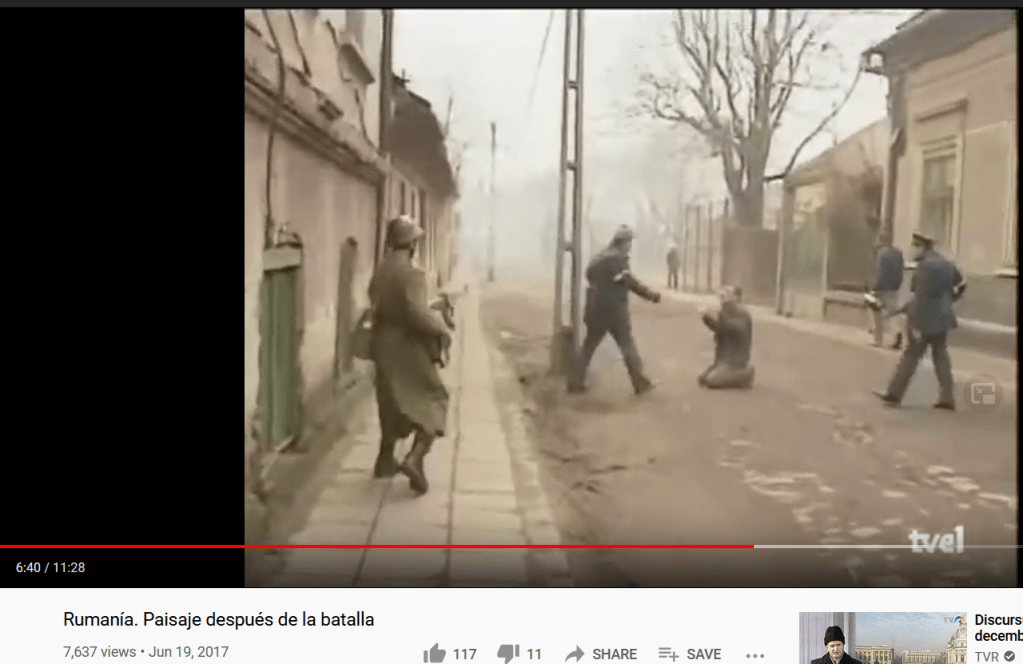
(Video 1989, TVEL) Rumanía. Paisaje después de la batalla


https://www.youtube.com/watch?v=9aoIfVPPeM4

7,653 views•Jun 19, 2017

Más que crónicas 30.7K subscribers Primeros días en Rumanía tras el derrocamiento de la dictadura de Ceucescu. El país empezaba a superar el miedo y la violencia, y se enfrentaba a una situación nueva. Imagen de Jesús Mata; producción de Ricardo R. Iznaola; guión de Vicente Romero.

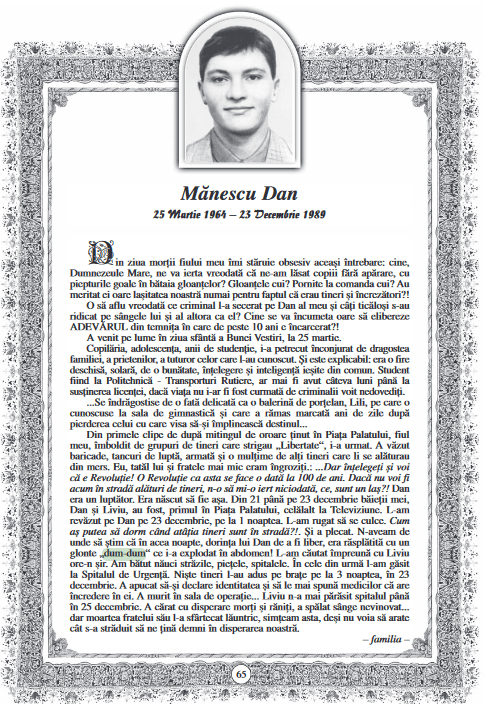
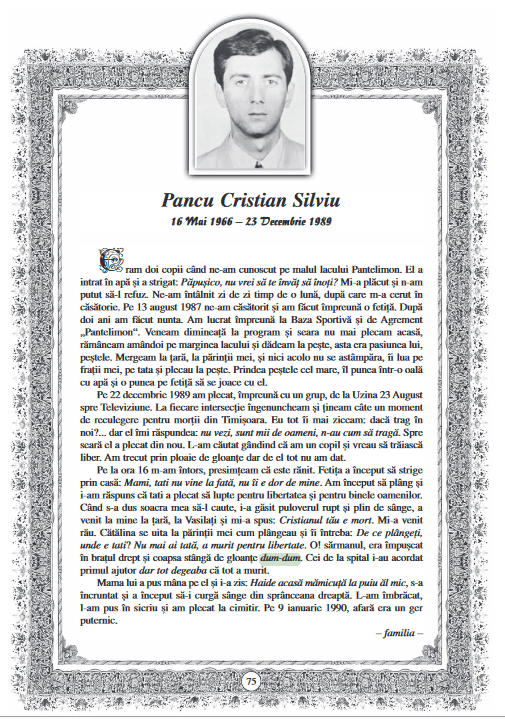
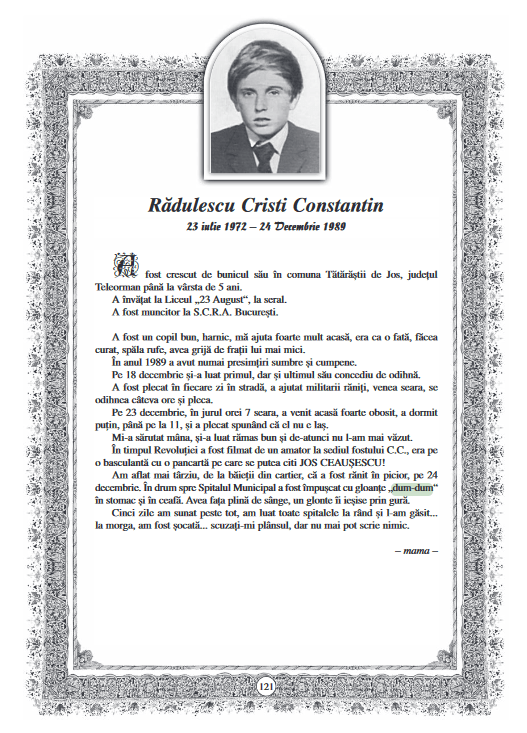
approx. minute 4:46, “gloante aceste”…”these bullets”…likely of smaller caliber…those with which civilians and military personnel were shot by the supposedly non-existent “terrorists”…based on earlier part of video, a hospital in Timisoara


approx. min. 5:01, nurses at a hospital in Timisoara…narrator talks about patients having been shot by “explosive bullets, dum-dum bullets”

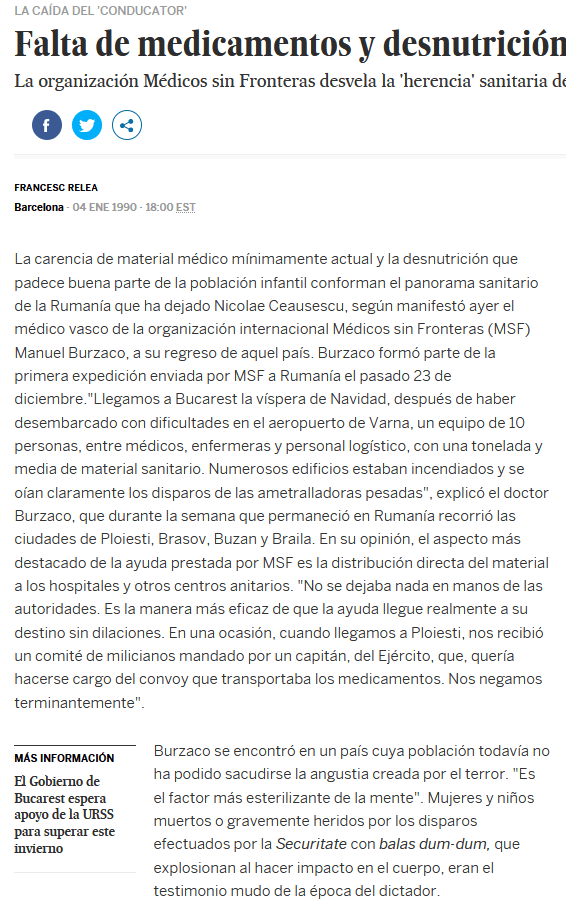
A Spanish doctor, Dr. Manuel Burzaco, from Doctors without Borders reported operating on patients, including infants, struck by dum-dum bullets, shot by the Securitate, here:

https://elpais.com/diario/1990/01/05/internacional/631494020_850215.html

LA CAÍDA DEL ‘CONDUCATOR’

Falta de medicamentos y desnutrición infantil

La organización Médicos sin Fronteras desvela la ‘herencia’ sanitaria de Ceaucescu

Francesc ReleaBarcelona – 04 ene 1990 – 18:00 EST

La carencia de material médico mínimamente actual y la desnutrición que padece buena parte de la población infantil conforman el panorama sanitario de la Rumanía que ha dejado Nicolae Ceausescu, según manifestó ayer el médico vasco de la organización internacional Médicos sin Fronteras (MSF) Manuel Burzaco, a su regreso de aquel país. Burzaco formó parte de la primera expedición enviada por MSF a Rumanía el pasado 23 de diciembre.”Llegamos a Bucarest la víspera de Navidad, después de haber desembarcado con dificultades en el aeropuerto de Varna, un equipo de 10 personas, entre médicos, enfermeras y personal logístico, con una tonelada y media de material sanitario. Numerosos edificios estaban incendiados y se oían claramente los disparos de las ametralladoras pesadas”, explicó el doctor Burzaco, que durante la semana que permaneció en Rumanía recorrió las ciudades de Ploiesti, Brasov, Buzan [sic. Buzau] y Braila. En su opinión, el aspecto más destacado de la ayuda prestada por MSF es la distribución directa del material a los hospitales y otros centros anitarios. “No se dejaba nada en manos de las autoridades. Es la manera más eficaz de que la ayuda llegue realmente a su destino sin dilaciones. En una ocasión, cuando llegamos a Ploiesti, nos recibió un comité de milicianos mandado por un capitán, del Ejército, que, quería hacerse cargo del convoy que transportaba los medicamentos. Nos negamos terminantemente”.

Más información

Burzaco se encontró en un país cuya población todavía no ha podido sacudirse la angustia creada por el terror. “Es el factor más esterilizante de la mente”. Mujeres y niños muertos o gravemente heridos por los disparos efectuados por la Securitate con balas dum-dum, que explosionan al hacer impacto en el cuerpo, eran el testimonio mudo de la época del dictador.ADVERTISING

Como contrapunto a la herencia dejada por Ceaucescu, las nuevas autoridades rumanas muestran una absoluta permeabilidad a la ayuda humanitaria internacional. “La gestión de los nuevos consejos revolucionarios es fenomenal y sumamente eficaz. Es gente variopinta, muy culta y tremendamente receptiva”. “Los hospitales”, explica el doctor Burzaco, “son muy antiguos, y están ahogados por la falta de medios. Necesitan nuevas especialidades como la cirugía plástica, la cirugía endoscópica o la pediatría para hacer frente a la desnutrición infantil. Carecen de alta tecnología. Sin embargo, cuentan con una calidad asistencial fuera de lo común. Son unos grandes artesanos”.

Parte de los equipos directivos de los centros sanitarios mantienen en su comportamiento cierta inercía del viejo régimen. Después de la revolución, muchos de los antiguos responsables sanitarios siguen en sus cargos, “ahora rechazan totalmente el régimen anterior”. Hasta ahora, ni el Consejo del Frente de Salvación Nacional ni el Ejército han intervenido en el nombramiento de nuevos cargos sanitarios. “Es el propio personal médico quien elige a sus dirigentes”.

El presidente de Médicos sin Fronteras-España, Josep Vargas, manifestó por su parte que después de las matanzas de Timisoara, la organización decidió actuar en Rumania a partir de su Unidad Europea de Intervención, constituida por Francia, Bélgica, Holanda, Suiza, Luxemburgo y España. La Comisión de las Comunidad Europea entregó dos millones de ECUs, y en los seis países se están recogiendo fondos particulares.

A terrorist suspect, captured somewhere in Timisoara or environs:
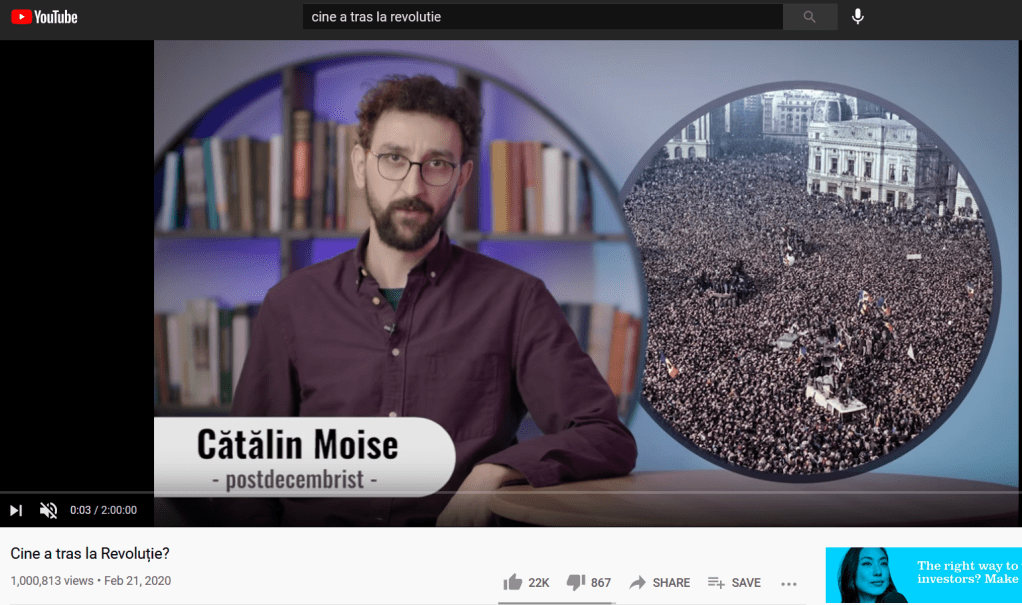
Cine a tras la Revoluție? Video Passes 1 Million Hits. Congratulations and Thank You to Catalin Moise!

As of this morning, the video compiled about our book , Andrei Ursu , Roland O. Thomasson , Mădălin Hodor (Prefață de Dennis Deletant), Trăgători și mistificatori. Contrarevoluția Securității în decembrie 1989 (Polirom, 2019), had received ONE MILLION views on Youtube.

1,000,797 views•Feb 21, 2020

Cine a tras la Revoluție?

This is in large measure a tribute to Catalin Moise (hosted by Zaiafet), who narrates the video, and the tireless efforts of my co-author, Andrei Ursu. It is hard to imagine a documentary video of this sort on a historical topic getting one million views in a little over 13 months but they have done it. Thank you so much to those who have stopped to view the video and comment or express their opinion on the site.

https://www.youtube.com/watch?v=qK_xPf532bw

Iliescu, IRRD, CCR, si Dosarul Revolutiei

There are valid reasons as my co-author Andrei Ursu argued this week for declaring that Institutul Revoluției Române din Decembrie 1989 has failed in its stated mission:

https://www.b1.ro/stiri/eveniment/exclusiv-ion-iliescu-acuzat-de-musamalizarea-evenimentelor-din-decembrie-1989-de-asociatiile-revolutionarilor-cine-a-tras-la-revolutie-andrei-ursu-erau-putini-dar-foarte-bine-antrenati-363415.html

What is not valid, however, is the invocation of the fundamentally flawed Rechizitoriu from April 2019 drawn up by the military prosecutors, that appeared both in the original OUG (thanks to C.A. for posting on FB)

and in the communique issued by Societatea Timisoara:

”Societatea Timișoara își exprimă revolta și dezgustul față de modul în care Curtea Constituțională sfidează ordinea de drept din România. Această instituție batjocorește memoria victimelor Revoluției din 1989, a celor căzuți după 22 decembrie, uciși în urma diversiunii menite să îl mențină la putere pe chiar președintele acestui institut, cu complicitatea întregii structuri care îl girează”, arată Societatea Timișoara într-un comunicat de presă.

https://romania.europalibera.org/a/societatea-timi%C8%99oara-institutul-revolu%C8%9Biei-rom%C3%A2ne-va-disp%C4%83rea-cu-siguran%C8%9B%C4%83-a%C8%99a-este-moral-/31170531.html

I encourage those who are interested and who have not read my chapter in Trăgători și mistificatori. Contrarevoluția Securității în decembrie 1989 to read it to find out just how bad the Indictment is.

below an excerpt and link to read an earlier English language version of the chapter

How the Securitate Won the War for the History of December 1989: 

A Detailed, Sourced Analysis of the SPM Rechizitoriu in the Dosarul Revolutiei of 5 April 2019

–The Securitate lost the battle to save the communist regime of dictator Nicolae Ceausescu in December 1989…but they won the war for how December 1989 is remembered.  

Nothing is better or more bitter proof of this claim than the subject of this chapter:  the 501-page Indictment in the Revolution File of 5 April 2019 drawn up by military prosecutors.[1] The Indictment charges long time communist party apparatchik and former President of Romania Ion Iliescu (1990-1996; 2000-2004) and others, including former Deputy Prime Minister Gelu Voican Voiculescu (1990-1991), with “crimes against humanity” for, according to the Indictment, the “862 deaths and 2,150 injuries” (p. 456) that occurred after Nicolae and Elena Ceausescu fled Bucharest by helicopter at midday on 22 December 1989. These officials and high-ranking military officers are accused of creating a “terrorist diversion” against non-existent Ceausescu loyalists during the period 22-31 December 1989 in order to legitimize their seizure of power and cover up the military’s role in the bloodshed that preceded Ceausescu’s ouster on 22 December 1989, the period of 16-22 December 1989. Nestor Ratesh once referred to this narrative as the “operetta war” theory[2]; it could also be termed “regime change” by “false flag” or “diversionary war”[3] theory, for it claims not as that theory does that powerholders go to war to divert attention from other issues, but that the first act of those who seized power, the act that brought them to power, was the creation of a diversionary war, in this case a false one.

The claim that the details and arguments of the former Securitate permeate and even inspire the Indictment in the Revolution File may strike some readers as outlandish. Afterall, haven’t the announcements of the Military Prosecutorial Section (SPM) been well received by domestic and international media since the file was reopened in late 2016? Has the work of the SPM in the Revolution File not been praised by Romania’s liberal, anti-communist, pro-West intelligentsia at home and abroad? Has it not been welcomed by the head of the most visible association of revolutionaries, the 21 December Association? Indeed, all of these are true, the work of the SPM has been praised and defended by Gabriel Liiceanu and Horia Roman-Patapievici, and no less than the Chair of the Presidential Commission to Analyze the Communist Dictatorship in Romania, Professor Vladimir Tismaneanu, whose Final Report was the basis for President Traian Basescu’s condemnation of the communist regime and the Securitate as “illegitimate and criminal” on 18 December 2006, considers that Ion Iliescu and the others are finally receiving real justice.[4]

Broad, Overarching Conclusions

Before we begin to break down the Rechizitoriu in detail, a few broader, overarching observations and interpretations are in order.  Some of these themes will be further developed in the detailed breakdown which follows; others will not.

  • In broad terms, who does the Rechizitoriu say are the guilty and the victims of the post 22 December 1989 mayhem and violence:

Guilty:

  1. MApN senior officers (including GRU/KGB recruited agents)
  2. PCR senior officials (including KGB/GRU recruited agents)
  3. Media (TVR, former PCR-State press)
  4. C.A.A.T. (Comandamentul Apărării Antiaeriene a Teritoriului, for the diversiune radio-electronica)
  5. DIA (strongly suggested—they had the simulators; they had the lupta de rezistenta training,;their people were accused of pointing the finger at the Securitate (ex. Teodor Stepan, Resita)

Victims:

  • the entire Romanian population and international opinion
  • military rank and file (they didn’t know about the diversion)
  • suspected Arabs and other foreigners (arrested based on disinformation and preducial suspicion)
  • the Securitate (and to a lesser extent the Militie)
  • Stefan Gusa (with the exception of his listing for his role in the Timisoara repression, he is upheld as a hero having opposed Iliescu et al. and the Russians; this is in stark contrast to the treatment of Militaru)

a) The SECURITATE–the secret police of the communist regime of dictator Nicolae Ceausescu–is mentioned only in passing, in the context of having, along with all other armed state and party institutions, (allegedly) put themselves (in their totality) at the disposition of the CFSN and its leadership (in particular, Ion Iliescu) as of 4 pm on 22 December 1989.  NICOLAE CEAUSESCU AND ELENA CEAUSESCU are mentioned only in the context of witless victims, as the target of the dastardly diversion, as victims of a simulated criminal trial, sentencing, and execution.

b) The alleged diversion is attributed to the “Supreme Military Council” subordinated to the CFSN.  Only two military officials of the Supreme Military Council are mentioned, both Army Generals, Victor Atanasie Stanculescu (active duty) and Nicolae Militaru (in the reserves at the time). (Whereas Army Generals Stanculescu and Militaru are alleged to have participated in the alleged diversion, there is no mention of Major Mihai CHITAC, but especially there is no mention of Army General Stefan GUSA.)  Ion Iliescu, Gelu Voican Voiculescu, Iosif Rus, and Emil Dumitrescu–the latter two air force and navy respectively–are said to have participated directly in carrying out the diversion and disinformation!  NO SECURITATE OFFICIALS ARE MENTIONED IN CONNECTION WITH THE ALLEGED DIVERSION!

c) SECURITATE Generals Iulian VLAD, Gianu BUCURESCU, Aristotel STAMATOIU, and Gheorge VASILE, all four of whom were arrested at the time in late December 1989 for their alleged role in the bloodshed, are NOT mentioned, suggesting that they had no role in the alleged diversion and were therefore unjustly arrested.  (Moreover, since it is maintained that the terrorists were an invention, a fiction created by the so-called diversion, that means by definition there were no Securitate terrorists, that no Securitate were intentionally responsible for direct bloodshed after 22 December 1989.)

  • Extended sections dealing with the “terrorists” and arrested foreigners are taken verbatim from „Sinteza aspectelor rezultate din anchetele efectuate de parchetele militare în perioada 1990 – 1994, în cauzele privind evenimentele din decembrie 1989” (See, for example, pp. 184-210; p. 438 ff. pp. 447-450.) released under prosecutors Samoila Joarza and Mihai Popa Ulupiu Cherecheanu et al. in December 1994, when Romania was de facto ruled by PDSR-PUNR-PSM-PRM-PDAR, a coalition which would formalized the following spring. 
  • The number of citations from former Securitate sources is large:  including Aurel Rogojan, Vasile Lupu, etc. and from pillars of the Ceausescu regime, such as Constantin Olteanu.  Even the “Soviet tourists”—a favorite theme of the former Securitate—appear in the testimonies of Vasile Lupu and Ion Mateescu (razboiul radio-electronic, p. 347)
  • Many testimonies were only recently taken, in the past few years (2017, 2018).  Testimonies from immediately after the events, or even in the initial years after the events, when those events would have been fresher in the minds of those testifying, are rare.  This increases the scope for so-called “recovered memories,” of witnesses forgetting, misremembering, confusing details, dates, and actors, of reinterpreting events through the political prism and personal and ideological feuds of the intervening years (decades!), of unintentionally mixing what they have heard or read elsewhere—especially from written histories and films—into their own accounts.
  • Our 2018 NRDO study is dealt with superficially, quickly, and unseriously (pp. 300-304).  The author of the Revista Securitatea article (1989) on lupta de rezistenta is interviewed, but says it was just theory, and the Molan case is dismissed because he had an army weapon and did not act like a professional.  This was at best a perfunctory, last minute effort to address evidence that they would had ignored and would prefer to ignore.
  • Whether it is investigating lupta de rezistenta, or simulators, or razboiul radio-electronic, the Rechizitoriu concludes the source was internal but then look through anyone but the Securitate, focusing mainly on DIA, CAAT, etc, as the culprits.  Two classic examples are allowing the author of the article in revista Securitatea to dispel the idea that his article had any basis in real plans (they accept this at face value), and citing Ioan Rusan UM 0110 (pp. 130-131) as the source to say that those who were on the Rombac to Sibiu on the evening of the 20th were Buzau 404 DIA!
  • This is NOT the Timisoara variant that underpinned much of previous military prosecutor Dan Voinea’s argument, and that, not surprisingly, is vigorously maintained and promoted by many Timisoara revolutionary participants.  That variant suggests that the Army leadership who participated in the Timisoara repression—in particular, Gusa, Stanculescu, and Chitac—was the engine of the alleged post- 22 December diversion of invented terrorists because they needed to cover up their bloody role in Timisoara and buy themselves amnesty from the new political leadership.  In this scenario, Ion Iliescu and the Front leadership were secondary, being brought into the Army diversion and acceding to it, rather than organizing and driving the diversion—the military prosecutors’ current argument.  The argument in the Rechizitoriu essentially turns the Timisoara variant on its head, suggesting that those military officers involved in the Timisoara repression glommed onto and were integrated into the pre-existing filosoviet conspiracy around Ion Iliescu and the core of the future CFSN. The Rechizitoriu’s argument is very much a “Bucharest” and partisan, post 22 December political argument; it is thus little wonder that it is eagerly and uncritically consumed by Romania’s Bucharest-dominated anti-communist/anti-Iliescu intelligentsia, among others.
  • Whose argument does the Rechizitoriu’s most closely resemble?  To some extent, this is reheated leftovers from 1996 and the majority opinion of the Sandulescu-Gabrielescu PNTCD version of the Senatorial Commission investigating December 1989 (whose Report, it not surpisingly quotes extensively from).  It includes strong currents of anti-communist, anti-Soviet/anti-Russia (Soviet/Russia discussion is heavy throughout, not just for Romania but allegedly for the collapse of communism in the whole region in 1989; see the introduction, and approximately pp. 392-437, with its focus on filosovietism), a sort of ideological, non-patriotarda/xenophobic nationalism.
  • Just as in 1996, it overlaps ca din minune with the writings of the former Securitate—less Pavel Corut than another former IV Directorate CI officer, Valentin Raiha.  The suggestion that DIA, but definitely NOT the Securitate bear a role for the post-22 violence and mayhem has a long history, from the likes of Gheorghe Ratiu, Nicolae Plesita, and many others.  In fact, the strong anti-Soviet/anti-Russian component of the Rechizitoriu and the arguments and evidence presented most strongly resembles the more “national security” focused (to the extent we can say that at all, since they were clearly also politically and ideologically focused) elements of the former Securitate:  Directorate IV Military Counter Intelligence and DSS UM 0110, the unit charged with countering espionage from fellow “fraternal” socialist countries, such as the Soviet Union and Hungary.

[1] The full, “non-anonimizat” version of the Rechizitoriu was posted online on 19 July 2019 ( https://www.b1.ro/stiri/eveniment/exclusiv-b1-ro-prezinta-integral-rechizitoriul-revolutiei-romane-episodul-1-dovada-implicarii-rusiei-in-evenimentele-din-decembrie-1989-filosovietismul-lui-iliescu-si-acolitilor-sai-286156.html) and can be accessed here:  I – paginile 1-125 ; II – paginile 126-250 ; III- paginile 251-375 ; IV- paginile 376-501.

[2] Nestor Ratesh, Romania:  The Entangled Revolution, (New York:  Praeger, 1991), pp. 61-62.

[3] For an overview, see https://en.wikipedia.org/wiki/Diversionary_foreign_policy.

[4] https://www.marginaliaetc.ro/gabriel-liiceanu-petre-roman-si-teodor-brates-ii-invata-pe-studenti-etica-la-universitatea-din-bucuresti/; https://adevarul.ro/cultura/carti/interviu-horia-roman-patapievici-scriitor-daca-alegerile-vor-confirmaformula-guvernare-psd-alde-ideea-romania-duce-culcare-1_5ce7d5fd445219c57efeb3a9/index.html; https://adevarul.ro/news/eveniment/teodor-maries-asociatia-21-decembrie-1989-despre-inculparile-dosarul-revolutiei-sunt-criminali-murit-900-oameni-mii-fost-raniti-1_5c1cbf6cdf52022f75bb6ab3/index.html;  https://putereaacincea.ro/post-comunismul-paria-al-lui-ion-iliescu/ ;  Vladimir Tismaneanu, “1989 and After: Morality and Truth in Post Communist Societies,” Current History, March 2019, pp. 114-116 athttp://www.currenthistory.com/Tismaneanu-CH2019.pdf.

for further reading, see the below:


https://www.academia.edu/43052683/How_the_Securitate_Won_the_War_for_the_History_of_December_1989_A_Detailed_Sourced_Analysis_of_the_SPM_Rechizitoriu_in_the_Dosarul_Revolutiei_of_5_April_2019_Initial_Draft_for_volume_Tragatori_si_Mistificatori_

(Video) Trei Zile Pana la Craciun (2012): Somebody’s missing from this story…

I watched about the first half of this movie without looking up any background on it…so, in other words, watching it “cold.” One thing emerged in the first half hour, however. Where were the Securitate? Where was a discussion of the Securitate? No, instead, we are told that Nicolae Ceausescu was interested in going to Pitesti because the army was stronger there…or to Voinesti…or he wanted to speak to the army in Bucuresti…or a clip with Army officer Ion Tecu saying they went to “Plantelor” because there was a nearby forest where the army had reserves…

The problem is, this just doesn’t jibe with what else we know.

Militian Constantin Paisie, who is portrayed for an extended period in this first part of the film, was clear in 2004: Nicolae Ceausescu did not depend on the Army or the Militia for any immediate help…he only had faith in the Securitate, and specifically wanted to be taken to a Securitate unit at Baneasa.

Stiu ca la un moment dat, Nicolae Ceausescu mi-a spus sa mergem la unitatea aia de Securitate, o unitate speciala la Baneasa, dar din partea Militiei sau a Armatei nu se astepta sa-i vina sprijinul imediat.

https://jurnalul.ro/campaniile-jurnalul/decembrie-89/ceausestii-au-crezut-ca-o-sa-i-salveze-cineva-71314.html

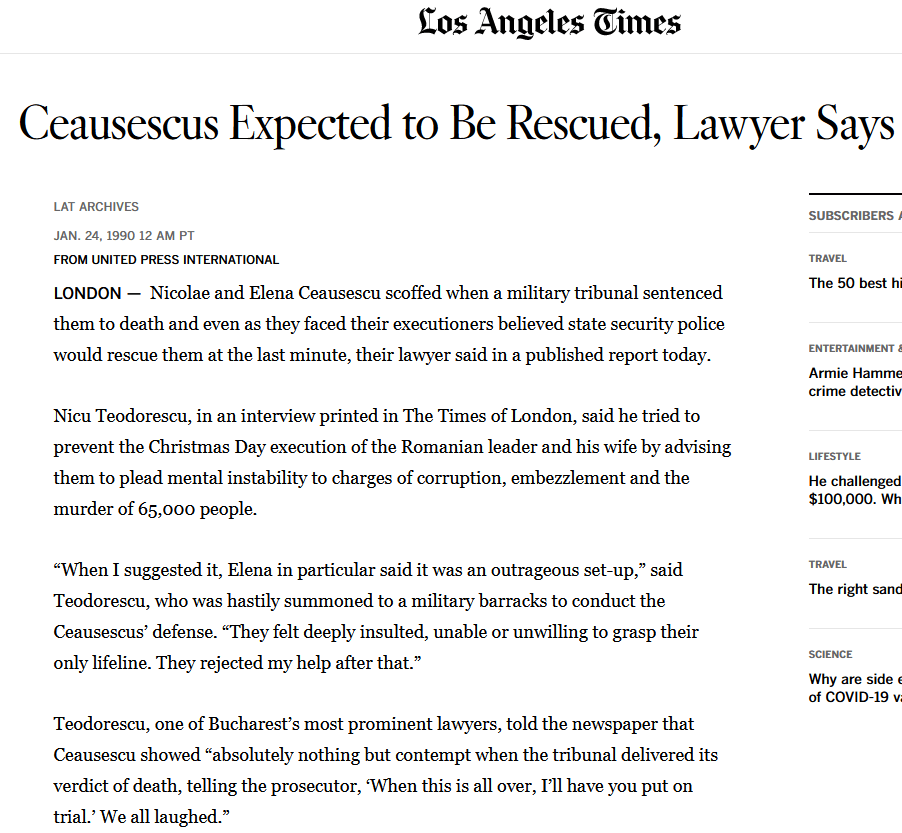
And a month after the trial and execution of the Ceausescus, the Ceausescus’ lawyer, Nicu Teodorescu, had stated:

“Ceausescu was convinced all along his Securitate would rescue him. He never thought the trial would end, and when it ended be showed absolutely nothing but contempt when death was pronounced,” Teodorescu says. https://archive.org/stream/NewsUK1990UKEnglish/Jan%2024%201990%2C%20The%20Times%2C%20%2363611%2C%20UK%20%28en%29_djvu.txt THE TIMES WEDNESDAY JANUARY 24 1990

UPI Archives Jan. 24, 1990

Lawyer: Ceausescus believed they would be rescued

LONDON — Nicolae and Elena Ceausescu scoffed when a military tribunal sentenced them to death and even as they faced their executioners believed state security police would rescue them at the last minute, their lawyer said in a published report Wednesday.

Nicu Teodorescu, in an interview printed in The Times newspaper, said he tried to prevent the Christmas Day execution of the former Romanian leader and his wife by advising them to plead mental instability to charges of corruption, embezzlement and the murder of 65,000 people.

‘When I suggested it, Elena in particular said it was an outrageous set-up,’ said Teodorescu, who was hastily summoned to a military barracks to conduct the Ceausescus’ defense. ‘They felt deeply insulted, unable or unwilling to grasp their only lifeline. They rejected my help after that.’

Teodorescu, one of Bucharest’s most prominent lawyers, told The Times that Ceausescu showed ‘absolutely nothing but contempt’ when the tribunal delivered its verdict of death, telling the prosecutor, ”When this is all over, I’ll have you put on trial.’ We all laughed.’

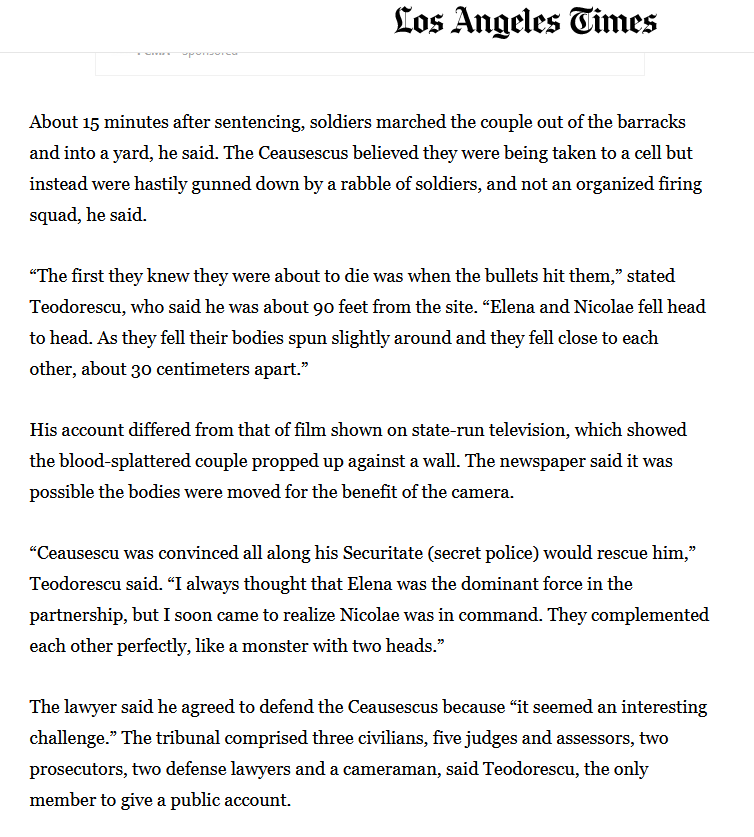
About 15 minutes after sentencing, soldiers frog-marched the couple out of the barracks and into a yard, he said. The Ceausescus believed they were being taken to a cell but instead were hastily gunned down by a rabble of soldiers, and not an organized firing squad, he said.

‘The first they knew they were about to die was when the bullets hit them,’ stated Teodorescu, who said he was about 90 feet from the site. ‘Elena and Nicolae fell head to head. As they fell their bodies spun slightly around and they fell close to each other, about 30 centimeters apart.’

His account differed from that of film shown on state-run television, which showed the blood-splattered couple propped up against a wall. The newspaper said it was possible the bodies were moved for the benefit of the camera.

‘Ceausescu was convinced all along his Securitate (secret police) would rescue him,’ Teodorescu was quoted as saying. ‘I always thought that Elena was the dominant force in the partnership, but I soon came to realize Nicolae was in command. They complemented each other perfectly, like a monster with two heads.’

The lawyer said he agreed to defend the Ceausescus because ‘it seemed an interesting challenge.’ The tribunal comprised three civilians, five judges and assessors, two prosecutors, two defense lawyers and a cameraman, reported Teodorescu, the only member to give a public account.

‘When I saw (the Ceausescus) dead, as a lawyer I didn’t feel anything at all,’ he said. ‘But as a citizen, I, like everybody, rejoiced. It was the most beautiful Christmas in my whole life.’

Teoderescu sustained a bullet wound in a firefight between soldiers and Securitate members as he returned to Bucharest, some 80 miles from the execution site. His 19-year-old son died during the revolt.

for a Romanian translation of the article, see: https://evenimentulistoric.ro/nicolae-si-elena-ceausescu-au-avut-o-singura-sansa-de-a-scapa-vii-din-unitatea-de-la-targoviste-dar-n-au-profitat-de-ea.html


and, in fact, there are the words of the Ceausescus themselves at the trial…as detailed in a previous post

Presed:  Dar la Bucuresti, in tinerii care au murit, cine a tras, peste care au trecut tanchetele Securitatii? A unei parti… [“tanchetele Securitatii, a unei parti…” this may be a reference to the ABIs of the USLA and/or a mistake/intentional mischaracterization of the concomitant participation of Army tanks in the Bucharest repression of 21/22 December 1989]

E.C. (Elena Ceausescu):  Pai, da, tero…

(N.C. (Nicolae Ceausescu) ii face semn sa taca) (Nicolae Ceausescu signals her to be quiet) [this is very revealing…clearly, Elena was stumbling into saying more than she should and Nicolae wanted to cut her off)

Presed:  Teroristi?  Teroristi?

E.C. Teroristii se spun ca sint, pe aicea vorbeau oamenii, ca sint al Securitatii…

Presed:  Teroristii sint ai Securitatii?

E.C. Asa se vorbea.

Acuz:  Si Securitatea nu era a comandamentului suprem?

https://rolandothomassonphd.home.blog/2020/04/30/the-most-accurate-available-transcript-of-the-trial-of-nicolae-and-elena-ceausescu-ii-elena-pai-da-tero/

——————————————————

It is not surprising then to find out who wrote the script and screenplay for this film

…none other than Grigore Cartianu!

–someone who has whitewashed the role of the Securitate in December 1989

https://ro.wikipedia.org/wiki/Trei_zile_p%C3%A2n%C4%83_la_Cr%C4%83ciun

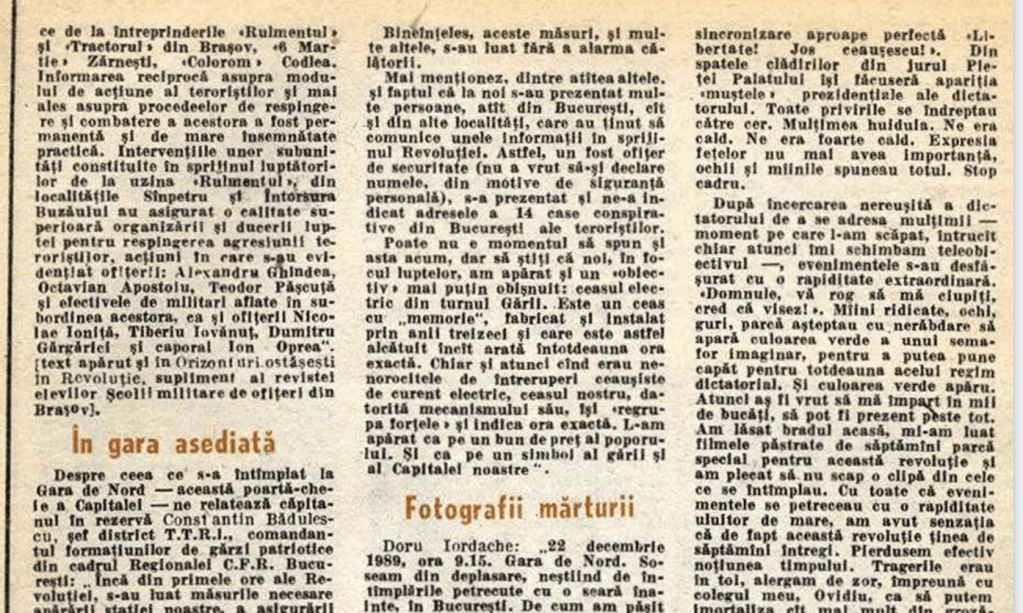
“Astfel, un fost ofiter de securitate (nu a vrut sa-si declare numele, din motive de siguranta personala) s-a prezentat si ne-a indicat adresele a 14 case conspirative din Bucuresti ale teroristilor” (Constantin Badulescu, zona Gara de Nord, “Magazin Istoric,” februarie 1990)

Here we have a case where, those fighting on the side of the Revolution against Nicolae Ceausescu, were grateful to and thanked a former Securitate officer who 1) volunteered information that he had access to by virtue of his previous employment or by being in contact with still active personnel; 2) wished to supply the helpful information, but was afraid of retribution, whatever the fate of the Revolution and thus requested anonymity (assuming the person relaying this information is being truthful); 3) that “case conspirative” or “safe houses” were being utilitzed by some of those opposing the Revolution; and 4) given that he was former Securitate (per the speaker/journalists) and refers to these as the “safe houses” of the “terrorists” in Bucharest, the “terrorists” both existed and were likely Securitate personnel.

http://www.milisoft.ro/doc/Carti%20in%20format%20digital/Colectii%20din%20Epoca%20de%20Aur/Magazin%20Istoric%20-%20arhiva%20online/199002_MI_02(275).pdf

Magazin Istoric , februarie 1990, p. 6.


This is of course in keeping with many accounts from the time and after that suggest some of the “terrorists” used and shot from “safe houses” (which hardly means all or even most “safe houses” in the Securitate’s vast network of them…)

Marian Valer, who was involved as military prosecutor in the initial stages of investigations in Sibiu (Nicu Ceausescu’s fiefdom) in the first half of 1990–before stepping down because of former Securitate/SRI non-cooperation and intimidation–spoke about a map found by the Army that detailed the Securitate safehouses around military units from which those military units were fired upon in December 1989.

In acest sens, in timpul evenimentelor din decembrie 1989 din Sibiu, armata a gasit o harta cu casele conspirative ale Securitatii din jurul unitatilor militare din municipiu, in care urmau sa fie plasate cadre de securitate care sa actioneze impotriva  acestora, in eventualitatea dezicerii armatei de regimul ceausist.  In urma investigatiilor efectuate, s-a constatat ca din asemenea case s-a actionat cu foc asupra unor unitati militare, incepind cu dupa-amiaza zilei de 22 decembrie 1989, deci dupa rasturnarea dictaturii.  S-a mai constatat ca, in general, in casele respective locuiau foste cadre de securitate sau militie, care se pensionsera sau trecusera in rezerva, sau informatori al securitatii, precum si ca, dupa inceperea manifestatiilor anticeausiste la Sibiu, la casele respective au intrat autoturisme care aveau numere de inmatriculare din alte judete, de exemplu Constanta, Iasi, Bacau. 

Monica N. Marginean, “MARIAN VALER:  Asistam la ingroparea Revolutiei,” Expres, nr. 33 (septembrie 1990), p. 2.

https://romanianrevolutionofdecember1989.com/sibiu-the-capture-disappearance-and-metamorphosis-of-terrorist-maps-i/

Lt. Col. Aurel Dragomir confirmed the existence and disappearance of this map which showed from which dwellings there was gunfire.  

Dupa evenimente au disparut niste declaratii date la comisiile de ancheta, au disparut caietele brute de inregistrare de la ofiterii de serviciu, plus o harta in care am insemnat casele de unde s-a tras .  Mortii care erau in combinezoane si aveau mai multe haine dedesubt i-am identificat:  erau cadrele ale M.I. din Sibiu (Militie si Securitate)….S-au gaist pistoale si munitii care nu sint in dotarea armatei, s-au gasit pistoale cu amortizor, care nu sint in dotarea noastra etc.”   (Aurel Dragomir cu Dan Badea, “Secretele Revolutiei,” Expres, nr. 22 ( 7-13 iunie 1994), pp. 8-9.)

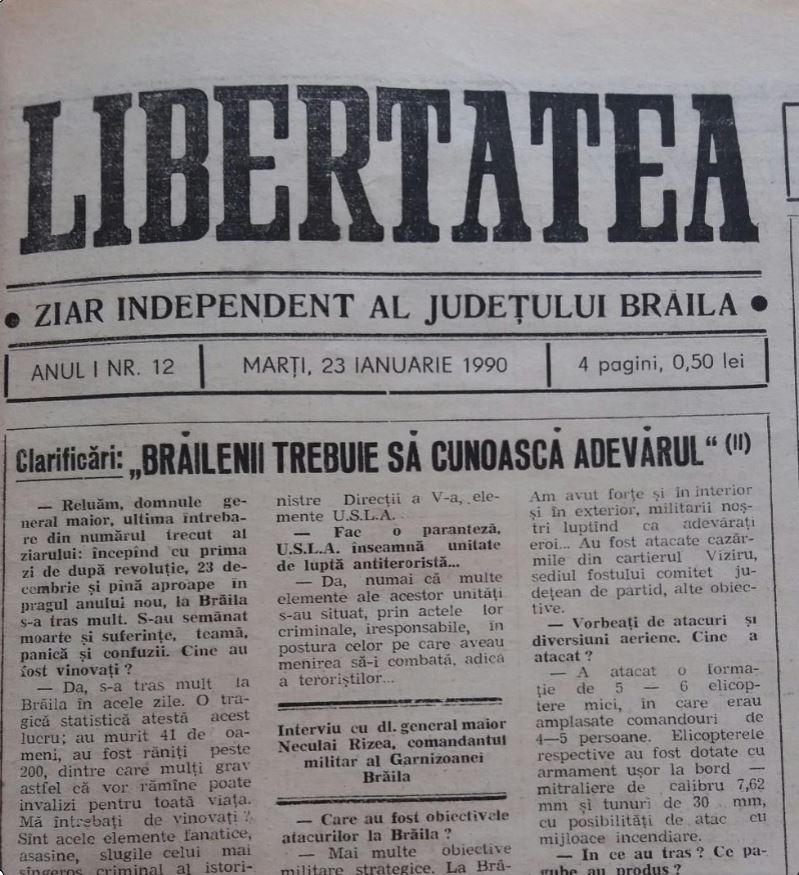
General Niculae Rizea also discussed the use of safe houses in Braila by the Securitate terrorists in an early 1990 interview:

Rep. (Libertatea Braila):  A descoperit armat ascunzatori de arme?

Gen.:  Desigur, in cimitirul Sf. Constantin si in port.

Rep.:  Au existat oameni care sa fie surprinsi in actiuni teroriste?

Gen.:  Da. Au tras din cele mai diverse locuri utilizind si casele conspirative.

Rep.:  Cite case conspirative a gasit armata?

Gen.:  Destule.  Multe nelocuite, dar dotate ultramodern, cu rezerve de hrana, cu munitii si posibilitati de tragere perfecte. Retineti ca au folosit si cartuse explozive de tip dum-dum. Pentru stergerea urmelor au folosit captatoare de tuburi. Au dispus de arme ultramoderne, inclusiv de lunete cu raze infrarosii, de arme cu teava-lisa, imitatoare de zgomot. Au dispus de slupe proprii, de barci pneumatice, dotate cu motoare de tip “Johnson”.

Rep.:  D-le general, credeti ca au existat in Braila alte forte paralele, neincluse pe statele de plata oficiale?

Gen.:  Eu, personal, cred ca da. Securitatea a distribuit arme unor elemente declasate, unor tigani care au tras din cimitirul Sf. Constantin. Aici am gasit un mini-depozit de arme si curios, unele de fabricatie artizanala. Avem indicii ca indivizii au fost platiti cu importante sume de bani necontabiliati.”…

Gen.:  Elementele teroriste au folosit uniforme si grade militare pentru a semana confuzie, pentru a introduce panica si deruta. Una dintre cele mai edificatoare dovezi e harta cu interceptarile convorbirilor radio, detinuta de o unitate speciala de-a noastra. S-a emis din mai multe puncte. Avem o banda de cinci file, reprezentind convorbirile codificate pe care-le au avut. Au mai fost descifrate trei sferturi din acestea. Mai este de identificat o singura persoana.”

https://romanianrevolutionofdecember1989.com/in-raportul-parchetului-militar-totul-este-o-minciuna-vi-braila/


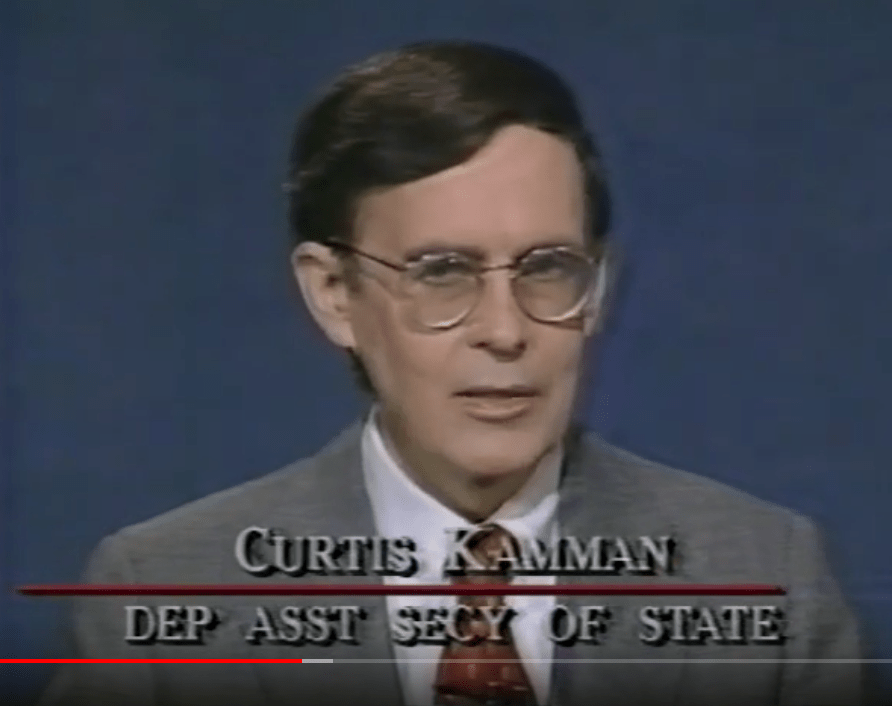
Curtis Kamman, Deputy Assistant Secretary of State for the Soviet Union and Eastern Europe (ABC News Nightline, 26 December 1989): “pockets of resistance from the security police”

see also a previous post on this video:

https://rolandothomassonphd.home.blog/2021/02/25/video-securitate-underground-operations-center-thousands-of-american-made-bullets-poison-gas-nicolae-ceausescu-business-cards-mike-lee-abc-news-december-1989/

Romanian Revolution on american TV

181 views•Nov 28, 2020

Many thanks to John’s Cafe Deva 55 subscribers for posting this and several other videos.
https://www.youtube.com/watch?v=CxPm6m_dWZg&list=PLLoPVu0YgDTzN1gpqTGaWYG7r7M_ybTir&index=2

Today, I will address the follow clip:

from approximately …

min 40:00 A young Chris Wallace (sitting in for Ted Koppel) from what appears to be the 26 December 1989 edition of the ABC News Nightline program.

min. 45:50 “Anton Unku, Romanian Journalist” (aka Anton Uncu, Romania Libera)

———————————————-
min. 49:05 Curtis Kamman, Deputy Assistant Secretary of State for the Soviet Union and Eastern Europe, Chief Task Force monitoring Romanian Situation since 21 December 1989

min 49:38 Kamman refers clearly to “pockets of resistance from the security police here and there”

min 49:56 Kamman states when asked that these Securitate remnants pose “no threat to the control” of the new government, but they can cause bloodshed

Was Kamman just talking off the top of his head, repeating things from Romanian Television or the leaders of the Front, as some people would today have us believe. Of course not:

Fullscreen capture 1252019 85638 AM

ROMANIA:  CIA National Intelligence Daily 28 December 1989 (declassified from Top Secret and Released to the public on 10 December 2019, https://digitalarchive.wilsoncenter.org/collection/633/cia-reports-on-the-collapse-of-communism-in-europe/5)

Romania:  New Regime Consolidating Security

The government continues to make limited progress in eliminating the threat from Securitate diehards, but Romanians are increasingly skeptical of Communist dominance of the new government.

On Tuesday [26 December 1989], the new government put internal security forces and border guards under the Defense Ministry and set a new deadline for the Securitate troops to surrender.  The government is also calling on civilians to turn in all arms issued to defeat Nicolae Ceausescu.  xxxxxxxxxxxxxxxxxxxxxxxxxxxxxxxxxxxxxxxxxxxxxx Information not declassified for protection of sources and methods xxxxxxxxxxxxxxxxxxxxxxxxxxxxxxxxxxxxxxxxxxxxxxxxxx nearly half of an estimated 200 Securitate members in Timisoara were dead, captured, or had escaped.  xxxx Classification not declassified xxxx

Significantly, the CIA NID from 28 December 1989 is consistent with what National Security Council (NSC) Director for European Affairs Robert Hutchings maintained in 1997: “It was an argument that had a few adherents at staff level during those chaotic days, during which a successful counterrevolution by Ceausescu loyalists seemed a real danger110. …With Moscow as with others [“Bonn, London, Paris, and other capitals”], there was a broadly shared desire to see Ceausescu loyalists defeated, the bloodshed ended, and the democratic ‘spirit of Timisoara’ vindicated.” https://romanianrevolutionofdecember1989.com/robert-hutchings-nsc-director-for-europe-89-92-on-romania-december-1989/

————————————————-
min. 53:30 “A Romanian political analyst now teaching Political Science in this country” Vladimir Tismaneanu, Fellow at Foreign Policy Research Institute…and lectures in Political Science at the University of Pennsylvania…

(Video) “Securitate underground operations center…thousands of American made bullets…poison gas…Nicolae Ceausescu business cards (Mike Lee, ABC News, December 1989)

Romanian Revolution on american TV

181 views•Nov 28, 2020

Many thanks to John’s Cafe Deva 55 subscribers for posting this and several other videos.
https://www.youtube.com/watch?v=CxPm6m_dWZg&list=PLLoPVu0YgDTzN1gpqTGaWYG7r7M_ybTir&index=2

Today, I will address the follow clip:

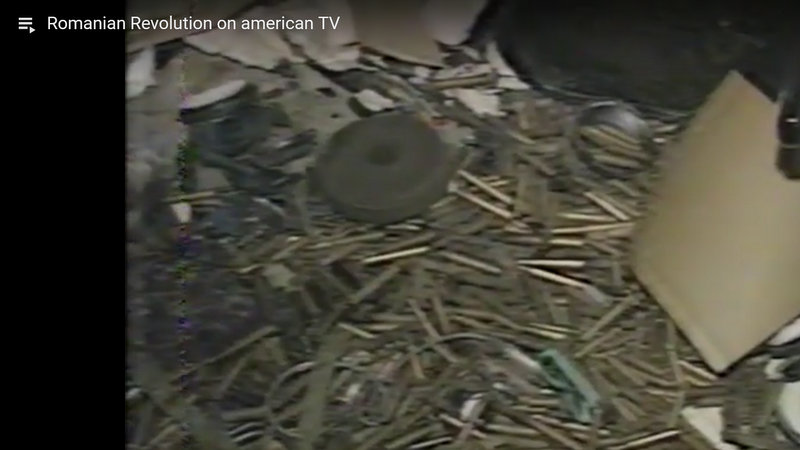
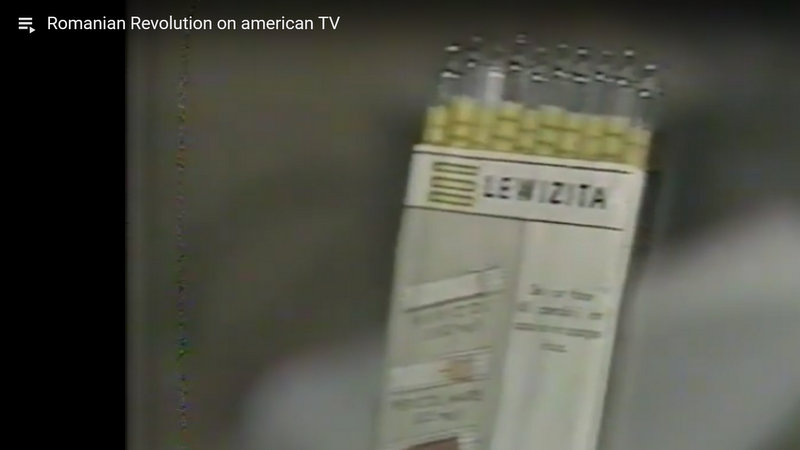
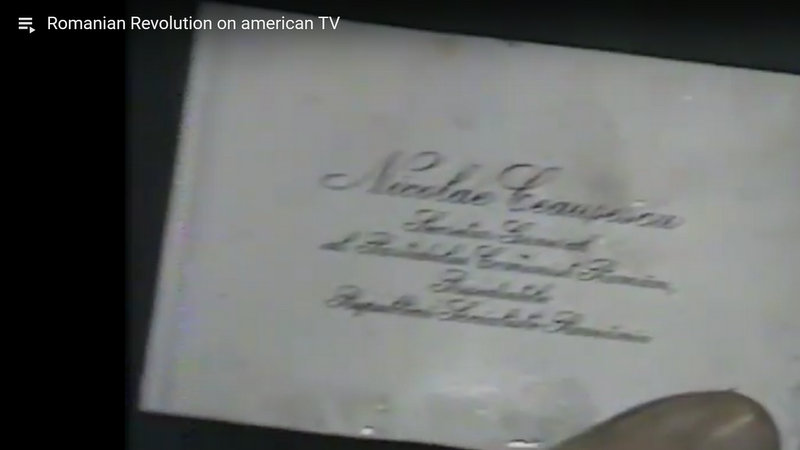
From minute:
108:50 Securitate
109:04 in this underground operations center,
109:07 Securitate stored thousands of bullets,

109:09 much of them made in America

109:31 small containers of poison gas (Lewizita)
NOTE: THIS APPEARS TO BE https://en.wikipedia.org/wiki/Lewisite , Lewisite (L) is an organoarsenic compound. It was once manufactured in the U.S., Japan, Germany[2] and the Soviet Union[3] for use as a chemical weapon, acting as a vesicant (blister agent) and lung irritant. Although colorless and odorless, impure samples of lewisite are a yellow, brown, violet-black, green, or amber oily liquid with a distinctive odor that has been described as similar to geraniums.[4][5]
My guess, for a variety of reasons, is that this would have been a bunker associated with the USLA (special unit for anti-terrorism unit), precisely because of the existence of gas masks (see video) and then this poison gas, which, like the American made bullets above, OFFICIALLY/ON THE BOOKS, Romania, and in no case THE SECURITATE, would have had…only that here they were captured on film!

109:49 Mike Lee ABC News
109:58 Business cards, Nicolae Ceausescu, General Secretary of Romanian Communist Party, President of the Romanian Socialist Republic

Cum se recunoşteau teroriştii

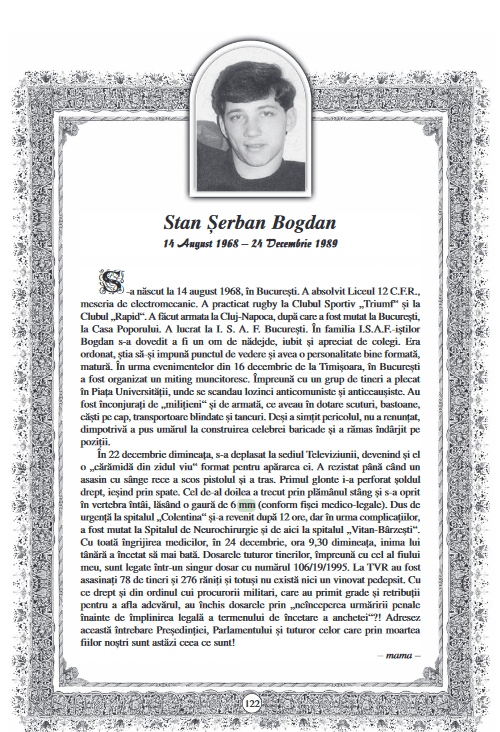
Teroriştii au fost învăluiţi într-un mister absolut imediat după fuga lui Ceauşescu. Tot atunci au fost lansate zeci de poveşti, care mai de care mai SF, dar şi numeroase perdele de fum. Nu vin acum cu un alt scenariu. Sunt încă mult prea multe întrebări fără răspuns. Însă, am să relatez o poveste adevărată, trăită pe pielea mea. Imediat după fuga lui Ceauşescu, în Bucureşti a început să se tragă. Apoi, s-a vorbit despre teroriştii care ar încerca să-l aducă pe Ceauşescu din nou la putere. Se zicea că sunt arabi în combinezoane ori treninguri negre. Era doar o variantă. Apoi, pe toate canalele, presă ori tv, s-a spus că luptătorii în slujba Diavolului se recunosc între ei datorită unor cărţi de vizită pe care scrie: „Nicolae Ceauşescu”. Nimeni nu ştia exact de unde vine informaţia. Dar şi eu avem în portofel o asemenea carte de vizită şi, uitându-mă în oglindă, m-am întrebat dacă nu cumva sunt terorist.”
http://www.portalulrevolutiei.ro/arhiva/2009_1001.html


Oh yes, where, oh where, could such information that the “terrorists” who were suspected Securitate members were carrying “business cars” with Nicolae Ceausescu written on them!!!

Paul Abrudan, SIBIUL in revolutia din decembrie 1989 (1990)

The events of Sibiu–Nicu Ceausescu’s fiefdom–in December 1989 have been in the news. Thanks to my colleague and co-author, Andrei Ursu, I have been able to virtually leaf through the following long since forgotten book from 1990. It is a testament to the Lewis Caroll-like “Through the Looking Glass” character of today’s media and intellectual discourse about December 1989 in Romania that the truth of what happened in Sibiu should seem so foreign and distant. Here are a few snip-its and excerpts of relevance. If you want to judge someone’s actions in December 1989, in Sibiu or elsewhere, getting the details and context of the time correct should be your first order of business.


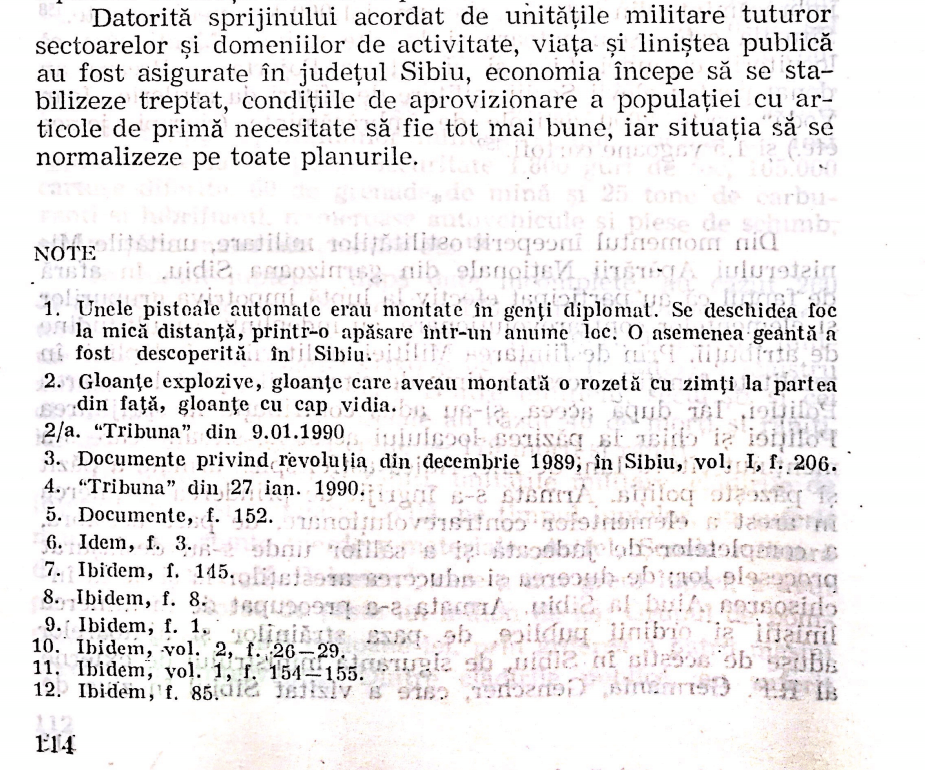
On page 8, Abrudan discusses the equipment and tactics of the “terrorists.”

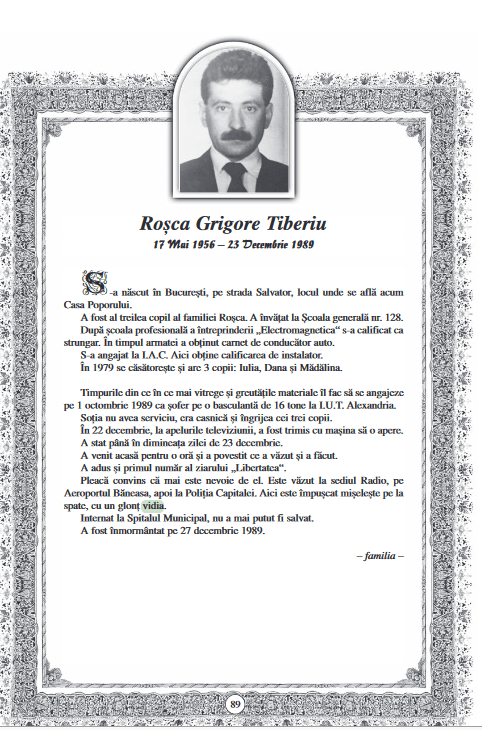
On page 114, endnote 2, he details the atypical munitions used exclusively by the terrorists, as follows:
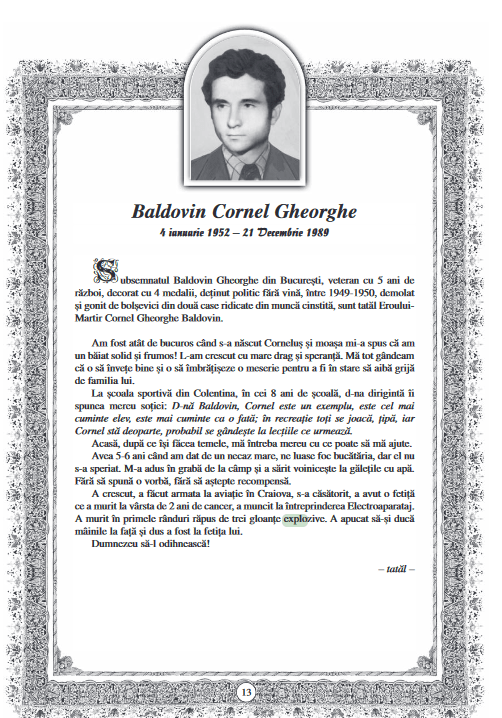
2. Gloante explozive, gloante care aveau montata o rozeta cu zimti la partea din fata, gloante cu cap vidia.

Abrudan on pages 9 and 110 again discusses the presumed goals of the terrorists. There is little doubt from reading the testimonies and accounts of this book, taken in the first six months after December 1989, as to the former Securitate and Militia being the primary source of the counterrevolutionary terrorism.

Other recent posts on Sibiu:

https://rolandothomassonphd.home.blog/2020/12/22/sibiu-dupa-22-decembrie-1989-documente/ (includes video excerpts from Gheorghe Cocos)
https://rolandothomassonphd.home.blog/2020/12/20/sibiu-21-22-decembrie-1989-documente/

Ne-am aflat, brusc, într-o situaţie de luptă pentru care nu mai erau valabile nici una din schemele tactice pe care Ie ştiam — ne-a mărturisit mr. Glistor Stoia, comandantul unităţii [Comandamentul aviaţiei militare, Otopeni] (Libertatea, 5 ianuarie 1990)

Pentru că din noaptea de 22/23 decembrie, aeroportul Otopeni şi regimentul au constituit ţinta unor susţinute atacuri teroriste. Urmele acestora se văd si azi. Carcasele calcinate ale unui TAB şi ale cîtorva autoturisme, cicatricile lăsate de gloanţe în corpul aeronavelor, urmele de împuşcături de pe clădirile regimentului.


Ne-am aflat, brusc, într-o situaţie de luptă pentru care nu mai erau valabile nici una din schemele tactice pe care Ie ştiam — ne-a mărturisit mr. Glistor Stoia, comandantul unităţii. Ne-am constituit din mers în dispozitiv de apărare, încorporînd efectivele sosite în ajutor. Au fost nopţi în care tirul nu a încetat, practic, nici un moment, cînd am fost atacaţi din clădirile mai înalte dinspre sat de cuiburi de mitraliere şi chiar de rachete sol-sol. Făceam faţă unor efective bine antrenate, aplicînd scheme tactice variate şi surprinzătoare şi dispunînd de armament sofisticat, cu dispozitive de ochire pe timp de noapte, cu cartuşe explozive şi gloanţe din oţel vidia…

https://www.amosnews.ro/remember-5-ianuarie-1990-presa-acum-25-de-ani-2015-01-05

În serviciul activ al Revoluţiei

JURNAL DE FRONT

Una dintre primele formaţii intrate în luptă, în serviciul activ al Revoluţiei a fost unitatea militară a aviaţiei de transport de la Otopeni. O dată ce „insurecţia piepturilor goale” din bd. Magheru şi din Piaţa Palatului i-a pus pe fugă pe dictatori, a apărut necesitatea apărării şi consolidării acestei istorice victorii. Comandamentul aviaţiei militare a acţionat cu promptitudine, hotărând blocarea la sol a celorlalte elicoptere cu trupe, solicitate imperios de dictator şi blocînd pistele aeroportului Otopeni pentru a împiedica, orice tentativă de fugă cu vreunul dintre numeroasele aparate de zbor ale „flotilei personale” a lui Ceauşescu. În aceste con-
diţii regimentul de transport a acţionat, din primele ore cu cîte 8—10 aparate de zbor concomitent, trimise pentru a aduce trupe de paraşutisti de la Bobocu, Titu, Caransebeş şi Timişoara, în scopul apărării principalelor obiective strategice — aeroportul, televiziunea, radiodifuziunea şi altele. Aceste misiuni s-au desfăşurat, în primele două zile ale revoluţiei, în condiţii dramatice, de adevărat război, sub gloanţe şi proiectile, sub tir de rachete şi baraje de foc de pe autovehicule blindate. Pentru că din noaptea de 22/23 decembrie,

Octavian ANDRONIC

(Continuare în pag. a II-a)

(Urmare din pag. I)
aeroportul Otopeni şi regimentul au constituit ţinta unor susţinute atacuri teroriste. Urmele acestora se văd si azi. Carcasele calcinate ale unui TAB şi ale cîtorva autoturisme, cicatricile lăsate de gloanţe în corpul aeronavelor, urmele de împuşcături de pe clădirile regimentului.

—    Ne-am aflat, brusc, într-o situaţie de luptă pentru care nu mai erau valabile nici una din schemele tactice pe care Ie ştiam — ne-a mărturisit mr. Glistor Stoia, comandantul unităţii. Ne-am constituit din mers în dispozitiv de apărare, încorporînd efectivele sosite în ajutor. Au fost nopţi în care tirul nu a încetat, practic, nici un moment, cînd am fost atacaţi din clădirile mai înalte dinspre sat de cuiburi de mitraliere şi chiar de rachete sol-sol. Făceam faţă unor efective bine antrenate, aplicînd scheme tactice variate şi surprinzătoare şi dispunînd de armament sofisticat, cu dispozitive de ochire pe timp de noapte, cu cartuşe explozive şi gloanţe din oţel vidia…

A fost un adevărat infern, dar atacurile au fost respinse şi aeroportul apărat. Nu s-au înregistrat pierderi de aeronave. Mai mulţi ostaşi au fost răniţi. Atmosfera de campanie domneşte şi acum, fiind improvizate
dormitoare în toate sălile iar efectivelor de 3—4 ori mai mari decît de obicei li s-au asigurat toate mijloacele de subzistentă. „Botezul focului” a fost primit cu curaj şi tenacitate de către aviatori. Subunităţile de elicoptere au executat misiuni de cercetare a dispozitivului, pe timp de zi şi de noapte, localizînd operativ, între altele şi zona în care a fost debarcat cuplul prezidenţial fugar. De la declanşarea revoluţiei echipajele aeronavelor au efectuat peste 70 de misiuni, cu avioane şi elicoptere, însumînd în numai 13 zile, 143 de ore de zbor! (În ultima vreme, exigenţele „economisiri de combustibil” făceau ca nici într-un an să nu se înregistreze atîtea ore de zbor !).
Misiuni de zi şi de noapte în condiţii de vizibilitate sub plafonul minim atît la aterizare cît şi la decolare. Au fost efectuate şi misiuni peste graniţă, în Bulgaria şi Ungaria, de unde au fost aduse ajutoare umanitare oferite de către guvernele ţărilor vecine…

Privesc chipurile acestor oameni care nu şi-au văzut familiile de peste zece zile. Interval în care unitatea le-a fost şi casă şi masă şi loc de muncă şi de luptă.
Sînt chipuri obosite, dar pe care se poate descifra în egală măsură, hotărirea şi optimismul.
Sentimente pe care le degajă, de altfel şi rîndurile pe care le-a aşternut pe hîrtie, între două zboruri, căpitanul Arpad Pandelescu şi pe care ni le-a încredinţat în dorinţa de a sugera cititorilor „Libertăţii” cîte ceva despre atmosfera care a domnit şi domneşte aici. Iată-le:

„Oricare pilot ar fi aterizat la fel de bine!”.

29.12.1989 ora 7. Ordin de misiune. Echipajul mr. Ştefan Gligor: „Decolaţi în cel mai scurt timp, destinaţia Debreţin, de unde veţi transporta alimente pentru Otopeni”.

În drum spre aeronavă mi se derulau în memorie datele necesare executării zborului, condiţiile meteorologice deosebite, starea aeronavei şi… (Ia Otopeni s-au dat lupte grele). Decolăm, luăm înălţime şi pe drumul cel mal scurt spre Debreţin. Controlorul de trafic: Aveţi posibilitatea de a vorbi în limba engleză ? Răspuns: engleză. rusă, maghiară. Porfect: maghiarii vă primesc în engleză.

Aterizăm. Urgent sîntem încărcaţi: 5 300 kg alimente. Felicitări scurte, strîngeri de mînă sincere si… decolăm spre tară. 

Sintem Informaţi că Ia Otopeni condiţiile meteorologice s-au înrăutăţit. Primim ordin să aterizăm pe Timişoara.

—    Otopeniule, încărcătura noastră este necesară pentru popor, sînt alimente şi dacă sînt necesare în Bucureşti, la Otopeni dorim să aterizam”!

După 5 minute se schimbă destinatia: Otopeni! Intrăm în frecvenţă cu Otopeniul şi ni se ordonă să rămînem în aer, trafic intens la aterizare pe Otopeni. Aeronave străine, cu ajutoare, aveau prioritate.

Condiţiile se înrăutăţeau, vizibilitatea scădea, ninsoarea se înteţea, iar vîntul “prietenul” nostru, creştea în intensitate. Eram informaţi la intervale scurte că aerodromurile din jur se închideau meteo. Ni se cere să alegem un alt aerodrom de aterizare. Ni se permite coborîrea şi venirea Ia aterizare asistaţi de radar. În cabină linişte. Comenzi scurte, clare. Execuţie ireproşabilă. Aeronava răspundea docilă la comenzi. Vîntul bate în rafale. Era rău. Nu vedeam nimic. Mîinile strinse pe manşă. Secundele păreau imense. S-au văzut luminile, înălţime 30 m. Vizibilitate 300 m.
„Cornel, sintem deasupra pistei, aterizăm. Am luat contact cu solul. Vîntul tare. Era viscol”.
Fane, am reuşit, totul e O.K.?
Totul e normal.

mai recent, despre cazul Otopeni: https://rolandothomassonphd.home.blog/2021/01/27/otopeni-decembrie-1989-ianuarie-1990-dezvaluirile-lui-maior-dan-buzescu-video-comentari/