A draft for the eventual chapter:
https://www.academia.edu/43544903/Dum_Dum_Bullets_in_December_1989_09222019tk3_post
This probably explains why, during the brief first window in early 1990 discussed earlier in this paper, scattered USLA personnel—sometimes identified as USLA, sometimes identified by their new rank reflecting their integration into the Ministry of National Defense at the end of December 1989—turned up in the press to discuss the characteristics of the weapons and ballistics used by the so-called terrorists. For example, a former USLA officer referred to as an Army Major engineer specializing in weapons and ammunition[1] described for a Bucharest daily in late March 1990 ‘soft-nosed bullets,’ in other words, colloquially, dum-dum bullets:


‘Kynoch-Magnum’ cartridges were found in Buzău, but also around Television and it appears a ‘sample’ was discovered in the area around the former CC building.[2]
The bullet is of the ‘Softnosed’ type, which in translation means ‘with a soft nose,’ which means that when the bullet hits its target, the head of the bullet deforms radially, which produces deep wounds at entry. It is not a penetrating bullet that remains in the place it struck, but provokes a wound of categorical lethality. The bullet has a lead core which is in a jacket of tombac, a mixture based on copper.
The appearance of these cartridges proves that in Romania there also existed similar hunting rifles…in the stocks of our armed forces there did not exist such a weapon…the ‘Kynoch-Magnmum’ cartridges remain foreign, through their shiny appearance on the streets of the Capital, alongside the whole ‘collection’ of bullets gathered by military teams that policed the underground tunnels of Bucharest.[3] (Alexandrescu 1990b)
[1]Ion Ştefanut was the USLA officer in question. He was interviewed in Horia Alexandrescu, ‘Gloanţele, pe ȋntelesul tuturor (I). Cartuşe pentru…Elefanţi!’ Tineretul Liber, 25 March 1990. Significantly, the series, ‘Bullets, for Everyone’s Understanding,’ appears to have ended abruptly and without any explanation, after the second episode three days later, even though Alexandrescu had promised a future episode would discuss the so-called, unconventional ‘vidia bullets.’ The section of the article quoted above originally appeared in Perva and Roman 1991, pp. 103-104. Members of the Securitate’s ‘Special Unit for Anti-terrorist Warfare’ (U.S.L.A.) who were not activated as part of the offensive actions of the Ceauşescu resistance plan and did not participate in such a capacity, were willing in the early months of 1990 to give details in public about the Securitate ‘terrorists.’ Naturally, they were reasonably familiar with the weapons’ choices of those in the Ceauşescu resistance—some of whom were fellow USLA officers—and could comment knowledgably. This was probably a way of proving their bona fides to the new regime, and the population, and also a way for the new regime to salvage and rebrand the ‘usable’ part of the former Securitate.

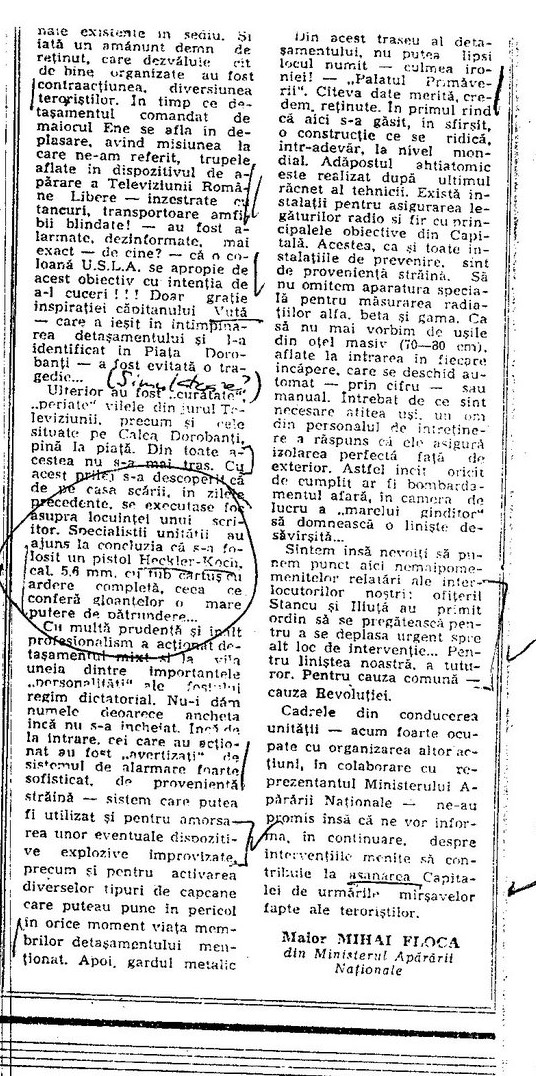
For example, Io[a]n Iliuţă and Major Ene Zaharia of the USLA appear to be the sources of the following revelation to Army Major Mihai Floca in early January 1990: ‘Upon clearing out the houses surrounding the Television station, it was discovered, that from the staircases they were firing at the house of a writer. Specialists of the unit [presumably the USLA] arrived at the conclusion that a 5.6 mm Heckler-Koch pistol with a cartridge that melts away for added impact was used.’ (Major Mihai Floca, ‘Reportaj la U.S.L.A.,’ Tineretul Liber, 5 January 1990, p. 4.)

Iliuţă also showed up in the pages of the Army daily, Armata Poporului: ‘How can we explain the amazing precision of the terrorist gunfire: even though in the majority of cases, they operated at night, most victims were shot—mortally—in the head, throat, or heart?’ ‘To this question—which we took from letters and telephone calls received at the editorial office—responded major engineer Ion Iliuţă, specialist in antiterrorist warfare: ‘Much has been said and written in the press about the infrared scopes of the terrorists. The truth is that they possessed means of targeting that were even more sophisticated, more precise. I am talking about a complex apparatus that possesses a laser marker and a light-amplifier of the LITTON variety…’ ‘Cum ocheau teroriştii?’ Armata Poporului, 3, 17 January 1990, p. 6.
[2] This may be the type of bullet presented to the camera in a video which shows civilians rummaging through materials and munitions removed from V-a Headquarters. See the video posted by ‘Tioluciano’ entitled ‘Sediului fostei DSS in data de 24 decembrie 1989’ at https://www.youtube.com/watch?v=cs3FxteH5uM.
[3] Part of their knowledge about these bullets apparently came from their role in ‘cleaning up’ after the ‘terrorists.’ Witness, for example, the comments of an employee of the Museum of National Art located in the old Royal Palace across from the CC building in central Bucharest. ‘The next day [23 December 1989] and over the following days I found bullets in the Museum. They were not normal bullets. They had a rounded head. They appeared to have a lead jacket. It was of a caliber between five, five something. The USLAşi did not want to leave us a bullet. I asked them to leave me at one as a memento. They did not want to. They said that they needed them for the purpose of identification. They noted where they gathered them from.’ (Dan Iliescu, interview by Ion Zubaşcu, “Misterioasa revoluţie română,” Flacăra, 51, 19 December 1990, p. 11).


