How the Securitate Won the War for the History of December 1989: A Detailed, Sourced Analysis of the SPM Rechizitoriu in the Dosarul Revolutiei of 5 April 2019 (I)

(a serialized version of the original draft for my contribution in Tragatori si Mistificatori: Contrarevolutia Securitatii in decembrie 1989 (Polirom, 2019), Andrei Ursu, Roland O. Thomasson, and Madalin Hodor)

How the Securitate Won the War for the History of December 1989: 

A Detailed, Sourced Analysis of the SPM Rechizitoriu in the Dosarul Revolutiei of 5 April 2019

–The Securitate lost the battle to save the communist regime of dictator Nicolae Ceausescu in December 1989…but they won the war for how December 1989 is remembered.  

Nothing is better or more bitter proof of this claim than the subject of this chapter:  the 501-page Indictment in the Revolution File of 5 April 2019 drawn up by military prosecutors.[1] The Indictment charges long time communist party apparatchik and former President of Romania Ion Iliescu (1990-1996; 2000-2004) and others, including former Deputy Prime Minister Gelu Voican Voiculescu (1990-1991), with “crimes against humanity” for, according to the Indictment, the “862 deaths and 2,150 injuries” (p. 456) that occurred after Nicolae and Elena Ceausescu fled Bucharest by helicopter at midday on 22 December 1989. These officials and high-ranking military officers are accused of creating a “terrorist diversion” against non-existent Ceausescu loyalists during the period 22-31 December 1989 in order to legitimize their seizure of power and cover up the military’s role in the bloodshed that preceded Ceausescu’s ouster on 22 December 1989, the period of 16-22 December 1989. Nestor Ratesh once referred to this narrative as the “operetta war” theory[2]; it could also be termed “regime change” by “false flag” or “diversionary war”[3] theory, for it claims not as that theory does that powerholders go to war to divert attention from other issues, but that the first act of those who seized power, the act that brought them to power, was the creation of a diversionary war, in this case a false one.

The claim that the details and arguments of the former Securitate permeate and even inspire the Indictment in the Revolution File may strike some readers as outlandish. Afterall, haven’t the announcements of the Military Prosecutorial Section (SPM) been well received by domestic and international media since the file was reopened in late 2016? Has the work of the SPM in the Revolution File not been praised by Romania’s liberal, anti-communist, pro-West intelligentsia at home and abroad? Has it not been welcomed by the head of the most visible association of revolutionaries, the 21 December Association? Indeed, all of these are true, the work of the SPM has been praised and defended by Gabriel Liiceanu and Horia Roman-Patapievici, and no less than the Chair of the Presidential Commission to Analyze the Communist Dictatorship in Romania, Professor Vladimir Tismaneanu, whose Final Report was the basis for President Traian Basescu’s condemnation of the communist regime and the Securitate as “illegitimate and criminal” on 18 December 2006, considers that Ion Iliescu and the others are finally receiving real justice.[4]


Broad, Overarching Conclusions

Before we begin to break down the Rechizitoriu in detail, a few broader, overarching observations and interpretations are in order.  Some of these themes will be further developed in the detailed breakdown which follows; others will not.

  • In broad terms, who does the Rechizitoriu say are the guilty and the victims of the post 22 December 1989 mayhem and violence:

Guilty:

  1. MApN senior officers (including GRU/KGB recruited agents)
  2. PCR senior officials (including KGB/GRU recruited agents)
  3. Media (TVR, former PCR-State press)
  4. C.A.A.T. (Comandamentul Apărării Antiaeriene a Teritoriului, for the diversiune radio-electronica)
  5. DIA (strongly suggested—they had the simulators; they had the lupta de rezistenta training,;their people were accused of pointing the finger at the Securitate (ex. Teodor Stepan, Resita)

Victims:

  • the entire Romanian population and international opinion
  • military rank and file (they didn’t know about the diversion)
  • suspected Arabs and other foreigners (arrested based on disinformation and preducial suspicion)
  • the Securitate (and to a lesser extent the Militie)
  • Stefan Gusa (with the exception of his listing for his role in the Timisoara repression, he is upheld as a hero having opposed Iliescu et al. and the Russians; this is in stark contrast to the treatment of Militaru)

a) The SECURITATE–the secret police of the communist regime of dictator Nicolae Ceausescu–is mentioned only in passing, in the context of having, along with all other armed state and party institutions, (allegedly) put themselves (in their totality) at the disposition of the CFSN and its leadership (in particular, Ion Iliescu) as of 4 pm on 22 December 1989.  NICOLAE CEAUSESCU AND ELENA CEAUSESCU are mentioned only in the context of witless victims, as the target of the dastardly diversion, as victims of a simulated criminal trial, sentencing, and execution.

b) The alleged diversion is attributed to the “Supreme Military Council” subordinated to the CFSN.  Only two military officials of the Supreme Military Council are mentioned, both Army Generals, Victor Atanasie Stanculescu (active duty) and Nicolae Militaru (in the reserves at the time). (Whereas Army Generals Stanculescu and Militaru are alleged to have participated in the alleged diversion, there is no mention of Major Mihai CHITAC, but especially there is no mention of Army General Stefan GUSA.)  Ion Iliescu, Gelu Voican Voiculescu, Iosif Rus, and Emil Dumitrescu–the latter two air force and navy respectively–are said to have participated directly in carrying out the diversion and disinformation!  NO SECURITATE OFFICIALS ARE MENTIONED IN CONNECTION WITH THE ALLEGED DIVERSION!

c) SECURITATE Generals Iulian VLAD, Gianu BUCURESCU, Aristotel STAMATOIU, and Gheorge VASILE, all four of whom were arrested at the time in late December 1989 for their alleged role in the bloodshed, are NOT mentioned, suggesting that they had no role in the alleged diversion and were therefore unjustly arrested.  (Moreover, since it is maintained that the terrorists were an invention, a fiction created by the so-called diversion, that means by definition there were no Securitate terrorists, that no Securitate were intentionally responsible for direct bloodshed after 22 December 1989.)

  • Extended sections dealing with the “terrorists” and arrested foreigners are taken verbatim from „Sinteza aspectelor rezultate din anchetele efectuate de parchetele militare în perioada 1990 – 1994, în cauzele privind evenimentele din decembrie 1989” (See, for example, pp. 184-210; p. 438 ff. pp. 447-450.) released under prosecutors Samoila Joarza and Mihai Popa Ulupiu Cherecheanu et al. in December 1994, when Romania was de facto ruled by PDSR-PUNR-PSM-PRM-PDAR, a coalition which would formalized the following spring. 
  • The number of citations from former Securitate sources is large:  including Aurel Rogojan, Vasile Lupu, etc. and from pillars of the Ceausescu regime, such as Constantin Olteanu.  Even the “Soviet tourists”—a favorite theme of the former Securitate—appear in the testimonies of Vasile Lupu and Ion Mateescu (razboiul radio-electronic, p. 347)
  • Many testimonies were only recently taken, in the past few years (2017, 2018).  Testimonies from immediately after the events, or even in the initial years after the events, when those events would have been fresher in the minds of those testifying, are rare.  This increases the scope for so-called “recovered memories,” of witnesses forgetting, misremembering, confusing details, dates, and actors, of reinterpreting events through the political prism and personal and ideological feuds of the intervening years (decades!), of unintentionally mixing what they have heard or read elsewhere—especially from written histories and films—into their own accounts.
  • Our 2018 NRDO study is dealt with superficially, quickly, and unseriously (pp. 300-304).  The author of the Revista Securitatea article (1989) on lupta de rezistenta is interviewed, but says it was just theory, and the Molan case is dismissed because he had an army weapon and did not act like a professional.  This was at best a perfunctory, last minute effort to address evidence that they would had ignored and would prefer to ignore.
  • Whether it is investigating lupta de rezistenta, or simulators, or razboiul radio-electronic, the Rechizitoriu concludes the source was internal but then look through anyone but the Securitate, focusing mainly on DIA, CAAT, etc, as the culprits.  Two classic examples are allowing the author of the article in revista Securitatea to dispel the idea that his article had any basis in real plans (they accept this at face value), and citing Ioan Rusan UM 0110 (pp. 130-131) as the source to say that those who were on the Rombac to Sibiu on the evening of the 20th were Buzau 404 DIA!
  • This is NOT the Timisoara variant that underpinned much of previous military prosecutor Dan Voinea’s argument, and that, not surprisingly, is vigorously maintained and promoted by many Timisoara revolutionary participants.  That variant suggests that the Army leadership who participated in the Timisoara repression—in particular, Gusa, Stanculescu, and Chitac—was the engine of the alleged post- 22 December diversion of invented terrorists because they needed to cover up their bloody role in Timisoara and buy themselves amnesty from the new political leadership.  In this scenario, Ion Iliescu and the Front leadership were secondary, being brought into the Army diversion and acceding to it, rather than organizing and driving the diversion—the military prosecutors’ current argument.  The argument in the Rechizitoriu essentially turns the Timisoara variant on its head, suggesting that those military officers involved in the Timisoara repression glommed onto and were integrated into the pre-existing filosoviet conspiracy around Ion Iliescu and the core of the future CFSN. The Rechizitoriu’s argument is very much a “Bucharest” and partisan, post 22 December political argument; it is thus little wonder that it is eagerly and uncritically consumed by Romania’s Bucharest-dominated anti-communist/anti-Iliescu intelligentsia, among others.
  • Whose argument does the Rechizitoriu’s most closely resemble?  To some extent, this is reheated leftovers from 1996 and the majority opinion of the Sandulescu-Gabrielescu PNTCD version of the Senatorial Commission investigating December 1989 (whose Report, it not surpisingly quotes extensively from).  It includes strong currents of anti-communist, anti-Soviet/anti-Russia (Soviet/Russia discussion is heavy throughout, not just for Romania but allegedly for the collapse of communism in the whole region in 1989; see the introduction, and approximately pp. 392-437, with its focus on filosovietism), a sort of ideological, non-patriotarda/xenophobic nationalism.
  • Just as in 1996, it overlaps ca din minune with the writings of the former Securitate—less Pavel Corut than another former IV Directorate CI officer, Valentin Raiha.  The suggestion that DIA, but definitely NOT the Securitate bear a role for the post-22 violence and mayhem has a long history, from the likes of Gheorghe Ratiu, Nicolae Plesita, and many others.  In fact, the strong anti-Soviet/anti-Russian component of the Rechizitoriu and the arguments and evidence presented most strongly resembles the more “national security” focused (to the extent we can say that at all, since they were clearly also politically and ideologically focused) elements of the former Securitate:  Directorate IV Military Counter Intelligence and DSS UM 0110, the unit charged with countering espionage from fellow “fraternal” socialist countries, such as the Soviet Union and Hungary.

[1] The full, “non-anonimizat” version of the Rechizitoriu was posted online on 19 July 2019 ( https://www.b1.ro/stiri/eveniment/exclusiv-b1-ro-prezinta-integral-rechizitoriul-revolutiei-romane-episodul-1-dovada-implicarii-rusiei-in-evenimentele-din-decembrie-1989-filosovietismul-lui-iliescu-si-acolitilor-sai-286156.html) and can be accessed here:  I – paginile 1-125 ; II – paginile 126-250 ; III- paginile 251-375 ; IV- paginile 376-501.

[2] Nestor Ratesh, Romania:  The Entangled Revolution, (New York:  Praeger, 1991), pp. 61-62.

[3] For an overview, see https://en.wikipedia.org/wiki/Diversionary_foreign_policy.

[4] https://www.marginaliaetc.ro/gabriel-liiceanu-petre-roman-si-teodor-brates-ii-invata-pe-studenti-etica-la-universitatea-din-bucuresti/; https://adevarul.ro/cultura/carti/interviu-horia-roman-patapievici-scriitor-daca-alegerile-vor-confirmaformula-guvernare-psd-alde-ideea-romania-duce-culcare-1_5ce7d5fd445219c57efeb3a9/index.html; https://adevarul.ro/news/eveniment/teodor-maries-asociatia-21-decembrie-1989-despre-inculparile-dosarul-revolutiei-sunt-criminali-murit-900-oameni-mii-fost-raniti-1_5c1cbf6cdf52022f75bb6ab3/index.html;  https://putereaacincea.ro/post-comunismul-paria-al-lui-ion-iliescu/ ;  Vladimir Tismaneanu, “1989 and After: Morality and Truth in Post Communist Societies,” Current History, March 2019, pp. 114-116 athttp://www.currenthistory.com/Tismaneanu-CH2019.pdf.

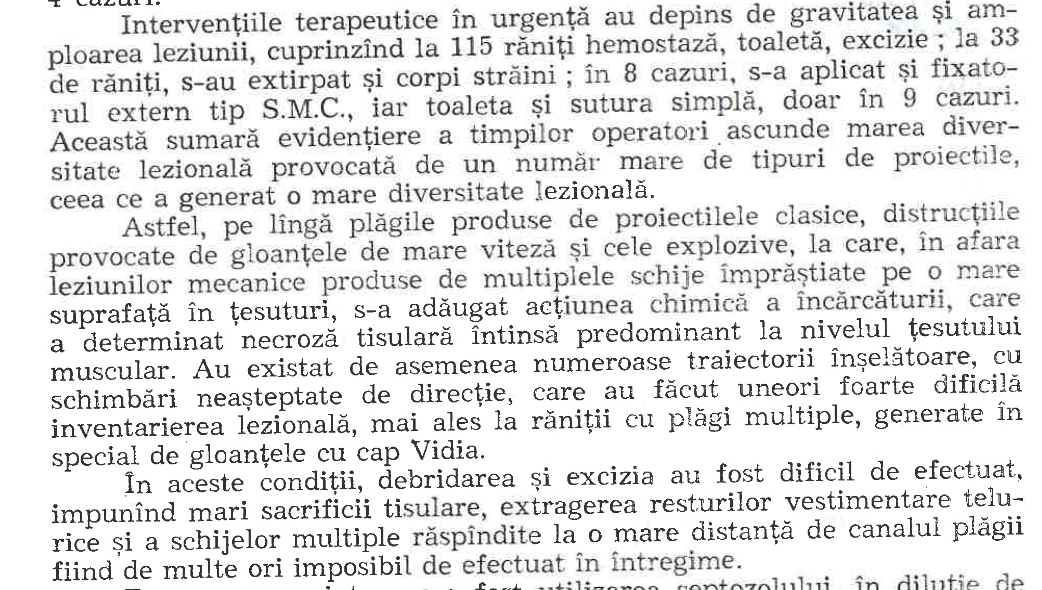
“Aspecte logistice ortopedico-chirurgicale pe marginea a 228 raniti osteoarticulari in cursul evenimentelor din decembrie 1989” (Revista de Medicina Militara, 26 septembrie 1990)

You can be damned sure that the Military Prosecutors responsible for the Rechizitoriu from Dosarul Revolutiei (aprilie 2019) never considered or even knew of this when they wrote their indictment.  Thankfully, not all of the past has been expunged from public memory in Romania.  This appears to have been posted by a military orthopedic surgeon Dr. Marius Scarlat, one of the FIFTEEN doctors who attached their name to this document in 1990, who relocated to France in 1991.  Many thanks to Dr. Scarlat for having done so.  It will take some time to digest this, and those with medical and ballistics knowledge might be able to clarify some aspects for us.  Here is the link, and here are some snips from the document for your perusal.

Surgery study of wounded soldiers 1990 page 1

Surgery study of wounded soldiers 1990 page2

Surgery study of wounded soldiers 1990 page3

Surgery study of wounded soldiers 1990 page 5

surgery study of wounded soldiers 1990 page6

Click to access Orthopaedic-surgical-logistic-problems-in-treating-228-wounded-persons-with-osteo-articular-lesions-during-the-events-of-December-1989.pdf

Thanks to co-author Andrei Ursu, for making some of the above searchable below:

Aspecte logistice ortopedico-chirurgicale pe marginea a 228 răniţi osteoarticulari în cursul evenimentelor din decembrie 1989  General-locotenent medic prof. dr. doc. Gbeorghe Niculescu, maior medic dr. Aurel Dorobanţu, maior medic dr. Cristian loCotenent-major medic dr. Marius Scarlat, locot.-colonel medic dr. Dan Mănăstireanu, colonel medic dr. Ştefan Savu, colonel medic dr. Silviu Diaconescu, colonel medic dr. George Constantin, locot.-colonel medic dr. Constantin Corhan, dr. Alexandru Fiilăp, maior medic dr. Dan Mischianu, maior medic dr. Cătălin Butunoiu, maior medic dr. Adrian Barbilian, locotenent-major medic dr. Sabin Stănescu, maior medic dr. Dan Vornicel  Din totalul de 228 răniţi, 157 au fost internaţi in primele 4 zile aie revoluţiei, cu răni grave şi foarte grave, fapt ce a necesitat organizarea unui bun triaj bipolar, unul la camera de gardă, urmat de al doilea, in Clinica de ortopedie şi traumatologie din Spitalul Militar Central. Bucureştl, stabi-lindu-se urgenţa şi amploarea tratamentului ortopedico-chirurgical. in acest fel, s-a reuşit un triaj eficient, inlăturindu-se unele erori din triajul primar. Considerăm utilil participarea unui medic anestezist la triajul răniţilor, mai ales la cel primar. Majoritatea răniţilor au fost tineri sub 20 de ani (171), fără tare orga-nice. Plăgile s-au produs prin proiectile de mare viteză, gloanţe de dimensiuni mici, gloanţe cu cap Vidia etc. Alături de plăgile prin ricoşare, s-au remarcat multiple plăgi neobişnuite ca localizare, datorită unghiurilor diferite de tragere (inălţime, subsol etc.), cu retenţie de corpi străini. 

Tabelul 1. Ziua accidentului  Nr. crt. Ziua cazurt 1 21.12.89 1 2 22.12.89 28 3 23.12:89 87 4 24.12.89 29 5 25.12.89 13 6 26.12.89 8 7 27.12.80 6 8 28.12.89 4 9 29.12.89 4 10 30.12.89 3 11 31.12.89 2  TOTAL = 185 

Caracteristicile plăgilor Plăgile au fost produse predominant prin impuşcare. Proiectilele au fost în general de mare viteză, dar şi din categorii speciale (dimensiuni foarte mari, glonţ cu cap Vidia etc.). S-au înregistrat răniţi prin impus-care din apropiere şi prin ricoşare. Unii răniţi au prezentat plăgi neobiş-nuite ca localizare, datorate unghiurilor de tragere inedite — de Ia inăl-ţime sau din subsol (plăgi calcaneene, perineale, cu interesarea articu-laţiei coxo-femurale). Orificiul de intrare a fost în marea majoritate a cazurilor puncti-form, dar au existat şi răniţi la care orificiul de intrare, provocat de gloanţe speciale, era anfractuos, cu corpi străini, putînd fi uşor confundat cu cel de ieşire. Foarte importantă in astfel de cazuri a fost stabilirea traiectului, mai ales în plăgile multiple, unde puteau fi omise traiectele, care, cel mai adesea conţineau corpi străini. Orificiul de ieşire a fost de regulă anfractuos, cu pierderi musculo-cutanate mari, Mai ales în cazul gloanţelor speciale. Datorită specificului luptelor, distanţa dintre luptători fiind adesea mică, răniţil au prezentat frecvent plăgi transfixiante ale membrelor aceştia orificiul de ieşire a fost deosebit de anfractuos, ridicînd probleme serioase de ordin operatoriu.  Revista de medicină militară, 1990, nr. 2-3 117

Justitia de tranzitie si evolutia Romaniei in post-comunism (marti, 25 august 2020): Dan Voinea, Antonie Popescu, Raluca Grosescu, Andrei Ursu, Cosmin Budeanca)

I encourage readers to watch the cogent interventions of my co-author Andrei Ursu, especially at min. 36:40-48:35, and from approximately 1:37:00- .

Unfortunately, aside from the rather factual and straight-forward contributions of Raluca Grosescu and Mariana Pirvulescu, the audience has to contend with the comments of Dan Voinea, Antonie Popescu, and Cosmin Budeanca, the moderator, who accepted at face value what Voinea and Popescu had to say.  Voinea refused to engage with Andrei Ursu’s presentation, instead relying on what he has repeated for years.  His comments deserve derision.  At 10:47, he says that after the 25th of December 1989 “nu s-a mai tras” (there was no more shooting) and “n-a murit nimeni” (nobody died), a so easily contradicted lazy lie that it is amazing.  After Andrei Ursu spoke, Voinea did not make any attempt to directly address what Mr. Ursu said.  No, instead  he repeated from min. 50:22 that in 90 percent of the cases (nice round number no?), it had been established…in Brasov, in Sibiu, in Timisoara, in Braila, and in Bucuresti. who had shot into who precisely.  At 53:10, he says that there doesn’t exist “nici un fel de dubiu” (any doubt), that the “terrorists” did not exist.  Instead, he goes on to talk about Pircalabescu and the Patriotic Guards, pompieri, militieni, and activisti de partid as having fired…but no where, in no case, were they securisti, the secret police of the communist regime.  At this point, 55:55, Cosmin Budeanca chimes in and parrots that we should speak of “criminali din sistem” (criminals of the system).  Throughout, this is what we get from Budeanca, Voinea, and Popescu, the globalization (and consequent dispersion) of blame…”communists,” those who were part of the system…were to blame, were guilty…the former Securitate disappear into the ether.

A few comments on Voinea and Popescu.  Voinea memorably was described by the respected Laura Codruta Kovesi as “having made mistakes not even a novice would make” when she dismissed him in 2009.  (See, for example, https://web.archive.org/web/20090926033848/http://www.evz.ro/articole/detalii-articol/868918/Kovesi-despre-revolutia-ratata-a-lui-Voinea-A-gresit-ca-un-incepator/ )  (Despite this, Voinea’s claims were presented positively and uncritically in the chapter on December 1989 in the so-called “(Vladimir) Tismaneanu Commission Report” of 2006)  Significantly, Voinea’s claims about December 1989 are invoked by none other than the former Securitate themselves in their serial publication:   https://romanianrevolutionofdecember1989.com/dan-voinea-marturii-despre-revolutie-vitralii-lumini-si-umbre-an-viii-nr-29-decembrie-2016-februarie-2017-p-37/ .  The absurdity and the total lack of credibility of Voinea can be seen in the following passage from a 2015 interview with Dan Andronic (!) in Evenimentul ZileiUrmătorul dosar pe care l-am avut a fost cu cinci teroriști îmbrăcați în trei rânduri de costume. Erau reținuți acolo. I-am scos. Unul dintre ei, Pană, avea o cicatrice pe obraz. A făcut armata cu mine. Știam că-i zidar. Când l-am văzut, l-am întrebat: „Mă, ce cauți tu aici?”. Eu eram în uniformă, el nu m-a recunoscut. I-am zis: „Bă, eu sunt Dan Voinea, colegul tău de grupă, am făcut armata la Drăgășani”. Zice: „Dane, tu ești?”. „Da, am ajuns procuror militar și tu terorist. Ce faci aici, ce s-a întâmplat?”. „Păi, să vezi că m-au luat din comună ca zidar, să lucrez la Casa Poporului. Și eu, și ceilalți ne-am dus la Biserica Antim ca să ne dea de pomană. Vin şi nu mai ştiu ce”… Aveau trei rânduri de haine pe ei, pentru că la Casa Poporului nu intrai decât dacă aveai permis de intrare, şi ei aveau vreo trei legitimații. Aveau trei rânduri de haine, pentru că pe lângă hainele lor de lucru își mai puneau o pufoaică, o salopetă sau alte haine mai groase. (https://evz.ro/dan-voinea-nicolae-ceausescu-a-fost-sacrificat-de-comunisti-pentru-comunism.html)

Antonie Popescu (Facultatea de Drept, Universitatea din Bucuresti, 1992-1996) believes that the people on the ROMBAC from Bucuresti to Sibiu on 20 decembrie 1989…were not from the Securitate’s USLA…but from Soviet forces from Tiraspol (!):

Antonie Popescu
Antonie Popescu 12:41pm Aug 7
Or fi fost la pregatire in Tiraspol de unde venea rrombacul?!

It should not come as a surprise.  Popescu is part of an organization that includes genuine revolutionaries from December 1989, but also former USLAs Constantin Isac, who absolves his Securitate of being responsible for the terrorism of December 1989:  http://www.asociatia21decembrie.ro/2010/02/lunetistii/ . (For more on Isac, see https://romanianrevolutionofdecember1989.com/2010/04/18/cine-este-constantin-isac-martorul-la-uciderea-lui-trosca/https://romanianrevolutionofdecember1989.com/2010/12/12/constantin-isac-intre-14-si-22-decembrie-dinamovist-de-judo-la-iasi-prezent-in-zona-crematoriului-cenusa-si-martor-in-piata-universitatii/ )  And of course the head of Popescu’s organization is a most interesting character indeed…:  https://romanianrevolutionofdecember1989.com/teodor-doru-maries-iunie-1991-eu-sustin-ca-martor-ocular-ca-securistii-nu-au-tras-ba-mai-mult-si-au-lasat-armele-si-munitia-acum-inteleg-de-ce-probabil-ca-aveau-informatii-ca-go/ ; https://romanianrevolutionofdecember1989.com/teodor-doru-maries-securitatea-80-la-suta-cu-noi-si-generalul-iulian-vlad/ )

Cosmin Budeanca, like so many others, does not appear to know and does not make any attempt to address the declassified documents of foreign governments and security services 30 years after the Revolution.  This willful ignorance is unforgivable.  The following should be required reading for anybody interested in what happened in December 1989:

I post here together a compendium of the documents which have been declassified on the 30th Anniversary of the Romanian Revolution of December 1989.  The Americans, the British, the Canadians, the Soviets, and the Hungarians from documents from the time are clear:  the “terrorists” existed, they were in the main from the Securitate, and they were fighting on behalf of the fallen tyrant, Nicolae Ceausescu.  The question now is:  how many Romanians will be able to accept this fact?  Pleasant reading!

Fullscreen capture 1252019 85638 AM

https://rolandothomassonphd.home.blog/2020/02/23/the-romanian-revolution-of-december-1989-declassified-cia-us-department-of-state-british-foreign-office-canadian-external-affairs-department/

Lukasescu: Ceausescu 1989, Lukashenko 2020? (a video comparison)

Inevitably, especially after Belarussian President Alexander Lukashenko told a hastily called pro-regime rally on Sunday 16 August (dwarfed by the anti-regime sentiment of everyone not at the rally) that neighboring countries had amassed military forces on the border, and on Monday 17 August got booed and told to resign by workers at a factory to which he traveled by helicopter, observers have been drawing comparisons to Nicolae Ceausescu, especially on 21 and 22 December 1989.  Over the past week and especially the past few hours, more and more people are calling Lukashenko…”Lukacescu”!  A quick search revealed one of the earliest recent uses of this term, from back in April !:

“Dear friends! I am reading all of your comments now, and so I think that ‘Lukasescu’ will envy the destiny of Ceausescu soon!” https://charter97.org/en/news/2020/4/13/372860/

Of course, that was wishful thinking back then…thankfully less so today!  Personally, I tend to think the difference in regime type, international distribution of power and global zeitgeist, and Belarus’ delicate location and cultural and geopolitical significance for Russia, make Romania 1989 and Belarus 2020 quite dissimilar, as will likely be seen in how Belarus 2020 plays out.  Nevertheless, Mark Twain’s quip about history rhyming rather than repeating itself can’t help but be apt here when you compare some of the videos from the time to those of the past few days:

https://www.theguardian.com/world/video/2020/aug/17/belarus-workers-chant-resign-at-lukashenko-on-factory-visit-video

According to the poster, Lukashenko’s “Ceausescu moment”

https://www.youtube.com/watch?v=n1FboBr5S_w

from approximately 1:20 (Ceausescu’s speech on 21 December 1989…Dictator, interrupted)

https://www.youtube.com/watch?v=xntDto5TX10

DIA Chief Stefan Dinu (1/1994): “…din martie 1979 nu s-a mai numit nici un atasat militar in exterior….Pe stat erau 31 de atasati militari pentru acoperirea a 50 de tari, dar de fapt aveam patru in decembrie [1989]…Budapesta, Belgrad, Paris, Roma.”

an excerpt from a draft of my Appendix in Andrei Ursu and Roland O. Thomasson, Trăgători și mistificatori. Contrarevoluția Securității în decembrie 1989 (Polirom, 2019), with a fuller passage from Dinu’s 13 January 1994 testimony.  Those who seek to suggest that somehow the Army and the Securitate were equals (including in their weapons’ arsenals!”) or that both were subordinated equally to “The Party,” or that Nicolae Ceausescu’s sultanist dictatorship somehow affected all institutions equally, simply do not know or are unwilling to acknowledge facts like the following:

Three decades removed from the Ceausescu era, some readers would have little inkling of the “Steaua-Dinamo” (shorthand reference using the Military and Securitate football clubs as proxies for the broader clash) bureaucratic competition and distrust between the military and the Securitate that had come to characterize the late Ceausescu era.  No element of the military was regarded as more adversarial by the Securitate than the Army’s DIA unit.  And the military and the DIA specifically were keenly aware of efforts by the Securitate to surveil and control them.  In his testimony before the so-called Gabrielescu Senatorial Commission investigating December 1989, the head of DIA in December 1989, Rear Admiral Stefan Dinu stated in January 1994 that on paper the Romanian military had 31 military attaches abroad to cover 50 countries; in reality, by December 1989, it had only four, in Budapesta, Belgrada, Paris, si Roma![1]  According to Dinu,

Deci, aveam o sectie a atasatilor militari romani in strainatate.  Pe stat erau 31 de atasati militari pentru acoperirea a 50 de tari, dar de fapt aveam patru in decembrie.  Pentru ca, treptat-treptat, datorita poate adversitatii serviciilor de informatii DSS, nu avea interes sa mai existe alaturi de ei, undeva, independent, vreun serviciu de informatii.  Aveau intotdeauna obsesia ca nu se lucra corect in aceste servicii—vorbesc de cele externe, ca in tara noi nu aveam nimic—, ofiterilor sub acoperire li se gaseau tot felul de sicane ca sa fie retrasi.  Ii retragem si altii nu s-a mai numit.  Deci eu va declar aici cu toata raspunderea ca din martie 1979 nu s-a mai numit nici un atasat militar in exterior.

Cu exceptia astora patru care erau foarte in varsta si bolnavi.  Veneau si stateau in tara cate 3-4 luni la refacere si nu puteam sa numim altii.

Acestia erau la Budapesta, Belgrad, Paris, Roma.[2]

[1] Serban Sandulescu, Lovitura de Stat a Confiscat Revolutia Romana (Bucharest: Omega, 1996), pp. 211-212

[2] Serban Sandulescu, Lovitura de Stat a Confiscat Revolutia Romana (Bucharest: Omega, 1996), pp. 211-212

https://www.academia.edu/43052683/How_the_Securitate_Won_the_War_for_the_History_of_December_1989_A_Detailed_Sourced_Analysis_of_the_SPM_Rechizitoriu_in_the_Dosarul_Revolutiei_of_5_April_2019_Initial_Draft_for_volume_Tragatori_si_Mistificatori_

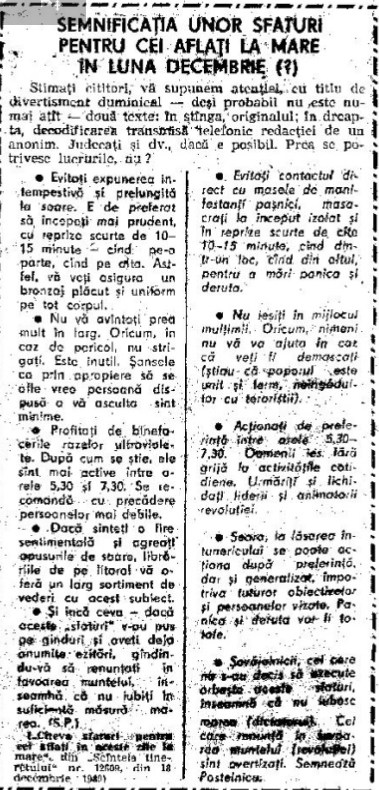
In December 1989-February 1990, Army officers General Nicolae Militaru, Lt. Mircea Ferestrăuariu, and General Dan Ioan all sought to make sense of “Citeva sfaturi” (Scinteia Tineretului, 18 decembrie 1989)

A week ago, I posted the following, demonstrating that the interest in the famous Scinteia Tineretului article of 18 December 1989 was not just something that developed in the minds of journalists at “Bucharest tabloids” many years after the fact.  The article’s reproduction and attempted deciphering is from 7 January 1990 and is from a local newspaper (Cuvintul Liber (Deva)), far from the capital…

https://rolandothomassonphd.home.blog/2020/07/24/scinteia-tineretului-18-decembrie-1989-semnificatia-unor-sfaturi-pentru-cei-aflati-la-mare-in-luna-decembrie-cuvintul-liber-deva-7-ianuarie-1990-p-4/


I have been able to recover a good article thanks to the Internet Archive Wayback Machine, because it is no longer available on the newspaper’s webpage.  Some selected excerpts below.

https://web.archive.org/web/20091208184303/http://www.adevarul.ro/societate/dupa_20_de_ani/Misterul-soarele-unui-arda-in_0_146985399.html

Florentina Tone, Adevarul, 4 noiembrie 2009….

Cine a xeroxat articolul?

Încă o problemă nelămurită: cui a folosit textul respectiv în acele zile? Pentru că el a creat, într-adevăr, o isterie generală. Sorin Preda îşi aminteşte bine momentul în care, efectiv, a început să se îngrijoreze: „De-abia în 22-23 decembrie a început nebunia. În 23 decembrie a apărut în Bucureşti textul meu, tras la xerox, iar deasupra articolului scria de mână: «Iată cine-a tras în noi!».

Şi-atunci, la ce xerox s-a tras articolul? Că în tot Bucureştiul nu erau decât câteva xeroxuri, erau xeroxurile de la CC al PCR… Dar să şi scrii pe ele de mână, asta era o chestie gândită. Şi copiile au apărut aproape simultan în mai multe oraşe, că sunau din toată ţara telefoane la redacţie, «ce-i cu chestia asta?». Textul se împrăştiase peste tot, într-un timp relativ foarte scurt, cu reacţii prompte. Încep să cred că scenariul ăsta a folosit cuiva. Dar cui? Cine şi de ce avea interes să mute în altă parte, în acele zile, atenţia presei şi a oamenilor? Oricum, în toată povestea asta, textul meu a căzut ca o mănuşă”.

Un text care i-a mâncat zilele

Sorin Preda, autorul, spune că textul i-a provocat destule spaime. În acele zile încurcate a primit adesea replica: „Ar trebui să te împuşcăm, din pricina ta mor atâţia tineri”. A dat o dezminţire în „România liberă”. N-a avut efect, „telefoanele în redacţie parcă se înmulţiseră”. A mers la TVR pentru o nouă dezminţire, „nu vedeam altceva mai bun decât o dezminţire la televiziune, toată lumea se uita”.

A fost trimis de urgenţă la Ministerul Apărării Naţionale, la ministrul Nicolae Militaru, să explice ce şi cum. Câteva zile mai târziu, la redacţie au venit oameni de la fosta Securitate. „Mi-au spus că vor să ştie ce e cu acel S.P. de la finalul textului. Şi când le spuneam că eu sunt S.P., plecau uşor dezamăgiţi. Că o problemă era dacă textul nu avea autor, că dacă nu avea, putea, într-adevăr, să fie semn de conspiraţie. Oricum, povestea asta mie mi-a mâncat o bună parte din viaţă”.


So from the above we know that Army General -Nicolae Militaru took an interest in this article and its nominal author Sorin Preda (“S.P.”).  The same article goes on to quote the following military officer

Mircea Ferestrăuariu avea 25 de ani în decembrie 1989 şi era locotenent în cadrul Şcolii Militare de Ofiţeri Activi şi Artilerie Antiaeriană şi Radiolocaţii „Leontin Sălăjan” din Braşov. Îşi aminteşte clar cum s-a răspândit în unitatea militară zvonul că „e ceva” cu articolul din „Scînteia tineretului”, că ar fi un articol codat şi cum, după câteva zile, a apărut şi o decodare pe care mai toată lumea din unitate şi-o copia de pe o fiţuică. Mircea Ferestrăuariu are şi-acum decodarea, într-o cutie cu documente din casă. „Nu ştiu cum a intrat în şcoală decodarea, cine a adus-o, de unde, dar ea părea veridică. Iar la sfârşitul decodării scria că ea fusese făcută de un maior şi de un căpitan, maiorul Ioan Ardelean şi căpitanul Ioan Hendre. Numele nu-mi erau cunoscute, nu erau din unitatea noastră. Oricum, eu sunt absolut convins că articolul a fost un ordin codat către forţele de represiune care nu făceau parte din structurile militare. Cine se duce la mare în decembrie să facă plajă şi baie? E de neconceput ca la vremea respectivă să apară un astfel de articol şi nimeni să nu sesizeze că e ceva aberant”.


Finally, there are the recollections of military prosecutor General Dan Ioan:

General Magistrat (r) Ioan Dan, Teroristii din ’89 (Lucman, 2012):

In luna ianuarie 1990 eram la Timisoara, cand un subaltern mi-a prezentat un articol intitulat “Cateva sfaturi pentru cei aflati in aceste zile la mare,” publicat in ziarul ‘Scanteia Tineretului’ din ziua de 18 decembrie 1989.  Articolul–la care, de asemenea, m-a referit–se compune din 5  fraze sub forma de strofe, pe care le reproduc:

image0-001

Cu toate incercarile de a fi convins de contrariu, am considerat si consider ca acest articol a constituit ordinul de lupta transmis structurilor acoperite ale Securitatii.  Spun “ordin”, deoarece cuvantul “sfaturi” este pus intre ghilimele.

image0

“Avem inca o declaratie, din atatea altele, care ne duce cu gandul la acel faimos articol din ziua de 18 decembrie 1989, publicat in “Scanteia Tineretului”, prin care se dadeau sfaturi la cei aflati in acele zile de decembrie la mare si faceau plaja, sa inceapa cu reprize scurte, de 10-15 minute, cand pe-o parte, cand pe alta.”

image0-001

p. 309 In aceaste ordine de idei…


If the Romanian military had been the author of this alleged coded message…and it had been directed to undercover military personnel in the field…why on earth would three senior military officers, and many other military officers, have been trying to so hard to decrypt this article?  Also, if the “terrorists” had been military personnel, as some have alleged, how is that nobody in the military seemed to know how to decode the message or find someone in the military structure who could and would tell them in the midst of the violence and mayhem of those days?  (Moreover, this is good further proof, that the military genuinely believed in the existence of counter-revolutionary “terrorists” because why else would they have tried so mightily to figure out this text if the “terrorists” supposedly did not exist?)

Rather clearly, the answer is precisely because the author of this message would have been the Securitate, those who controlled the “lupta de rezistenta,” and it would have been to undercover agents in the field (i.e. some, perhaps many of whom, did not have normal access, in part for reasons of cover, to secure T.O. telephone lines, etc.) who formed the backbone of the “lupta de rezistenta.”  And the idea that only ‘The Party was above the Army’ is laughable, when one considers the existence of the Securitate’s Fourth Directorate (Military Counter-intelligence), which meant that CI-sti were all over the place, undermining the Army’s corporate integrity and sovereignty and ensuring not the control of “The Party”–which had long ceased to function as a corporate entitiy–but of Nicolae and Elena Ceausescu and their clan of admirers and sycophants.


Scinteia Tineretului 18 decembrie 1989: “Semnificatia unor sfaturi pentru cei aflati la mare in luna decembrie (?),” Cuvintul Liber (Deva), 7 ianuarie 1990, p. 4.

Even in the local press, in the immediate aftermath of the counterrevolutionary violence of December 1989, some attention was devoted to this now infamous article from Scinteia Tineretului, 18 decembrie 1989:  “Citeva sfaturi pentru cei aflati in aceste zile la mare.”  Military officers have recounted how during the events of December and in the immediate aftermath they attempted to de-code what is rather clearly a coded message.  Although this is not the best decoding I have seen, it is not bad, and the truth is that we will never know for certain until those from the former Securitate who were familiar with it give us a word-by-word decoding or at least the key for decoding it.  Still this appears a decent attempt not long after the Revolution.

Semnificatia unor sfaturi 7 ianuarie 1990 cuvintul liber deva

http://www.bibliotecadeva.eu/periodice/cuvintulliber/1990/12/mobile/index.html#p=4

For a discussion of attempts by military officers through the years to decipher the message, I encourage readers to check out the following post:

https://romanianrevolutionofdecember1989.com/scinteia-tineretului-citeva-sfaturi-pentru-lupta-de-rezistenta-care-va-urma/

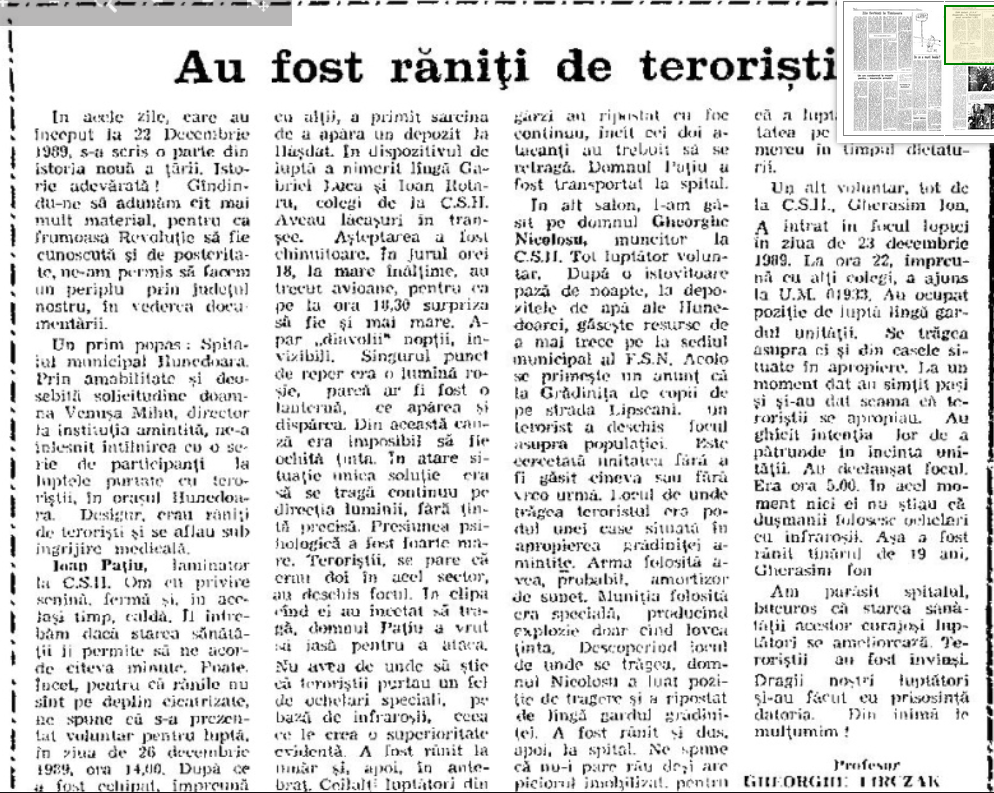
Profesor Gheorghe Firczak, “Au fost raniti de teroristi,” Calauza (Deva), nr. 2 (8 februarie 1990), p. 3.

Gheorghe Firczak 2 2 1990 Calauza Deva

http://www.bibliotecadeva.eu/periodice/calauza/1990/02/mobile/index.html#p=2

Rare are those whose stories have remained at all consistent through the years.  Prof. Firczak appears to be one of those rare few (see above from February 1990 and below on the 25th anniversary):

https://servuspress.ro/25-de-ani-de-la-caderea-comunismului-x_103406.html

Eroii martiri ai Revoluției Române din Decembrie 1989

Gheorghe Firczak, Liviu Lazăr


Din nefericire și în județul Hunedoara, mai ales în municipiul Hunedoara, au existat victime omenești în decembrie 1989, decedați și răniți.

Prima victimă a fost Nicolae Ovidiu Munteanu, din Orăștie, student la Facultatea de Construcții a Institutului Politehnic Timișoara. A fost împușcat în Complexul studențesc de soldații UM 01121 Timișoara și din formațiunile miliție/securitate la 17 decembrie 1989. Trupul i-a fost ars la  Crematoriul Cenușa București.

La Hunedoara, la UM 01933 au fost zile cumplite. Iată ce povesteşte col. Şerbulescu Nicolae, comandantul unităţii: Atacurile au fost organizate din timp conduse de oameni competenţi. Urmăreau crearea panicii, scoaterea din acţiune a unor unităţi subunităţi din sistemul apărării antiaeriene, procurarea de muniţie şi armament şi combustibil de avion, pentru că au atacat depozitul de la Bretea Streiului: Au vrut să influenţeze populaţia în sens negativ prin pierderea încrederii dacă ar fi fost posibil, mişcarea liberă în aer a elicopterelor pentru desantare. Se pare că au cunoscut bine subunităţile noastre şi rolul lor. Apărarea a fost fermă. Se pare că cei loviţi au fost recuperaţi de terorişti şi scoşi din dispozitivul de luptă. Maiorul Crişan Teodor, şef de Stat Major relatează despre evenimente: Înziua de 22 decembrie după ce am luat la cunoştinţă de evenimentele din municipiul Hunedoara, fiind în stare de război, noi nu am primit ordin să intervenim în oraş. Sarcina noastră era paza şi apărarea cazărmii, a dispozitivelor de luptă concomitent cu apărareaaeriană a zonei. S-a luat legătura cu GP pentru a coopera cu ei. Nu s-a pus nici un plan în funcţiune. Am fost solicitaţi la Comitetul Municipal Provizoriu. Ne  erau sesizate ţinte în spaţiul aerian. Dar de la divizie, de la Timişoara, ni se comunica inexistenţa unor avioane în aer. Cu aprobarea comandantului diviziei m-am deplasat eu la comitet. Am stat vreo două ore acolo. Eram informaţi la Comitet că vom fi atacaţi aerian. I-am spus domnului Tudose că nu mai pot sta. Când am ajuns la unitate ţintele au ajuns la Orăştie. Am informaţii că e posibil ca în elicoptere săfie elemente teroriste ce vor să ocupe unitatea. În noaptea de 22/23 decembrie unitatea noastră a fost atacată circular. Am fost sprijiniţi de GP. N-am crezut că vom putea coopera atât de bine, fantastic. Au stat şi ei în tranşee non-stop. Atacul a fost asupra cazărmilor: Hunedoara, Hăşdat şi punctul de comandă (oarecum mai puţin). Înainte de atacuri în zona situată între unitate şi Teliuc au aterizat 2-3 elicoptere. Atacul era executat cu armament special. Nu l-am văzut dar se pare că erau cu amortizor de zgomot, aer comprimat şi armament clasic. Eu cred că scopul lor nu a fost să ocupe cazarma ci să pună mâna pe depozitul de muniţie, pe depozitul special de la Hăşdat, să creeze panică şi să destabilizeze situaţia. Luând depozitele, populaţia şi-ar fi pierdut încrederea în armată. Au tras dinzona Teliucului cu armament clasic, din zona caselor de pe strada Alecu Russo, cimitirul de pe strada Dacilor şi de pe strada Rotarilor până-n comuna Hăşdat. În noaptea de 22/23 decembrie am avut o victimă, maior post-mortem Stîngă Mircea şi un rănit uşor. În jurul orelor 630-700, în 23 decembrie, au încetat parţial acţiunile din zona dinspre Teliuc. Tot atunci au aterizat două elicoptere, după care jocul a încetat definitiv, După zgomot nuam putut identifica tipul elicopterelor. Semănau ca formă cu “Alouette” “Puma”. Toată noaptea nu am ieşit din dispozitiv. După luptă am cercetat zonele rezultând următoarele: nu erau urme (tuburi de cartuşe) de la armamentul special dar s-au găsit tuburi de la armamentul clasic peste tot de unde s-a tras. Cetăţenii din zonă au declarat locurile de unde s-a tras. Gloanţele găsite în unitate erau perforant-incendiare sau de formă necunoscută. Glonţul incendiar derutează necunoscându-se direcţia de unde s-a tras. Ziua n-au mai fost acţiuni Noaptea de 23/24 decembrie la fel, dar s-a tras cu armament clasic: două mitraliere, una dinspre Teliuc una din zona dinspre oraş. Am avut două victime: slt. post-mortem Merticariu Dumitru slt. post-mortem Rotaru Lazăr răniţi uşor: Maruneac loan (GP) şi Inişconi Lucian, soldat înaintat la grad de caporal. Atacurile se executau ca în prima noapte. Dimineaţa n-au mai fost văzute elicoptere ceea ce a determinat un atac intens din zona Teliucului între orele 700 -1000. În noaptea de 24/25 decembrie atacurile au fost de o intensitate mai slabă. S-a tras doar cu armament modem a fost o victimă, sergentul Cotvas Marinel, venit de la UM 0812 Orăştie, rănit la poartă în timp ce, cu încă doi militari, căutau să anihileze doi terorişti. În timpul luptelor am reuşit să notăm un cod de semnalizare cu lumini roşii albastre şi sunete de la trageri. Exemple: LRS, PEE, DES, 230, 20 (în data de 25 decembrie, orele 21°°). Nu s-au putut decodifica. Erau transmise prin alfabetul Morse. Noaptea de 25/26 decembrie au fost trageri în zona IJTL, sere, staţia de transformare pentru înaltă tensiune Hăşdat. S-a intervenit cu transportorul blindat. Două persoane au văzut terorişti: maistrul militar Grigore însoţit de două persoane, şi o femeie. În dimineaţa zilei de 26 decembrie au încetat acţiunile de acest gen. Tot la aceași unitate au fost răniți Ioachim Crăciunescu, impiegat de mișcare, în grupul de voluntari care apărau unitatea, maistrul militar Ioan Buha, care a fost atacată de teroriști și în dimineața zilei de 26 decembrie 1989, Teodor Iancu, Gavrilă Moldovan, Sorin Petrea, voluntari și ei.

Despre cele întâmplate la UM 02332 Hațeg relatează lt.col.Ocolişan:. În noaptea de 23/24 decembrie atacurile au început simultan cu cele asupra celor două din garnizoană. Nu se poate şti cu ce forţe au acţionat. Au folosit şi mijloace de marcare a focului pentru a crea impresia că sunt mai mulţi. Armata nu are asemenea mijloace. Atacul din prima noapte a fost atacul de forţare a pătrunderii în unitate. S-au apropiat mult de teritoriul UM, chiar sub 50 m., folosind bine terenul. Ca urmare în prima noapte au fost victime: slt. post-mortem Cristea Valeriu, plt.maj. Amarinoaiei Vasile rănit la ambele picioare. Încercarea de pătrundere a fost făcută pe porţiunea deschisă a UM, partea dinspre poartă, unde este o vale cu lizieră ce a permis infiltrarea. Apărarea s-a organizat circular, mai ales în zonele descoperite. Am schimbat locurile de dispunere a luptătorilor. După primul atac am distribuit grenade, pe grupuri mici de 2-3 soldaţi. Al doilea atac a coincis cu această activitate. Poate s-a supravegheat clădirea. Cert este că declanşarea focului în cea de-a doua etapă s-a făcut în această perioadă. Slt. Cristea a fost surprins cu rafală de armă automată când ieşea din clădire, iar plt. maj. Amarinoaiei a fost lovit din aceeaşi direcţie. Din verificările făcute rezultă că muniţia este de fabricaţie românească. În după-amiaza de 23 decembrie, în jurul orelor 1830, unul din elicopterele atacatorilor, silenţios, a survolat celelalte unităţi. Cetăţenii din GP au informat că ziua au fost văzute grupuri de câte 2-3 oameni necunoscuţi, cu prezentă nejustificată. Patrulele au zărit urme proaspete de încălţăminte specială. S-au intercalat urme de cizme de paraşutişti. Probabil au acţionat circular în jurul UM, dar în grupuri mici. În nopţile următoare au vrut doar menţinerea panicii şi legarea militarilor de unitate. Atacatorii au avut protecţie antiglonţ. O părere semnificativă are plt. Cimpoieru Ardelean Mircea: În noaptea de 22/23 decembrie, pe la 2130, trebuia să-l schimb pe plt.maj: Cristea, şi încă 4 soldaţi. Când am ajuns la el şi la Gâlcă, m-au atenţionat să stau jos pentru că se auzeau paşi care se apropiau. Gâlcă a uitat că are cartuş pe ţeavă. Cristea a tras el cu pistolul lui Gâlcă. Toţi au început să tragă, cam 5-7 minute. Amarinoaiei, Gâlcă şi Cristea au mers după cartuşe. Cristea s-a reîntors la locul luptei. După cum cred eu moartea lui Cristea a survenit din unitate. Căpitanul Oros Moise Mircea a ordonat să se tragă asupra punctului de control şi astfel a fost omorât Cristea

De la Lupeni, în ziua de 23 decembrie s-au deplasat la București cu medicamente pentru cei răniți, predate la Spitalul Witing. S-au deplasat apoi în zona Academiei Militare să acorde ajutor răniților. S-a tras asupra celor nou sosiți. În această acțiune Nicușor Gociu și Tiberiu Lukacs au decedat iar Ferdinand Müller, Ion Tolea și  Virgil Sandolache au fost răniți. Tot la București, în zona Televiziunii, a fost împușcat Emanuel Iordache, din comuna Hărău, militar în termen la UM 01342 Turda.

Neculai Claudiu Berlea, sergent major la UM 01342 Turda, mecanic conductor. Era în tanc, fiind atacați de teroriști iar el deschide oblonul mecanicului vrând să arunce o grenadă spre atacatori. A fost împușcat în tâmpla stângă și în gât.

În dispozitivul de apărare al UM 01929 Reșița, militarul în termen Ioan Daniel Lupea a fost împușcat cu un glonț dum-dum venit din afara unității, care i-a determinat decesul. Acesta apăra cu cei din dispozitv la clădirea punctului de control de la intrarea principală unitatea militară care era atacată de forțe neidentificate.

Muncitor, voluntar pentru apărarea bazinelor cu apă de la Chizid, Ioan Maruneac, a fost împușcat cu patru gloanțe care i-au determinat decesul.

Ioan Mihai Mateș, din Ribița, era militar în termen la UM 01244 Tg Mureș. Era în dispozitivul de apărare al Aeroportului Tg Mureș când un autoturism cu teroriști se îndrepta spre ei. A fost controlat ulterior și dovedit a fi în regulă. Dar soldații de la UM 01980 Câmpia Turzii, aflați și ei în dispozitiv au deschis foc asupra autoturismului care se depărta și în acest context a fost împușcat mortal soldatul Ioan Mihai Mateș.

În timp ce asigura paza la Plafar Orăștie plt Călin Gabriel Morariu, cu militari în termen și gărzi patriotice, a fost găsit decedat întrun șanț. Condițiile decesului său nu au fost elucidate până în prezent. Se pare că înainte de a deceda a fost bătut întrucăt prezenta urme semnificative pe corp.

Corneliu Călărașu, membru al CJ Hunedoara al FSN, datorită oboselii și pentrucă nu a mâncat circa două zile nimic a avut  o psihoză reactivă. A fost internat la Spitalul Județean Hunedoara–Deva cu fractură femurală datorată căderii de la înălțime. Ida Crăciunean a fost rănită prin împușcare la Hunedoara, operată, fiind extirpat un glonte. Mihai Crețu, hunedorean, era militar în termen la UM 01210 București. Unitatea a fost atacată de teroriști iar acesta era pe un transportor blindat și încărca muniție find împușcat. A fost operat la Spitalul Panduri, apoi reoperat la Spitalul Militar Central. Marius Harabagiu, hunedorean, militar în termen la UM 01258 Râmnicu Sărat a fost detașat din 7 decembrie 1989 La Asociația Sportivă Armata Buzău, secția de lupte greco-romane ca sportiv. Asociația  avea rezidența la UM 01671 Buzău. În 23 decembrie seara s-a deschis foc asupra unității. În acest context a fost rănit în umărul stâng, operat la Spitalul Județean Buzău. Sandu Marișca, din satul Șerel, comuna Pui, militar în termen la UM 01258. A participat la apărarea Aeroportului Otopeni asupra TAB-ului în care se afla s-a deschis foc fiind ucis un militar și răniți șase soldați. Florin Nan din comuna Balșa, soldat la UM 02658 București a fost rănit, în dimineața zilei de 23 decembrie, la Televiziunea Română în timp ce făcea de pază. Tot acolo a fost rănit și Mircea Senzaconi, miltar în termen la UM 01210 București. Gheorghe Nicolosu, voluntar în Gărzile Patriotice, la Hunedoara a fost chemat de un cetățean, împreună cu formațiunea din care făcea parte, să inspecteze clădirea Grădiniței ICSH deoarece acolo se ascundea un terorist. Din respectivul edificiu se executa foc asupra lor. Cu toate acestea el a fost împușcat de undeva din afara grădiniței deoarece era protejat de un gard de beton. Dorin Pavel, de asemenea voluntar pentru executarea unor misiuni de apărare a unor obiective a fost împușcat în gamba dreaptă. Este și cazul lui Sorin Petrea, rănit în data de 25 decembrie.  Petru Ocoș, din Hunedoara, militar în termen la 01929 Reșița a executat mai multe misiuni de apărare a unității militare. În dimineața zilei de 25 decembrie fiind în tranșeu a fost împușcat în cotul brațuli stâng pe parcursul uni schimb de focuri armate. Valentin Ursu, din Deva, militar în termen la UM 01040 a fost rănit în tim ce efectua pază în zona Prefecturii Alba.

O situație deosebită a avut Dorin Ioan Sângeorzan, care în seara zilei de 22 decembrie a fost împușcat de un voluntar din Gărzile Patriotice, Romică Apostu, fără nici o justificare. Dorin Sângeorzan a participat, la Lupeni, la controalele efectuate în numele noii puteri pentru menținerea ordinii.

Of course, the Romanian media being what it is, and after so many years of devastating revisionism…make him out to be a Martian…rather than look to see if others confirm the accounts from his interlocutors:

…Gheorghe Firczak a fost autorul unor volume dedicate evenimentelor petrecute în zilele Revoluţiei din decembrie 1989, însă mărturiile sale stârnesc controverse „Revoluţia atinge, la nivel central, apogeul: vechile structuri au fost înlăturate. S-a creat astfel posibilitatea proclamării unei noi puteri de stat. Vestea stârneşte un entuziasm uriaş şi la Deva unde, de la microfonul instalat în balconul Palatului Culturii, Gheorghe Firczak anunţă prăbuşirea regimului ceauşist şi constituirea unei noi structuri de putere provizorii”, susţine fostul deputat în cartea „Hunedoara, o cronică a Revoluţiei Române din Decembrie 1989”, rememorând ziua de 22 decembrie 1989….
Teroristul ascuns în grădiniţă În Hunedoara, potrivit datelor oficiale, în zilele de 22 – 23 decembrie 1989, cinci militari şi un civil au fost ucişi în împrejurări stranii, iar alte aproape 20 de persoane au fost rănite. Unele mărturii, consemnate de Gheorghe Firczak, se referă însă la aşa-zişii terorişti, găsiţi ţapi ispăşitori pentru crimele din Hunedoara. „Nicolosu Gheorghe, muncitor la ICSH, voluntar în Gărzile Patriotice, povesteşte: Duminică dimineaţa, 24 decembrie, ne-am dus la Consiliu. Am fost anunţaţi că un terorist s-a ascuns la grădiniţa de copii de pe Strada Lipscani. De fapt era urcat în podul unei case, dincolo de grădiniţă. Trăgea cu armă cu amortizor, gloanţele făcând zgomot doar când ajungeau la ţintă”, consemna Gheorghe Ficzak. „Duminică, 24 decembrie, am fost trimişi la Hunedoara 48 de soldaţi, conduşi de lt. Gortian Ovidiu. Am fost repartizaţi pe locuri de apărare. Un cetăţean ne-a chemat, spunându-ne că ştie unde se ascund teroriştii. Am înconjurat locul. Lt. Gortian şi încă patru soldaţi nu s-au putut apropia de nişte căpiţe, iar unii oameni nu ne-au lăsat să le percheziţionăm casele. Soldatul Plăcintă Ioan a observat lângă gardul unităţii ceva ce s-ar mişca. A tras. Teroriştii au răspuns. Am tras cam 10 minute după care au dispărut. Sergentul Cotvas Marinel i-a adus muniţie lui Plăcintă, pe la orele 5:35 în 25 decembrie. Sergentul a fost împuşcat, decedând în salvare, iar eu, după ce am schimbat încărcătorul, un glonte a lovit o piatră, care m-a lovit pe mine”, relata soldatul, citat de Gheorghe Firczak.

Oamenii în negru”
Teroriştii „erau îmbrăcaţi în negru. Pe umeri aveau un sul, de 10 – 15 centimetri. Aveau arme scurte cu care puteau să tragă foarte repede, fără zgomot şi fără flacără. Erau înalţi cam de 1,90 metri. M-am aşezat într-un beci să ochesc un terorist care trăgea asupra unităţii. Cu un GP-ist l-am luat la ochi. Am tras pentru că am observat că mă ocheşte el. Eu şi GP-istul am tras până i-a sărit arma din mână. El s-a aruncat în direcţia inversă de zbor a armei. După 20 de minute au apărut încă trei. Nu am tras asupra lor pentru că erau acoperiţi de o plasă de sârmă şi un perete. Erau luminaţi până la piept. Aşa i-am văzut că erau îmbrăcaţi în negru. Nu ştiu de câte ori mi-am făcut cruce şi am zis: Ori eu, ori ei. Au luat ostatici în case, dar oamenii nu au recunoscut, pentru că le era teamă să nu le omoare copiii. Trăgeau în aşa fel încât se părea că glontele vine din altă parte”, informa maistrul militar Gheorghe Ilie, citat în volumul lui Gheorghe Firczak. În zilele Revoluţiei din 1989, şase oameni au murit în Hunedoara, iar un militar a fost găsit asasinat într-un şanţ de lângă unitatea din Orăştie. Ucigaşii lor nu au fost identificaţi.

https://adevarul.ro/locale/hunedoara/vanatoarea-teroristi-cronicile-unui-privilegiat-revolutiei-1989-nu-stiu-mi-am-facut-cruce-zis-eu-ei-1_5a37e3245ab6550cb854e7a9/index.html


Excerpt from a draft for “Revoluția din 1989. Învinși și învingători” (Gabanyi et. al., Polirom): what former Securitate had to say about the terrorists’ arsenal in early 1990

A draft for the eventual chapter:
https://www.academia.edu/43544903/Dum_Dum_Bullets_in_December_1989_09222019tk3_post

This probably explains why, during the brief first window in early 1990 discussed earlier in this paper, scattered USLA personnel—sometimes identified as USLA, sometimes identified by their new rank reflecting their integration into the Ministry of National Defense at the end of December 1989—turned up in the press to discuss the characteristics of the weapons and ballistics used by the so-called terrorists.  For example, a former USLA officer referred to as an Army Major engineer specializing in weapons and ammunition[1] described for a Bucharest daily in late March 1990 ‘soft-nosed bullets,’ in other words, colloquially, dum-dum bullets:

image-9

image-8

‘Kynoch-Magnum’ cartridges were found in Buzău, but also around Television and it appears a ‘sample’ was discovered in the area around the former CC building.[2]

The bullet is of the ‘Softnosed’ type, which in translation means ‘with a soft nose,’ which means that when the bullet hits its target, the head of the bullet deforms radially, which produces deep wounds at entry.  It is not a penetrating bullet that remains in the place it struck, but provokes a wound of categorical lethality.  The bullet has a lead core which is in a jacket of tombac, a mixture based on copper.

The appearance of these cartridges proves that in Romania there also existed similar hunting rifles…in the stocks of our armed forces there did not exist such a weapon…the ‘Kynoch-Magnmum’ cartridges remain foreign, through their shiny appearance on the streets of the Capital, alongside the whole ‘collection’ of bullets gathered by military teams that policed the underground tunnels of Bucharest.[3] (Alexandrescu 1990b)


[1]Ion Ştefanut was the USLA officer in question. He was interviewed in Horia Alexandrescu, ‘Gloanţele, pe ȋntelesul tuturor (I).  Cartuşe pentru…Elefanţi!’ Tineretul Liber, 25 March 1990. Significantly, the series, ‘Bullets, for Everyone’s Understanding,’ appears to have ended abruptly and without any explanation, after the second episode three days later, even though Alexandrescu had promised a future episode would discuss the so-called, unconventional ‘vidia bullets.’ The section of the article quoted above originally appeared in Perva and Roman 1991, pp. 103-104.  Members of the Securitate’s ‘Special Unit for Anti-terrorist Warfare’ (U.S.L.A.) who were not activated as part of the offensive actions of the Ceauşescu resistance plan and did not participate in such a capacity, were willing in the early months of 1990 to give details in public about the Securitate ‘terrorists.’ Naturally, they were reasonably familiar with the weapons’ choices of those in the Ceauşescu resistance—some of whom were fellow USLA officers—and could comment knowledgably.  This was probably a way of proving their bona fides to the new regime, and the population, and also a way for the new regime to salvage and rebrand the ‘usable’ part of the former Securitate.

image-89

image-88

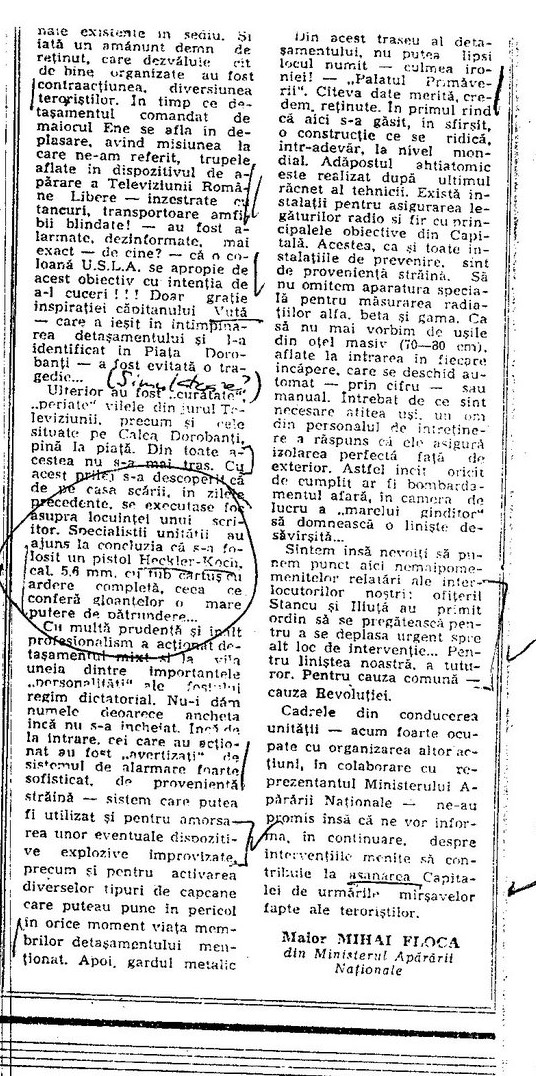
For example, Io[a]n Iliuţă and Major Ene Zaharia of the USLA appear to be the sources of the following revelation to Army Major Mihai Floca in early January 1990:  ‘Upon clearing out the houses surrounding the Television station, it was discovered, that from the staircases they were firing at the house of a writer.  Specialists of the unit [presumably the USLA] arrived at the conclusion that a 5.6 mm Heckler-Koch pistol with a cartridge that melts away for added impact was used.(Major Mihai Floca, ‘Reportaj la U.S.L.A.,’ Tineretul Liber, 5 January 1990, p. 4.)

https://romanianrevolutionofdecember1989.files.wordpress.com/2009/12/image-62.jpg

Iliuţă also showed up in the pages of the Army daily, Armata Poporului‘How can we explain the amazing precision of the terrorist gunfire:  even though in the majority of cases, they operated at night, most victims were shot—mortally—in the head, throat, or heart?’ ‘To this question—which we took from letters and telephone calls received at the editorial office—responded major engineer Ion Iliuţă, specialist in antiterrorist warfare:  ‘Much has been said and written in the press about the infrared scopes of the terrorists.  The truth is that they possessed means of targeting that were even more sophisticated, more precise.  I am talking about a complex apparatus that possesses a laser marker and a light-amplifier of the LITTON variety…’ ‘Cum ocheau teroriştii?’ Armata Poporului, 3, 17 January 1990, p. 6.

[2] This may be the type of bullet presented to the camera in a video which shows civilians rummaging through materials and munitions removed from V-a Headquarters. See the video posted by ‘Tioluciano’ entitled ‘Sediului fostei DSS in data de 24 decembrie 1989’ at https://www.youtube.com/watch?v=cs3FxteH5uM.

[3] Part of their knowledge about these bullets apparently came from their role in ‘cleaning up’ after the ‘terrorists.’  Witness, for example, the comments of an employee of the Museum of National Art located in the old Royal Palace across from the CC building in central Bucharest. ‘The next day [23 December 1989] and over the following days I found bullets in the Museum.  They were not normal bullets.  They had a rounded head.  They appeared to have a lead jacket.  It was of a caliber between five, five something.  The USLAşi did not want to leave us a bullet.  I asked them to leave me at one as a memento.  They did not want to.  They said that they needed them for the purpose of identification.  They noted where they gathered them from.’  (Dan Iliescu, interview by Ion Zubaşcu, “Misterioasa revoluţie română,” Flacăra, 51, 19 December 1990, p. 11).


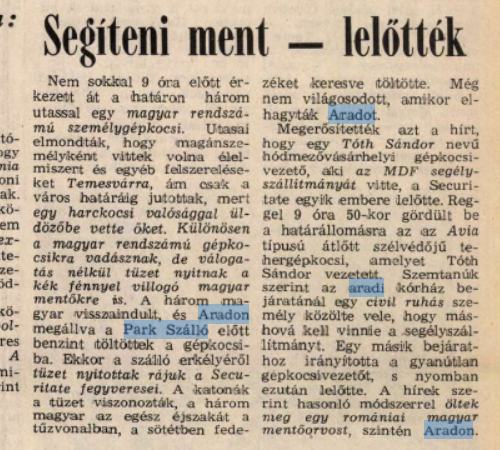
“The three Hungarians returned, stopping in Arad in front of Hotel Parc to fill their gas tank.  From the balcony of the hotel Securitate snipers opened fire on them.” (Vasarnapi Hirek, 24.12.1989)

https://rolandothomassonphd.home.blog/2020/06/10/ora-0100-23-decembrie-1989-arad-seriilor-lungi-de-arme-automate-din-hotelul-parc-li-se-raspunde-din-cetate-cu-un-foc-intens-armata-poporului-martie-1990/

https://rolandothomassonphd.home.blog/2020/06/09/ana-nemeth-si-alexandra-aslan-hotel-parc-arad-22-23-decembrie-1989-de-la-etajele-superioare-se-tragea-adevarul-arad-31-ianuarie-1990/

Arad events in which Sandor Toth (Toth Sandor) who was transporting aid from Hungary was killed.

A harom magyar visszaindult, es Aradon megallva a Park Szallo elott benzint toltottek a gepkocsit.  Ekkor a szallo erkelyerol tuzet nyitottak rajuk a Securitate fegyveresei.

“The three Hungarians returned, stopping in Arad in front of Hotel Parc to fill their gas tank.  From the balcony of the hotel Securitate snipers opened fire on them.”

Vasarnapi Hirek, 24 december 1989

Toth Sandor Park Szallo Arad 24 12 1989 Vasarnapi Hirek